Doosan Robotics said on 6 October that two of its proposals had been selected for South Korean government research projects with a combined budget of approximately 98.9 billion won, including about 68.1 billion won in state funding, Korea IT Times reported.
Key points
- One project covers collaborative robots designed to run AI processing without external computers or cloud systems.
- The other covers AI-assisted welding, with demonstrations planned at Doosan Enerbility’s Nuclear Power Center.
- Doosan Robotics aims to offer the new collaborative robot models as standard products from 2031.
The 98.9 billion won research budget
The Ministry of Trade, Industry and Energy is overseeing the government-backed work. The proposals cover on-device AI semiconductors for robots and technology to automate welding. Doosan Robotics will lead both projects, which put public research funding behind its plan to combine Korean-made chips, software and robot hardware.
Korea IT Times named the Korea Planning & Evaluation Institute of Industrial Technology as an overseeing institute. The Asia Business Daily instead named the Korea Institute for Advancement of Technology. The latter identified the proposals as part of the K-On-Device AI Semiconductor Technology Development Project and the Robot Industry Technology Development Project.
The robot development project is scheduled to run for 54 months and the welding project for 45 months. Their research groups bring together chip developers, robotics companies and public research institutes. Park In-won, Doosan Robotics’ chief executive, said the company wants robots that can learn and reproduce skills acquired by experienced manufacturing workers.
South Korea’s president pledged to double chip production in five years, AI Affairs previously reported. The Doosan projects centre on putting domestically developed AI processors into industrial equipment.
Welding demonstrations planned at Doosan Enerbility’s Nuclear Power Center
The welding project pairs collaborative robots with AI and digital-twin technology. Under the development plan, cameras will identify the material to be welded and the robots will adjust their position. The system is intended to learn from skilled welders’ movements to produce welding paths and the side-to-side torch motions used to control weld width.
Doosan Robotics aims for more than 95% alignment between paths generated by its robots and those used by skilled workers. It also targets path deviation within ±3 millimeters in tests by an accredited national institution. Those are development targets, alongside plans for welding in five or more layers and a reduction in working time of more than 50%.
Demonstrations are planned at Doosan Enerbility’s Nuclear Power Center. The initial work covers tack welding, preheating and welding during the manufacture of nuclear power equipment. Doosan Robotics plans to seek nuclear quality certifications before extending the technology to shipbuilding and industrial plants.
DEEPX, SAIGE and Changwon National University’s industry-academic cooperation foundation are research partners on the welding project. Doosan Enerbility will participate as an end-user company, placing the proposed system in a manufacturing setting for the demonstrations rather than limiting the work to robot development.
Doosan targets on-device robots for 2031
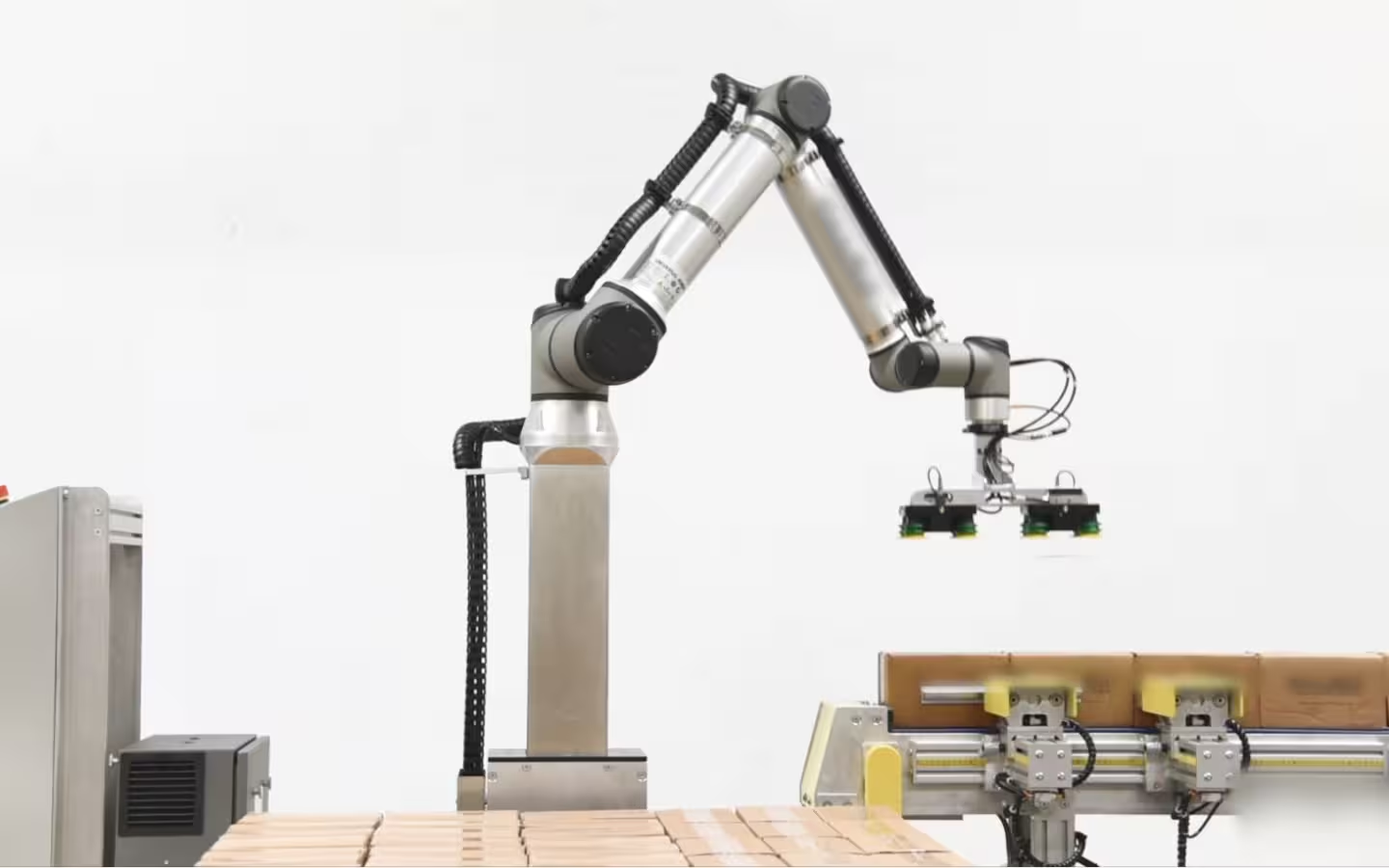
The other project aims to give collaborative robots the ability to perceive their surroundings, make decisions and control movement without relying on external computers or cloud computing. Its proposed Korean-developed system-on-chip will combine an AI neural processing unit with functions for real-time communication and control.
The planned robots will process inputs from cameras, tactile sensors, force and torque sensors, and voice commands at industrial sites. Doosan Robotics plans three collaborative models with payload capacities of 5 kilograms, 10 kilograms and 20 kilograms. It also plans an industrial humanoid designed for dual-arm operation and movement in all directions.
Aidin Robotics, Mobilint, the Korea Electronics Technology Institute, the Korea Institute of Industrial Technology and SAIGE are among the research partners on the 54-month project. Their work spans the processor and robotics components that Doosan Robotics intends to bring together in a domestic platform.
The development plan calls for the robots to operate continuously for 72 hours at two or more customer sites and to obtain international safety certification. Doosan Robotics aims to commercialise the collaborative robot models as standard products beginning in 2031.