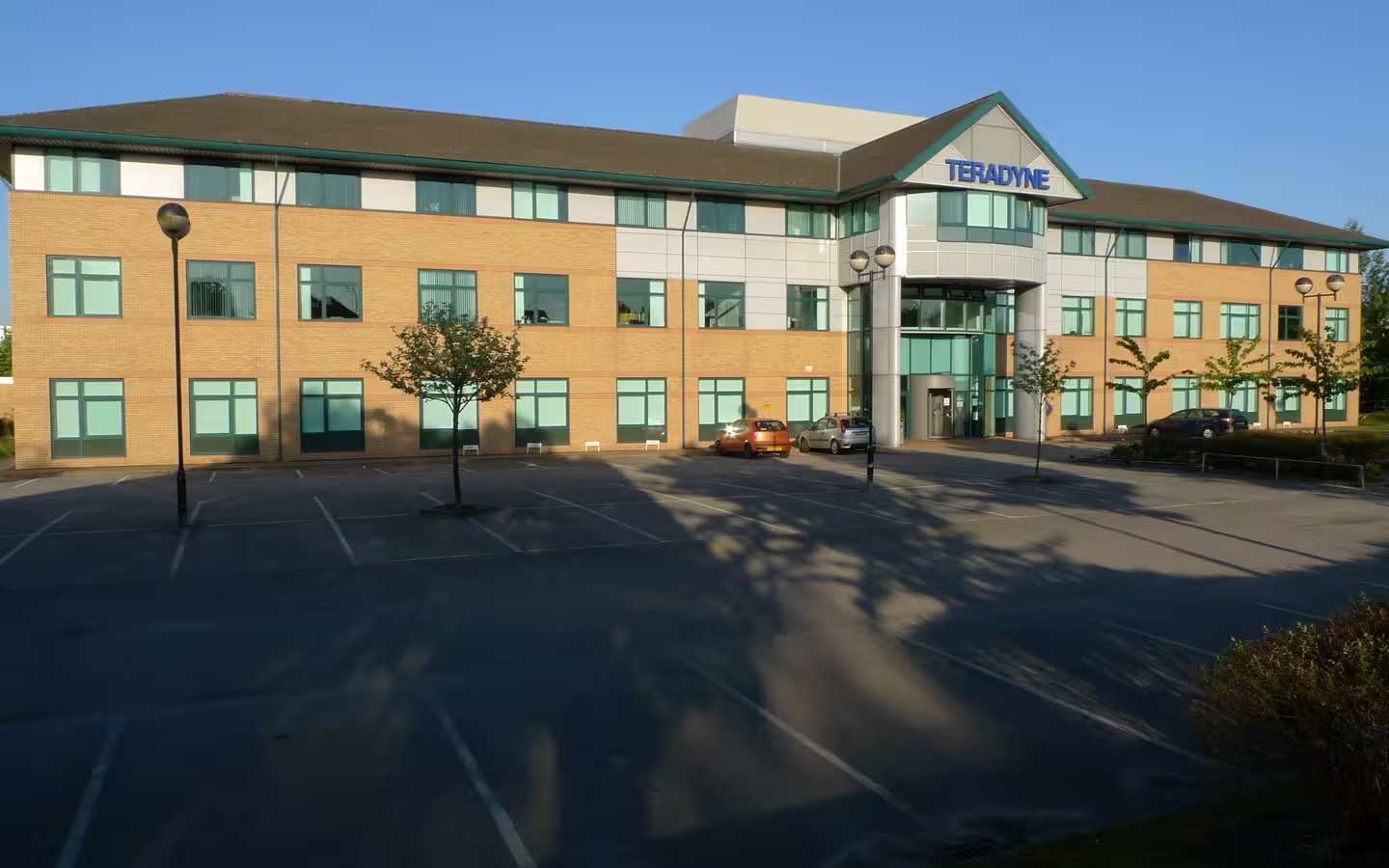
GS Microelectronics U.S. (GSME) and Teradyne announced a multi-year partnership on 22 September to establish a semiconductor test centre at GSME’s new 42,000-square-foot Silicon Valley headquarters, GSME said.
Key points
- GSME says it will operate a Teradyne-equipped test floor and provide engineering support to chip developers.
- The companies plan joint sales work, including target-account development and technical workshops.
- Teradyne’s Semiconductor Test revenue reached $1.12 billion in its fiscal second quarter, up 128.1% year on year, Yahoo Finance reported.
- GSME expects the centre to open in Q4 2026, with customer evaluations beginning shortly afterwards.
GSME will operate the test floor
GSME said it will run a dedicated floor equipped with Teradyne systems and supply engineering support to customers developing chips. The facility sits within GSME’s new headquarters, which the company describes as 42,000 square feet. GSME also plans to install test handlers and probers for work at the centre.
According to GSME, customers will be able to use the centre for demonstrations, device evaluation, engineering development, pilot production and technical training. Those activities would place test equipment alongside GSME’s design and manufacturing services during development, before customers move towards production. Farhat Jahangir, GSME’s president and chief executive, said the company is standardising on Teradyne platforms for that work.
The applications GSME named span AI, silicon photonics, automotive chips, power management and radio-frequency technologies. Shannon Poulin, president of Teradyne’s Semiconductor Test Group, linked the need for test development capacity to more complex semiconductor designs and AI data-centre construction. He said the partnership is intended to help customers progress from development to volume production.
GSME said it is expanding its test-engineering team in the United States, Taiwan, Europe and the Gulf Cooperation Council region. The company said those engineers will work on customer programmes, test development and requirements specific to individual applications. GSME describes its existing work as covering chip design, manufacturing, quality assurance and testing.
Teradyne’s test revenue reached $1.12 billion
Teradyne’s Semiconductor Test segment generated $1.12 billion in revenue in its fiscal second quarter, an increase of 128.1% from a year earlier, Yahoo Finance reported. The publication attributed the growth primarily to higher sales related to AI compute and memory chips. That segment result covers Teradyne’s test business rather than sales under the new partnership.
Teradyne makes automated test equipment, while GSME provides semiconductor design and manufacturing services, according to GSME’s announcement. Under their agreement, GSME will put Teradyne equipment on its test floor and staff the customer-facing engineering work. Teradyne’s role in the arrangement includes supplying the platforms and working with GSME to pursue customers.
Jahangir said the use of Teradyne systems is intended to connect GSME’s custom-silicon services with device evaluation, test development and preparation for production. Poulin described the combination as a way to give chip developers access to test-development capabilities as their designs become more complex. Both executives framed the centre around customers moving chips through those stages.
GSME and Teradyne plan joint sales
The commercial work extends beyond installing equipment. GSME said it and Teradyne will approach customers together through joint sales engagements, development of target accounts, technical workshops and briefings. The companies want those activities to produce more designs using Teradyne equipment and wider adoption of its test platforms.
For customers, GSME said the centre will bring demonstrations and engineering work into the same facility as pilot production and training. Its planned engineering expansion would support design engagements and the development of test programmes across several regions. The arrangement puts GSME in charge of operating the test floor and working directly with developers using it.
The partnership is described by GSME as multi-year. Its announced activities combine an equipped facility, engineering support and joint customer development. The customer work will cover technologies with different test requirements, from power-management and radio-frequency devices to silicon photonics and AI chips, according to the company.
GSME plans to open the test centre at its Silicon Valley headquarters in Q4 2026, with customer demonstrations and evaluations scheduled to begin shortly afterwards.