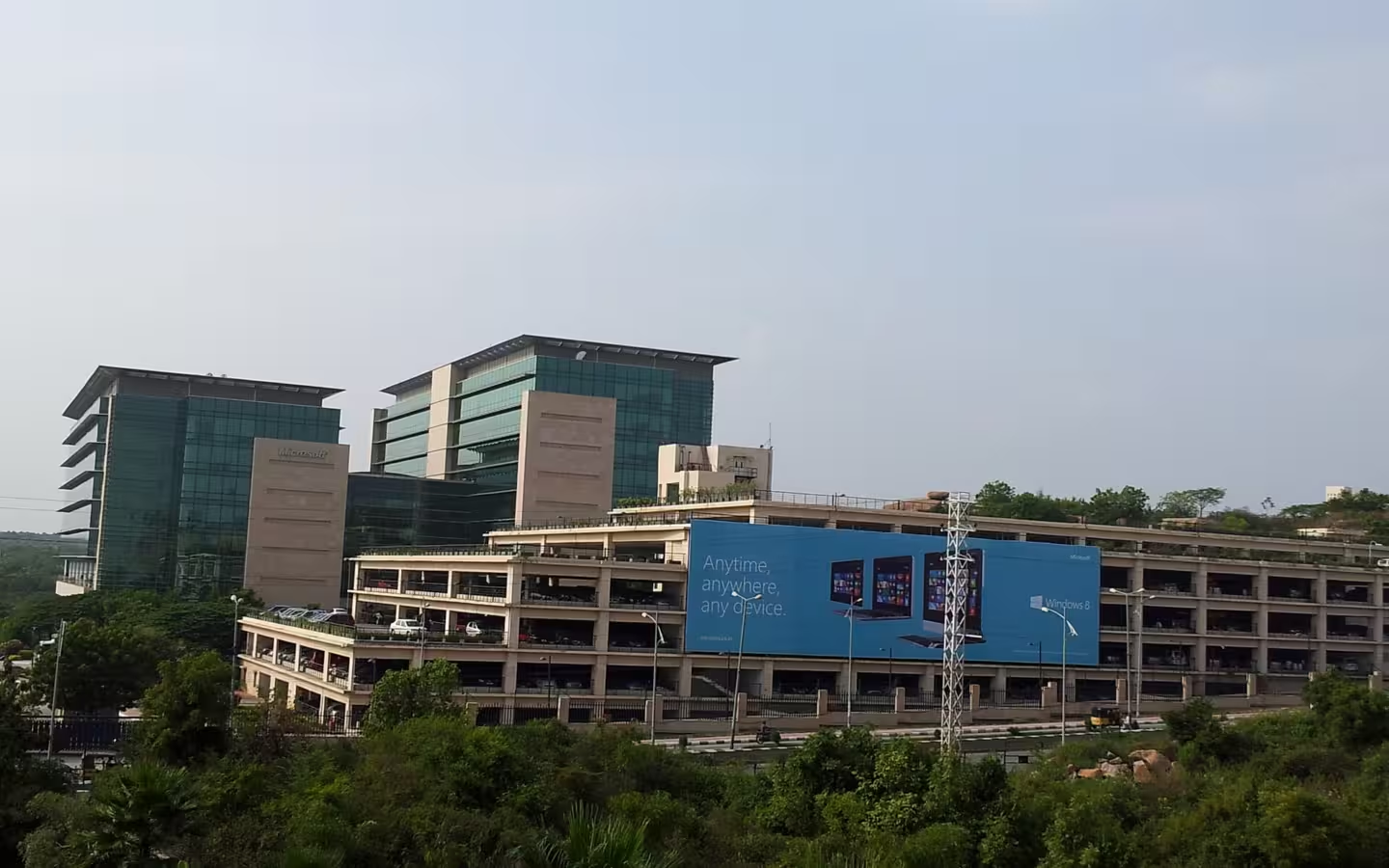
Microsoft designated its new Hyderabad datacenter region, India South Central, as a strategic hub for Asia and the Global South at the Microsoft AI Infrastructure Summit on 21 September 2026, marking an operational milestone in the company’s US$20.5 billion investment commitment to India.
Key points
- India South Central launches with a resilient three-zone architecture and a broad portfolio of Azure services, with Microsoft Foundry and additional AI capabilities rolling out.
- The region operates with high-efficiency mechanical cooling delivering effectively zero water use for cooling, supporting Microsoft’s 2030 carbon, water and waste commitments.
- Adani Group, Bajaj Finserv, HDFC Bank and PB Pay have already signed up on the new region.
- All Microsoft cloud regions in India are now AI-enabled with AI-capable hardware and high-efficiency cooling systems.
- Microsoft is a consortium partner in the I-2SEA submarine cable project, a planned 3,600 km cable connecting India with Malaysia and Singapore, targeted for service in 2029.
India South Central infrastructure, sovereign capabilities and zero-water cooling
The Hyderabad region features a three-zone architecture designed for sustained expansion and launches with a broad portfolio of Azure services. Microsoft Foundry and additional AI capabilities are slated to roll out in the coming months. The region expands Microsoft’s Sovereign Public Cloud foundation in India, giving organisations options for deploying eligible sensitive workloads with local data residency and governance capabilities. Microsoft says its Indian cloud regions provide capabilities aligned with Ministry of Electronics and Information Technology guidelines to help customers address applicable requirements under the Digital Personal Data Protection framework and guidance from the Reserve Bank of India and CERT-In. India South Central operates with high-efficiency mechanical cooling that delivers effectively zero water use for cooling, using a closed-loop system with air-cooled chillers instead of traditional water-based systems. The design supports Microsoft’s global 2030 commitments around carbon, water and waste. Around Hyderabad, Microsoft also supports rainwater harvesting, groundwater recharge and watershed resilience work through its Elikatta programme in Telangana’s Ranga Reddy district, which had added approximately five million litres of recharge capacity by June 2026.
Regional connectivity and the I-2SEA cable
Beyond datacenters, Microsoft is a consortium partner in the I-2SEA submarine cable project, a planned 3,600 km cable connecting India with Malaysia and Singapore. The system will land in India at two hubs, Machilipatnam and South Chennai, and is meant to make regional networks better connected and more resilient as AI, cloud and hyperscale demand grows. Tata Communications is also a consortium partner. The cable is targeted to be ready for service in 2029.
Investment breakdown and economic impact
The US$20.5 billion commitment comprises a US$3 billion pledge from early 2025 and a fresh US$17.5 billion investment announced in December 2025 for the 2026-29 period covering cloud and AI infrastructure, skilling and operations. A BCG study estimates India’s datacenter buildout could generate US$140-200 billion in economic output through 2030. Puneet Chandok, President Microsoft India and South Asia, stated at the summit that nearly 20 percent of the world’s data originates in India while the country holds only about 3 percent of global data center capacity, with current capacity of about 2 GW projected to reach 12-14 GW by 2035.
Skilling and enterprise adoption
Microsoft says it has so far given more than 10 million Indians AI skills, against a commitment to reach 20 million people by 2030. According to Chandok, 92 percent of Indian knowledge workers are using AI meaningfully and 40 percent of enterprises are beginning to scale AI. Microsoft employs more than 23,000 engineers across 10 cities in India and operates the company’s largest R&D lab outside the United States.