PrePass and Kodiak AI announced on 21 September 2026 a collaboration to integrate CVSA Enhanced Inspections for autonomous trucks into the PrePass weigh-station bypass platform, starting in Texas and Louisiana, according to a GlobeNewswire release.
Key points
- CVSA-trained inspectors verify autonomous trucks are free of safety defects before driverless operations. A successful Enhanced Inspection remains valid for up to 24 hours.
- Kodiak AI (Nasdaq: KDK) targets driverless commercial vehicle operations on public highways by end of 2026.
- PrePass Safety Alliance says it has invested over $1.3 billion in roadside screening technology and facilitated more than one billion safe bypasses.
- The integration does not replace the CVSA inspection process — it makes inspection data available through existing roadside systems.
- Competitor Aurora Innovation separately targets 20 driverless trucks per week by Q4 2026.
Texas and Louisiana launch begins 21 September
Initial implementation starts in Texas and Louisiana, where PrePass operates a network of inspection and screening sites connected to state enforcement agencies. The PrePass platform transmits Enhanced Inspection results from Kodiak’s autonomous trucks to enforcement personnel, who can verify the information, authorise a bypass, or issue additional instructions. PrePass CTO Chas Wurster said the next barrier to scaling driverless trucking “isn’t inside the truck. It’s the infrastructure around it,” adding that PrePass has spent years preparing through federal research, collaboration with state agencies, and continued investment in roadside screening technology.
CVSA Enhanced Inspection validity and process
The Commercial Vehicle Safety Alliance developed the Enhanced Commercial Motor Vehicle Inspection Program specifically for commercial vehicles equipped with automated driving systems. Under the programme, a CVSA-trained inspector confirms an autonomous truck is free of safety defects before it begins driverless operation. A successful inspection remains valid for up to 24 hours, subject to programme requirements. The PrePass-Kodiak collaboration does not change or replace that process. It makes the resulting inspection information available through established roadside screening systems. CVSA Executive Director Collin Mooney welcomed the collaboration as supporting implementation of the Enhanced Inspection Program, and said inspection and enforcement processes must evolve with vehicle technology while keeping a strong focus on transportation safety.
Kodiak targets year-end driverless highway operations
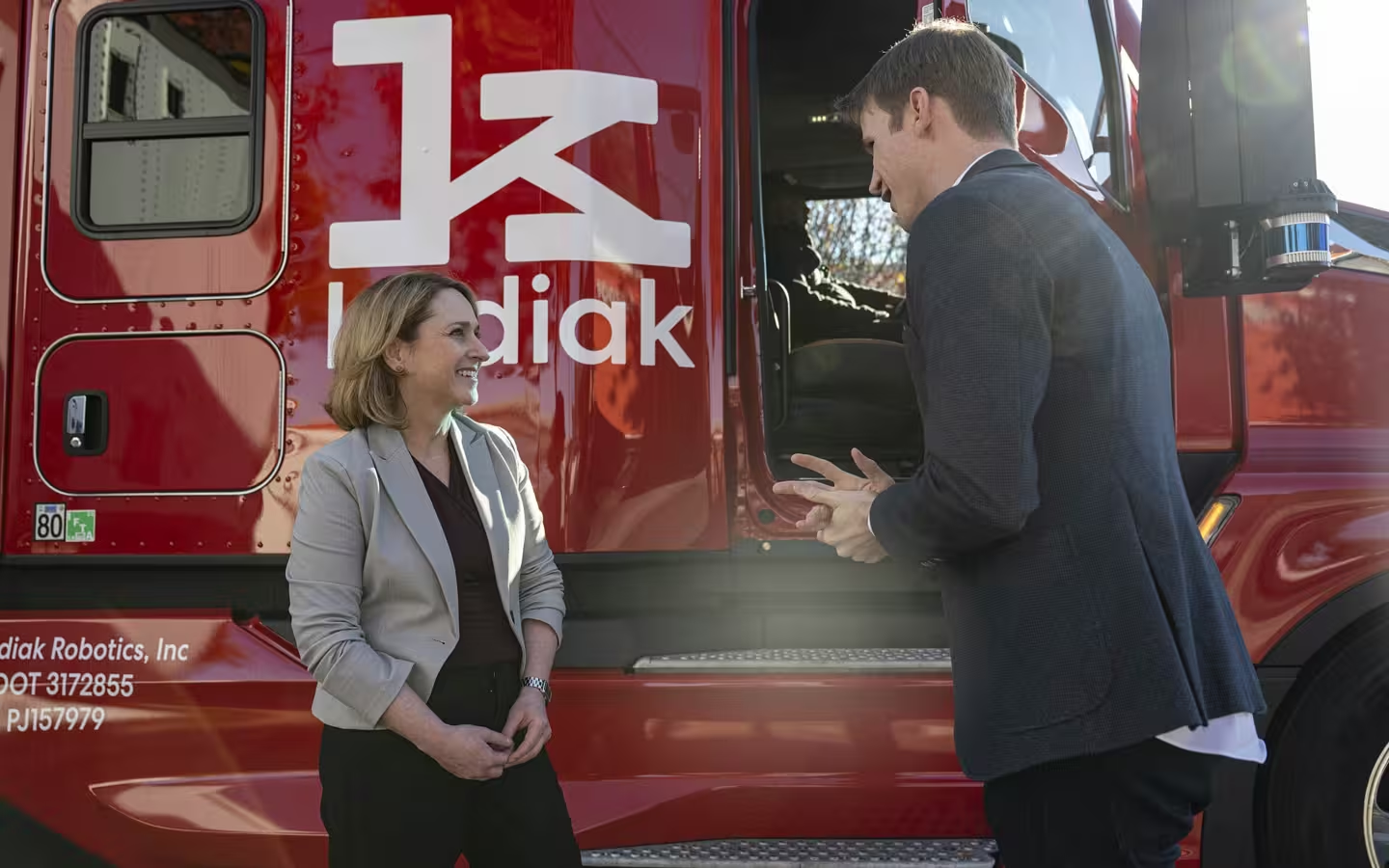
Kodiak CEO Don Burnette said the PrePass connection enables the company to “provide critical information to commercial vehicle enforcement agencies, maintain compliance with safety requirements and scale the Kodiak Driver across the United States.” The company said in early September 2026 that its safety case readiness, a measure it defines itself, had reached 93 per cent. Kodiak lists Atlas Energy Solutions, IKEA, Bridgestone, Werner Enterprises and C.R. England among its commercial partners and customers, and says the Kodiak Driver is already in commercial operation with no one in the cab. The Kodiak Driver, a vehicle-agnostic autonomous driving system combining AI-powered software with modular hardware, is deployed in long-haul trucking, industrial trucking, and defence sectors. In 2024 Kodiak said it became the first company to deploy driverless technology in customer-owned driverless semi-trucks.
PrePass infrastructure and competitive context
PrePass Safety Alliance, a non-profit public-private partnership of state agencies and trucking industry leaders, says it has invested over $1.3 billion to deploy services aimed at improving safety, reducing emissions, and preserving highway infrastructure. By its own count the network spans more than 580 inspection and screening locations nationwide and has facilitated more than one billion safe bypasses. Neither company said how many of those sites are in Texas or Louisiana, and no commercial terms were disclosed. PrePass says using existing systems — rather than requiring states to replace proven technology — provides a foundation for expanding the collaboration beyond Texas and Louisiana toward a consistent, scalable approach. Competitor Aurora Innovation separately targets 20 driverless trucks per week by Q4 2026 in a Driver-as-a-Service shift, as previously reported.