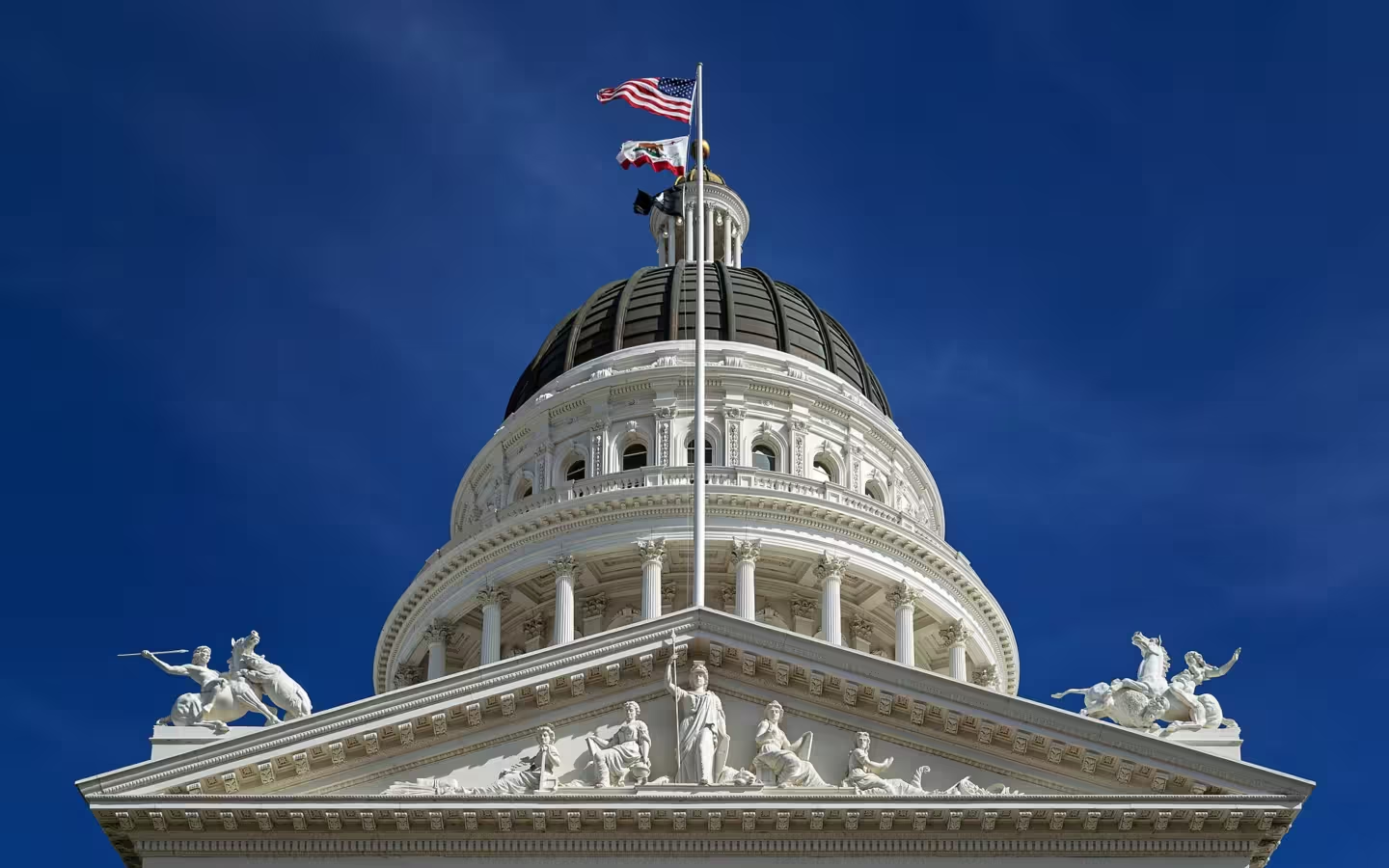
California Governor Gavin Newsom signed laws on 30 September restricting employers’ use of artificial intelligence in disciplinary decisions and requiring disclosure when AI causes a mass layoff. The governor’s announcement of the legislation also describes measures covering workplace surveillance, health care and AI-generated content. Newsom signed 13 bills across those areas and genetic research, KRCR reported.
Key points
- Employers cannot rely solely on AI when deciding to discipline or dismiss a worker.
- Employers must give notice when an AI system causes a mass layoff, relocation or termination.
- The measures restrict workplace surveillance and preserve clinicians’ professional judgment when clinical decision tools are used.
California requires people to review employment decisions
Under the employment measure described by the governor’s office, an employer may use AI in a decision to discipline or dismiss someone, but cannot make that decision solely on the system’s output. A person must review the action. The restriction concerns who makes the decision, rather than barring the technology from the process altogether.
A separate measure requires employers to disclose when an AI system causes a mass layoff, a relocation or a termination. Workers must receive written notice if AI is responsible for mass layoffs, ABC News reported. Together, the provisions put duties on employers at two different points: when an individual faces discipline or dismissal, and when the use of AI is connected to a broader change in staffing.
California Federation of Labor Unions, AFL-CIO President Lorena Gonzalez identified SB 947, SB 951, AB 1331 and AB 1883 as the four worker bills she welcomed at the signing. She said workers had sought rules that would maintain human oversight and limit surveillance. The governor’s office describes the four measures as first-in-the-nation worker protections.
Newsom framed the legislation as a response to risks that workers face as AI enters the workplace. “AI should expand opportunity — not come at the expense of workers and families,” he said in a statement reported by ABC News. At an event with reporters on 30 September, he criticised President Donald Trump over the lack of comprehensive federal AI regulation and said California had to do more without federal leadership.
Workplace surveillance faces California restrictions
The worker measures also reach uses of AI that do not directly determine whether someone keeps a job. Employers are barred from using the technology with workers’ biometric data to predict their emotional state, ABC News reported. That rule addresses a particular use of data collected from a person, rather than the wider question of whether an employer may monitor work.
The governor’s office describes another, location-specific limit: employers cannot use workplace surveillance tools in bathrooms at work. It also says California public higher education institutions must provide training for students, faculty and staff on AI and its procurement. The measures therefore assign responsibilities beyond private employers, including to institutions buying and using the technology.
The signing took place on Newsom’s last day to approve or veto bills before his term ends in January, ABC News reported. Earlier in September, he signed a law requiring operators of AI chatbots to assess risks before deployment. He also issued an executive order directing the state to consult experts on improving oversight of the industry.
Newsom extends AI rules beyond employment
The health-care measures preserve doctors’ and other licensed providers’ ability to exercise professional judgment when AI or other clinical decision tools are involved in patient care. Developers of those tools must make appropriate efforts to limit identified or foreseeable skew in their use, according to the governor’s office. The measures thus preserve clinicians’ discretion while requiring developers to address known or foreseeable bias.
Other measures address AI-generated material. The governor’s office says they prohibit removal of a digital watermark and allow access to metadata intended to help identify how content was made. The package also changes civil and criminal protections against false impersonation and the exploitation of a person’s likeness, including the creation of explicit content without consent using an AI deepfake.
Newsom signed a further measure requiring gene synthesis companies to follow safety guidelines, verify their customers and check the genetic material they supply for research. Earlier in September, he signed Senate Bill 813, establishing a framework for independent organisations to assess AI systems and models for safety and risk, and AB 1405, creating a state registry for AI auditors.
Newsom also signed an executive order on 30 September requiring California state agencies to continue calling the technology “artificial intelligence”. The order followed Trump’s instruction to US diplomats to use the term “super intelligence”.

,_NW_view_up.jpg)