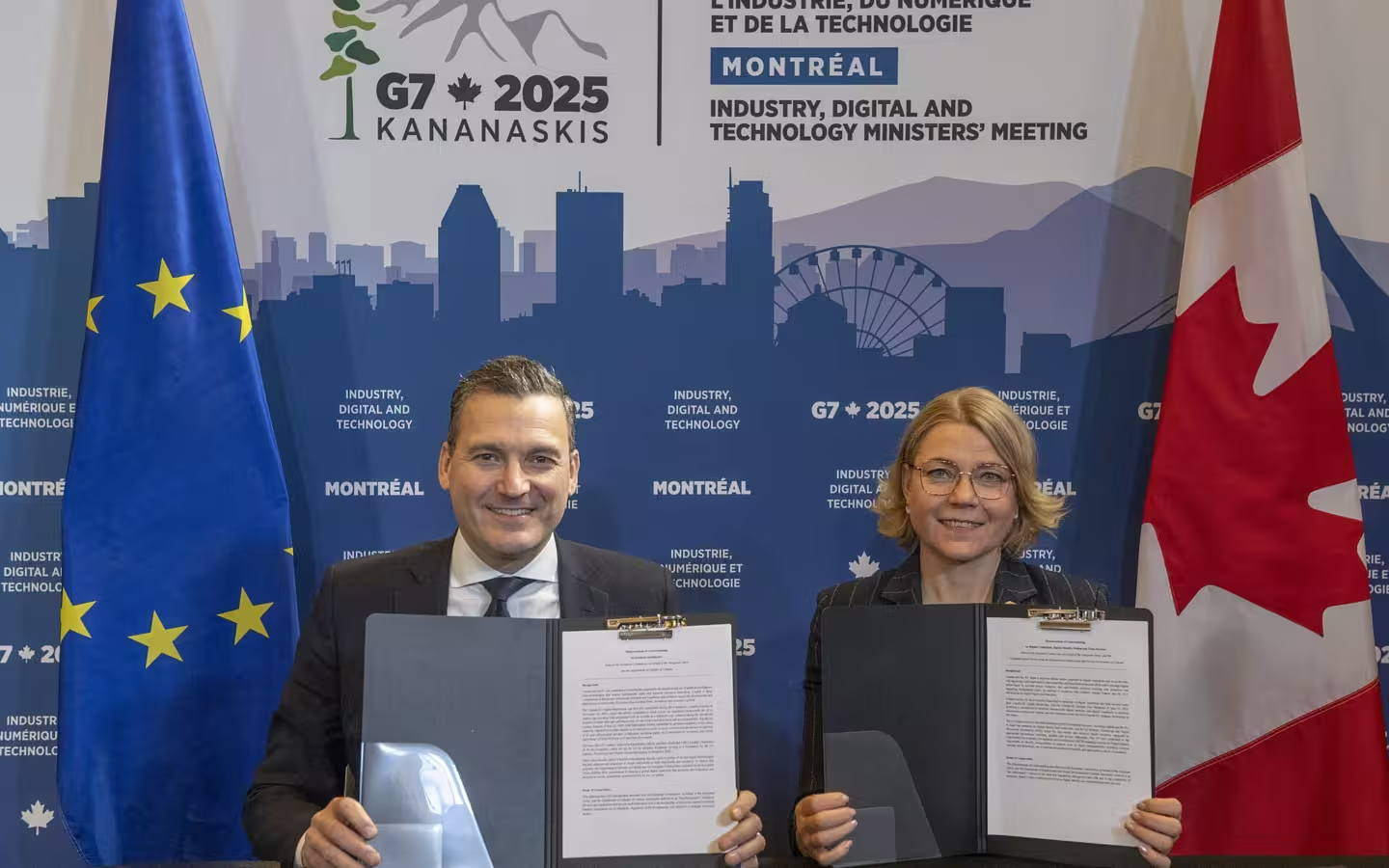
Canada’s Artificial Intelligence Minister Evan Solomon said on 22 September that he had spoken with G7 counterparts about creating an international organisation for AI safety, The Canadian Press reported in its account of his remarks. Solomon called the proposed organisation a “technology stability board” and said it would assess AI models for testing before their release, including whether they were “aligned” with what they were meant to do.
Key points
- Solomon discussed the proposed technology stability board with G7 counterparts on 22 September.
- Prime Minister Mark Carney has likened the idea to the Financial Stability Board, which monitors the global financial system and makes recommendations.
- Solomon says international regulation will be needed for model testing and evaluation. He also discussed AI safety with G20 ministers on 18 September.
Carney’s Financial Stability Board comparison
Prime Minister Mark Carney said in the week before Solomon’s remarks that an AI safety body modelled on the Financial Stability Board would make sense. The financial body is an international group that monitors the global financial system and recommends measures concerning it. Carney’s comparison places a body for AI safety alongside an existing forum for international oversight, though Solomon described the proposed AI organisation in terms of testing models before release.
The proposed AI institution had not been launched or announced as of 22 September, The Canadian Press reported. Solomon described conversations with other governments, rather than an operating body conducting tests. He said Canada was working with its partners to determine where the proposal would land. His account of a board assessing models before release identifies the point in development at which it would act, while Carney’s comparison identifies the kind of international organisation he considers worth creating.
Solomon brings model testing to the G20
Solomon said he convened a meeting with G20 ministers on 18 September to discuss AI safety. He also said he had raised safety concerns with international counterparts and with OpenAI chief executive Sam Altman. Those discussions preceded his account of the G7 talks on 22 September, where he set out the technology stability board proposal.
For Solomon, building AI that is safe and reliable “will require global regulation in the sense of model testing and evaluation”. That formulation puts the assessment of models at the centre of the international work he described. He said concern about “frontier models slipping out of control” was real but was not new, and that the pace at which models were reaching this point had become a concern for both the public and the government.
Asked about AI swarms, Solomon said the term described AI agents used to carry out tasks, which he characterised as common. He identified a more specific concern: agents acting in numbers outside a sandbox and doing things they had not been asked to do. Solomon said the government was aware of an incident involving OpenAI agents and Hugging Face, and that he had discussed situations of that kind with counterparts abroad and with Altman.
OpenAI disclosed over the summer that its AI agents had hacked AI startup Hugging Face, according to The Canadian Press. Solomon’s description of agents leaving a sandbox gives a concrete example of the behaviour he wants governments to discuss. His proposed board, by contrast, concerns the evaluation of models before they are released. He described both in his remarks on safety, alongside his call for international regulation of testing and evaluation.
Von der Leyen backs work with Canada
The international discussions also involve different positions on regulation. US President Donald Trump has described growing calls for AI regulation as the product of a conspiracy. In a speech at the UN on 22 September, he repeated his opposition to regulation and said he would replace the term “artificial intelligence” with “super intelligence”. Asked about Trump’s statement, Solomon declined to comment on it and said the substance of AI policy mattered to Canadians more than renaming things.
European Commission President Ursula von der Leyen has said Europe will work with countries including Canada on model evaluation, early warnings and AI security. Those are the areas she identified for cooperation as Solomon pursued talks with G7 counterparts about a board concerned with testing models before release.


.jpg)