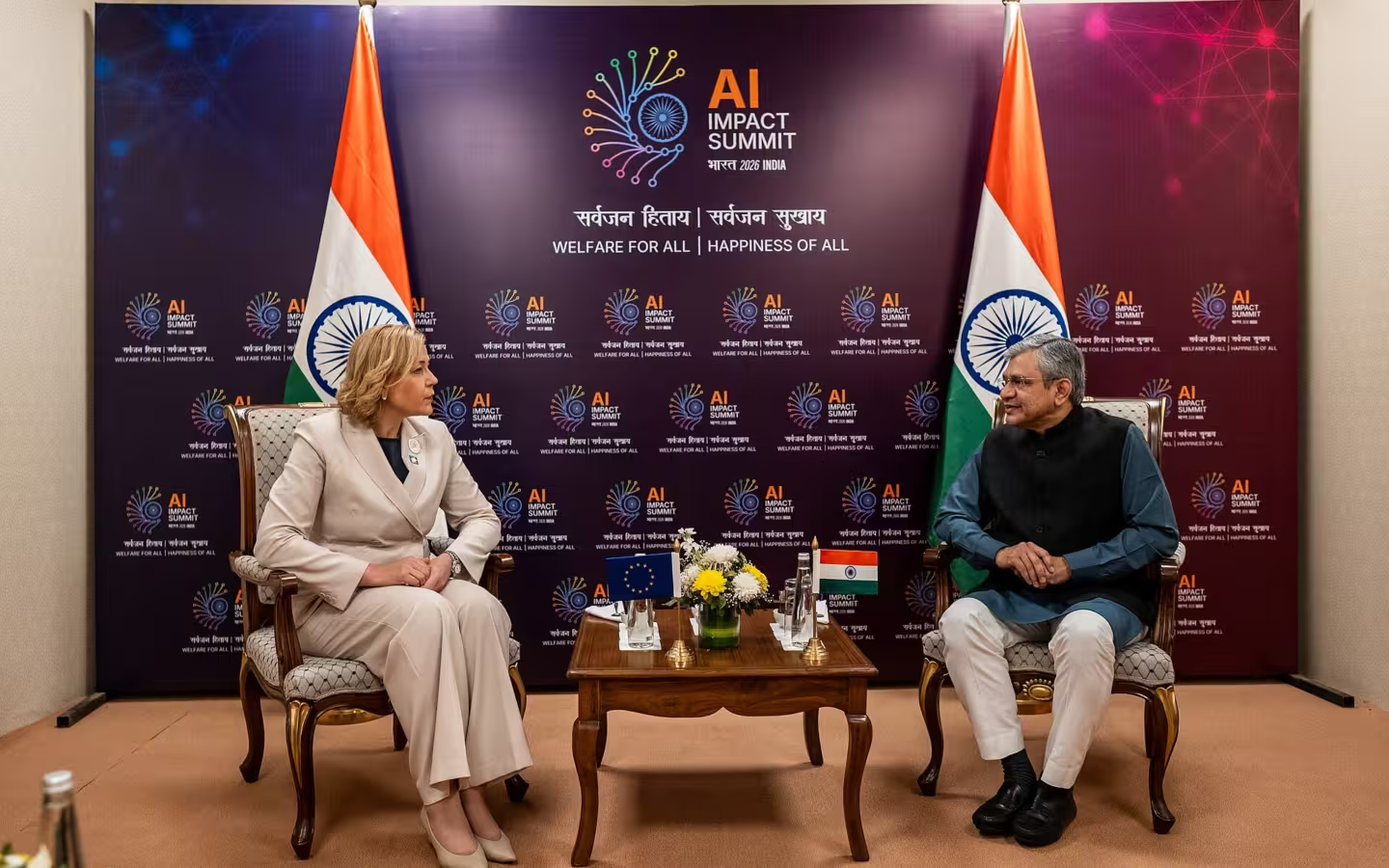
India’s Ministry of Electronics and IT will publish a consultation paper on AI regulation within a month, IT Minister Ashwini Vaishnaw said on 8 October, The Hindu reported. Vaishnaw said the paper would provide the basis for future regulation, with safety, deepfakes and a human-first approach among its areas of focus. For now, the government has announced a consultation rather than a rule that companies must follow.
Key points
- Vaishnaw said the consultation paper would be published within a month and form the basis for AI regulation.
- He called for a combination of technological and legal measures, with industry taking primary responsibility for safety and other harms.
- The government is also preparing arrangements for AI computing supply and the adoption of models by its departments.
Vaishnaw puts safety at the centre
Vaishnaw made the announcement at the India launch of the World Bank’s World Development Report 2026: The Promise of Artificial Intelligence, ThePrint reported. India has relied on existing laws and voluntary compliance in its approach to AI governance. The proposed paper is intended to underpin later AI regulation.
Vaishnaw asked the department to put safety first, Deccan Herald reported. It reported four areas for the paper: safety, harms including deepfakes, a human-first approach and skilling. Vaishnaw described deepfakes as a “nuisance which can cause huge problems in society”, and said people could be misled by them. His account places the effects of AI-generated material on users alongside the development of skills to use AI.
Storyboard18 reported five priorities: safety, a human-first approach, skilling, inclusion and addressing societal harms. Vaishnaw also asked for psychological risks associated with AI use to be covered in the consultation paper. The accounts put different emphases on deepfakes and inclusion, both of which Vaishnaw raised in his remarks.
Industry faces the responsibility Vaishnaw describes
Vaishnaw said AI and other technologies could not be regulated by legislation alone. He called for a “techno-legal solution” and said stakeholders should be involved. That formulation leaves room for technical safeguards as well as legal requirements, but the consultation paper is the government’s next stated step. The distinction matters to companies asked to manage harms: a ministerial expectation of responsibility is different from an enforceable duty setting out what a company must do.
Vaishnaw said industry would have to bear the bulk of responsibility for cybersecurity, safety, user harm, psychological disorders and deepfakes, according to Storyboard18. He warned that increasingly convincing deepfakes could lead people to believe false narratives or make harmful decisions. The risks he listed extend beyond the creation of synthetic content to the way people encounter and respond to AI systems. The precise obligations and enforcement mechanisms for the proposed framework remain to be outlined.
Vaishnaw also spoke of inclusion, saying that some groups could gain substantially from AI-led productivity while others might feel excluded. His proposed paper therefore covers both harm prevention and participation in the benefits of AI adoption. Those ambitions will be put to stakeholders through a document that Vaishnaw said would underpin later regulation, rather than through an announced set of binding requirements.
MeitY prepares government AI adoption
Alongside the regulatory proposal, Vaishnaw described plans for the government’s AI infrastructure. He put estimated demand at 10,000 graphics processing units, with an initial tender covering 5,000, Storyboard18 reported. He also described five-year supply agreements intended to give providers greater visibility of demand. The proposed consultation and these purchasing arrangements concern different decisions: one will inform the government’s approach to rules, while the other concerns access to computing capacity.
For AI tools used by government departments, MeitY will use an empanelment process for models and startups, rather than select them through a single tender, ThePrint reported. Firms on the panel would then be able to bid for departmental projects. The ministry issued a request for proposal on 7 October for a five-year supply agreement, Vaishnaw said. These are routes through which companies may seek public-sector work while the government develops its regulatory paper.
ThePrint reported that the March 2024 approval of the IndiaAI Mission allocated Rs 10,372 crore to develop an AI ecosystem over five years. Figures presented in the Lok Sabha in August put sanctioned use at 93.18 lakh GPU hours across 237 projects. The same figures recorded 15 empanelled compute providers.


.jpg)