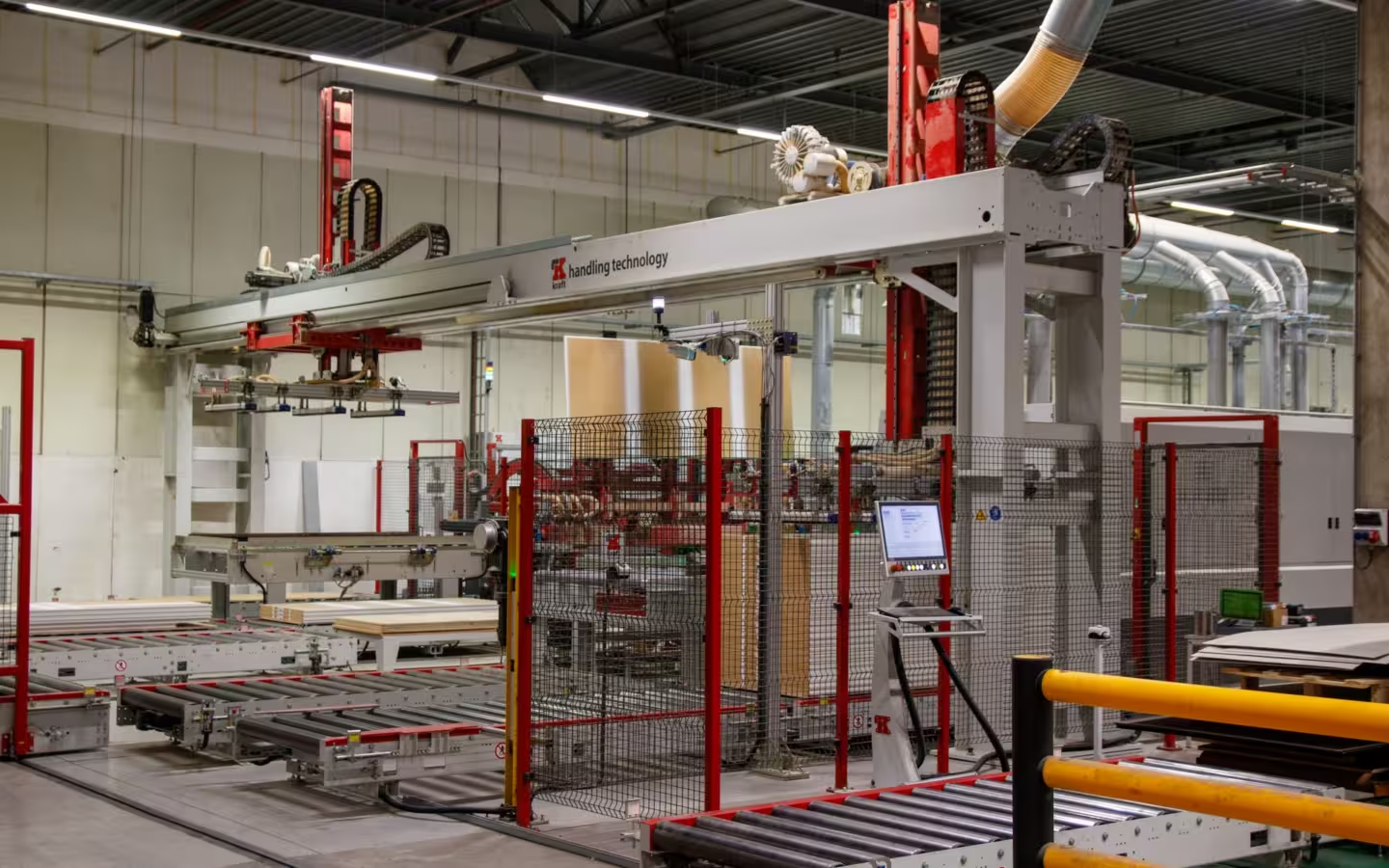
The Japanese government and leading machinery manufacturers have agreed to assign unique identifiers to individual factory equipment across producers, creating a cross-manufacturer data collection framework for physical AI development, Nikkei Asia reported on 21 September.
Key points
- Unique IDs will be assigned to factory equipment across manufacturers to enable cross-company data gathering
- The initiative targets physical AI applications such as autonomous robots and foundation models that operate in the real world
- Industrial robot makers including Yaskawa Electric are positioned to benefit from the pooled dataset
- The programme represents a new government-backed effort not previously disclosed publicly
A sovereign data asset from the installed base
The initiative addresses a structural gap in Japan’s AI strategy. Japanese robotics and machine-tool makers — Fanuc, Yaskawa Electric, DMG Mori, Okuma among them — hold decades of proprietary operational data from the installed industrial base. Until now, no framework existed to pool that data across competitive boundaries. The government’s solution is procedural rather than capital-intensive: assign a unique identifier to each piece of equipment, standardise the telemetry formats, and create a governance layer that determines who accesses what, under what conditions, and for which training runs.
Physical AI — models that perceive, reason and act in the physical world — has become a strategic priority for manufacturing economies. The United States and China have pursued it through frontier labs and state-backed compute respectively. Japan’s lever is different: an installed base of precision machinery that generates the kind of high-fidelity, real-world interaction data that simulation cannot replicate. If the identifier scheme works, Japan turns a competitive fragmentation problem into a sovereign data asset that no single company, and no foreign lab, could assemble alone.
Who gains power, and on what terms
The immediate beneficiaries are the robot makers. Yaskawa Electric, named in the Nikkei report, gains access to operational contexts beyond its own install base — welding cells, assembly lines, material-handling sequences from Fanuc or DMG Mori equipment — without having to sell a single additional robot. The trade-off is reciprocity: Yaskawa’s data enters the same pool. For the government, the gain is a domestic foundation model ecosystem that reduces reliance on American or Chinese models for critical manufacturing automation. The power shift is subtle but real: the ministries coordinating this — likely METI working with the Digital Agency — now sit at the centre of a data governance regime that did not exist last week.
What remains undecided is the enforcement mechanism. Unique identifiers are a necessary condition for cross-manufacturer data sharing. They are not sufficient. The scheme still requires agreement on data schemas, quality thresholds, liability for model failures trained on pooled data, and the commercial terms under which a resulting foundation model is licensed back to the contributors. Nikkei’s reporting indicates the programme was learned through its own sourcing, not a public announcement, which suggests the operational details are still being negotiated between the ministries and the industry consortium.
The capital question underneath the identifier scheme
There is a capital dimension that the identifier scheme does not solve. Training physical AI foundation models at frontier scale requires compute budgets that Japanese corporate balance sheets have not yet demonstrated they can sustain. The government has signalled support for domestic AI infrastructure — SoftBank, Sony and Honda are already working with Nvidia chips on a separate Japan AI initiative — but the gap between contracted revenue from industrial automation and the depreciation schedule of GPU clusters remains wide. The data pool makes training possible. It does not make it paid for. The next procedural step to watch is whether METI attaches a compute subsidy or a sovereign wealth allocation to the identifier framework, and on what timeline.
Next procedural step
The ministries are expected to publish a framework document by the end of the fiscal year detailing the identifier standard, the data governance board composition, and the access tiers for model developers. That document will reveal whether this remains a voluntary industry consortium or becomes a regulated data space with mandatory participation for equipment above a certain threshold. The distinction matters: voluntary schemes in Japanese manufacturing have historically achieved high coverage through peer pressure, while mandatory schemes attract legal challenge. Either way, the identifier rollout begins the moment the standard is frozen.