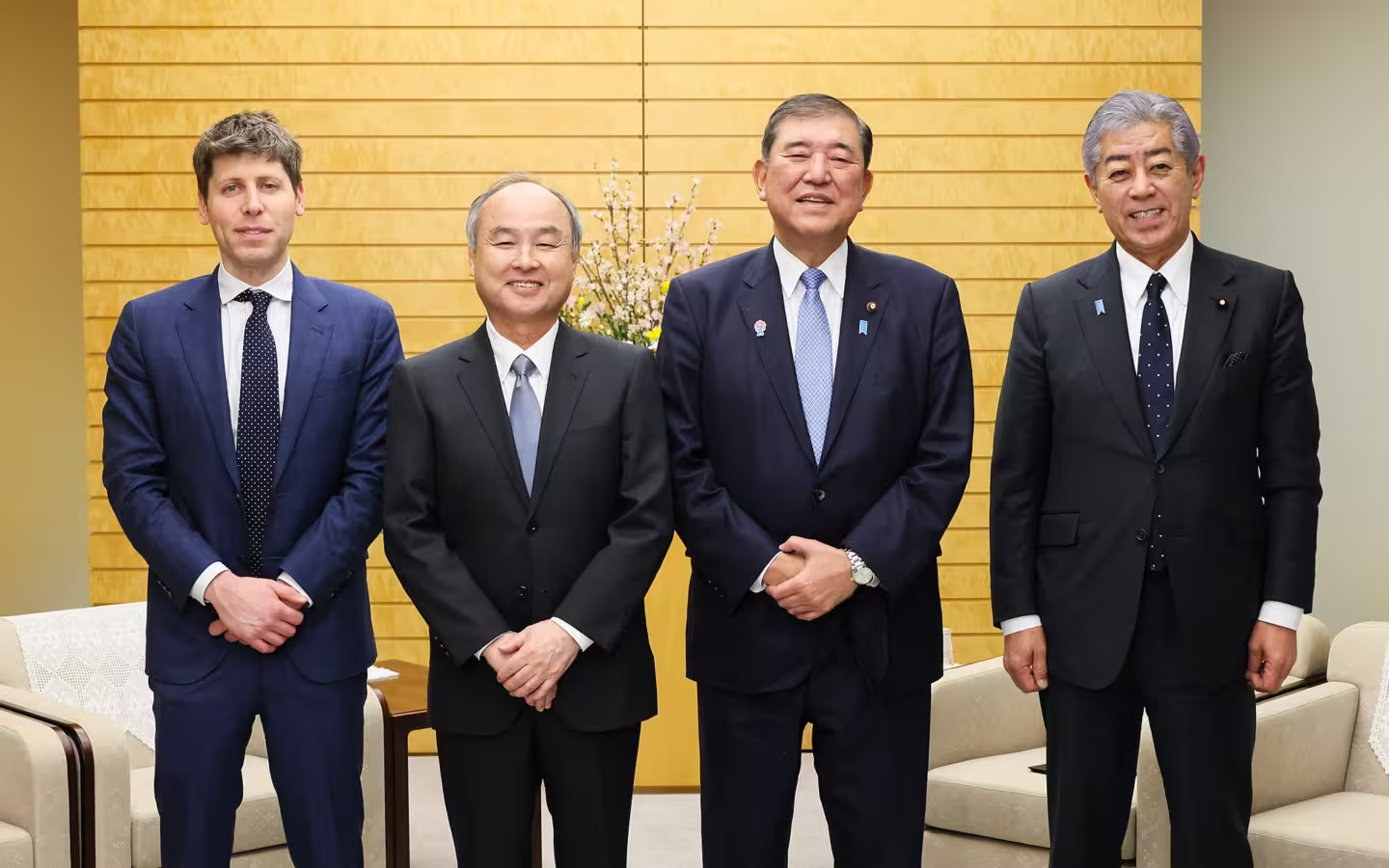
OpenAI chief executive Sam Altman is scheduled to brief the United Nations Security Council next week, Reuters reports, marking the first known appearance by a frontier artificial intelligence laboratory leader before the UN’s primary body for international peace and security.
Key points
- Sam Altman will brief the UN Security Council next week, the first such engagement by a frontier AI lab chief executive
- The briefing elevates AI governance to the highest level of international peace and security diplomacy
- The Security Council held its first formal debate on AI as a threat to international peace in July 2023
- Frontier model developers have previously engaged national legislatures and multilateral forums, but not at this level
- The event underscores growing government attention to the role of private AI companies in shaping global norms
What the briefing means for AI governance
The Security Council briefing represents a procedural escalation in how the international system treats artificial intelligence. Since the Council’s first formal debate on AI in July 2023, convened under the United Kingdom’s presidency, the body has returned to the subject intermittently, but always through the lens of member-state statements and briefings by UN officials. Inviting the chief executive of the most prominent frontier laboratory changes the architecture of the conversation: it places a private actor, whose commercial interests are inseparable from the technology under discussion, at the same table where the Permanent Five negotiate resolutions on conflict, proliferation and sanctions.
That invitation carries implicit recognition that the firms building the most capable models now hold operational knowledge that no government possesses. The Council’s mandate under Chapter VII of the UN Charter covers threats to the peace, breaches of the peace and acts of aggression. By asking Altman to brief, the Council is treating the deployment trajectory of frontier systems as a potential Chapter VII matter — or at minimum as a situation likely to require Council attention under Article 34. The distinction matters. A briefing under Article 34 is investigative, while a determination under Chapter VII is enforceable. The Council has not signalled which track this follows.
Precedents and the Security Council’s evolving role
Frontier model developers have testified before the US Congress, the European Parliament, the UK House of Commons and the Japanese Diet. They have participated in the G7 Hiroshima Process, the UK AI Safety Summit, the Seoul Summit and the forthcoming Paris AI Action Summit. They engage the OECD, the G20 and the International Telecommunication Union. But the Security Council is distinct: its resolutions bind all 193 member states, and its permanent members hold veto power over any enforcement action. A briefing here is not a consultation. It is a briefing to the body that can authorise sanctions, peacekeeping operations and, in principle, measures affecting the supply chains that sustain AI development — semiconductor exports, cloud infrastructure access, talent mobility.
The July 2023 debate, initiated by then-UK Foreign Secretary James Cleverly, produced no resolution. It produced a presidential statement noting that AI “could pose risks to international peace and security” and calling for “further discussion.” That language is deliberate. The Permanent Five — China, France, Russia, the United Kingdom and the United States — disagree on whether AI constitutes a threat to the peace within the Charter’s meaning, and on whether the Council has competence to regulate a dual-use technology that is predominantly developed by private companies in two of their jurisdictions. China’s position, articulated by Ambassador Zhang Jun in 2023, is that AI governance should occur through “inclusive” multilateral channels, not a Council dominated by nuclear powers. The United States, represented by then-Ambassador Linda Thomas-Greenfield, emphasised voluntary commitments and industry-led safety standards. Altman’s briefing will test whether either position has shifted.
What remains undecided and who gains influence
Three practical questions sit beneath the symbolism. First, whether the briefing is open or closed. A closed briefing (consultations of the whole) allows members to ask classified or commercially sensitive questions without public positioning, while an open briefing creates a record that can be cited in future negotiations. The Reuters report does not specify the format. Second, whether Altman appears in a personal capacity or as a designated representative of a UN process. The Secretary-General’s High-Level Advisory Body on AI delivered its final report in 2024. The Global Digital Compact, adopted at the Summit of the Future, calls for a scientific panel and a policy dialogue. Altman’s briefing could be framed as input to either, but the Council is not formally seized of those tracks. Third, what follow-up the Council requests. A presidential statement asking the Secretary-General to report on AI risks within six months would create a recurring agenda item. A request for a panel of governmental experts would shift authority to capitals. Silence would leave the briefing as a one-off signal.
Power follows procedure. If the Council establishes a standing mechanism — a panel, a reporting cycle, a sanctions committee mandate covering AI-enabled cyber operations or disinformation — the permanent members gain a veto over global AI governance. If the Council instead endorses the Secretary-General’s scientific panel, authority shifts to the UN bureaucracy and the member states that fund it. If the briefing produces no procedural outcome, OpenAI gains legitimacy without accountability: the appearance of statesmanlike engagement without the constraint of a binding instrument. The same dynamic applies to other frontier labs. Anthropic, Google DeepMind, xAI and Chinese counterparts such as Zhipu AI and Moonshot AI will watch closely. A precedent that the Security Council briefs the CEO of the leading American lab creates pressure for equivalent access, or for a rotating industry seat, or for a formal industry advisory group — each of which would embed private influence into the UN’s most powerful organ.
Next procedural step
The briefing is scheduled for next week, and the exact date has not been disclosed. The immediate procedural marker is whether any Council member requests a formal meeting record, a presidential statement or a resolution draft in the weeks following. Absent that, the next scheduled opportunity for the Council to address AI is the Secretary-General’s report on the implementation of the Global Digital Compact, due before the 80th General Assembly session in September 2025. That report will indicate whether the Altman briefing was a ceremonial milestone or the first step in a binding track.

.jpg)