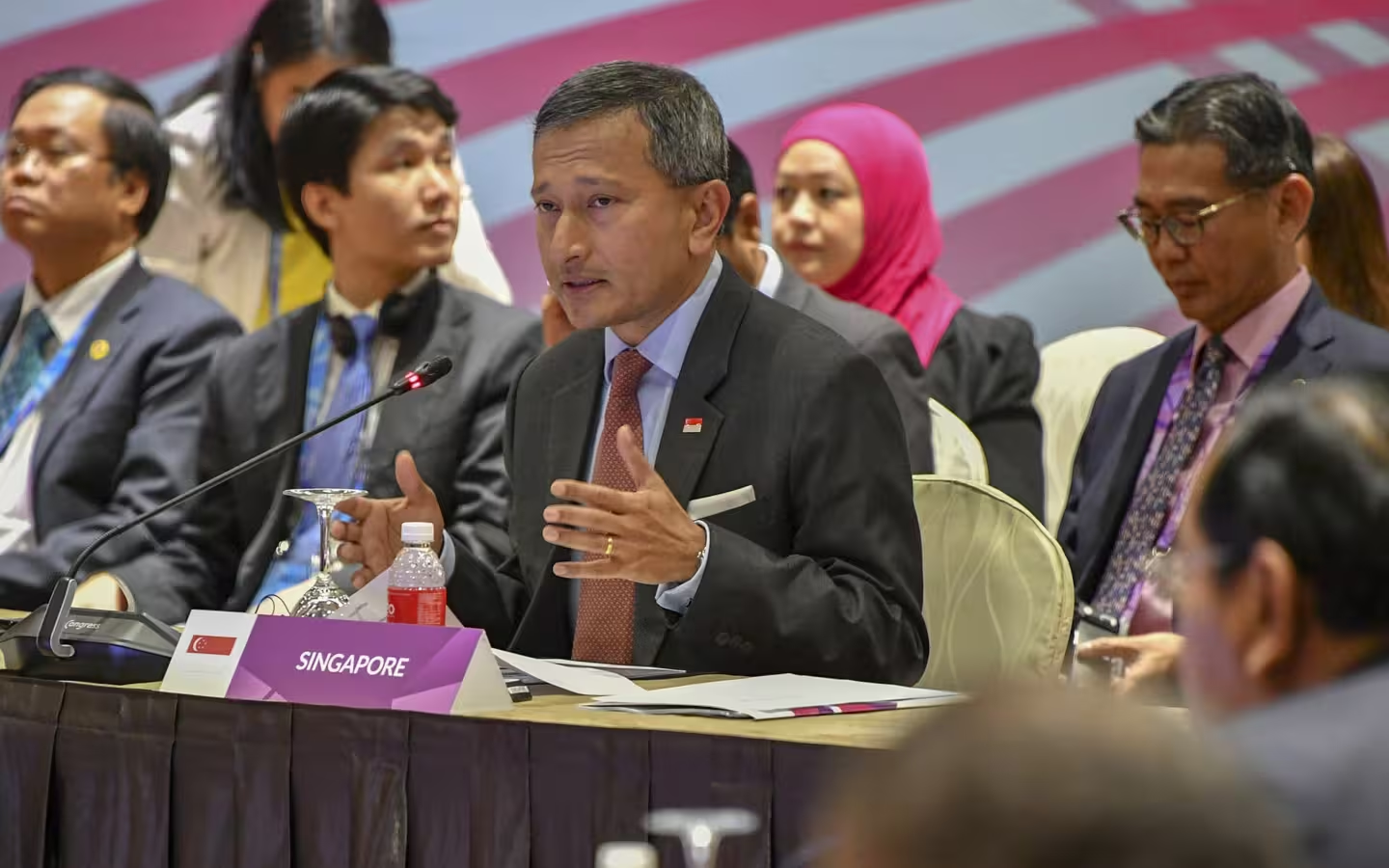
Singapore’s Foreign Affairs Minister Vivian Balakrishnan called for a UN framework convention on AI safeguards in the country’s national statement at the 81st United Nations General Assembly in New York on 26 September, The Straits Times reported. He also proposed considering an international institution that could set technical standards and carry out verification for AI.
Key points
- Balakrishnan urged countries to explore a UN framework convention on AI safeguards.
- He proposed comparable testing, limits on autonomous systems and ways for people to intervene when systems behave unexpectedly.
- More than 20 countries and the European Union signed a separate declaration calling for binding government oversight of frontier AI models.
Balakrishnan puts testing before deployment
Balakrishnan identified three kinds of danger: autonomous systems slipping beyond human control, rogue actors employing AI to make biological arms or other weapons intended for mass destruction or widespread harm, and upheaval in economic, social and political life. He argued that governments should continue investing in AI while developing safeguards alongside it. A halt was no longer a workable course, he said, citing competition between major powers and the financial incentives of companies that already have frontier models.
Singapore’s proposed approach would require rigorous testing and evaluation before deployment, boundaries on what autonomous systems may do, and means for people to intervene if those systems behave unexpectedly, CNA reported. Balakrishnan said humans must retain control and accountability. His examples concern decisions made before a system is used as well as the ability to act once it is operating — two tasks that would need to be addressed in any shared safeguards he is proposing.
Balakrishnan argued that national measures alone could not address risks that cross borders. He also described a lack of trust between governments as an obstacle to common safeguards, at a time when advanced technology is part of strategic competition. In his account, a durable arrangement would need to give every country a meaningful role, rather than allowing those with the most advanced models, the most money or the greatest military capabilities to determine its terms.
A UN convention and an AI institution
Balakrishnan urged governments to explore a UN framework convention, presenting it as one option rather than a settled negotiating plan. He said the UN should bring countries together because its membership is universal. He separately raised the possibility of an AI institution with functions resembling those of the International Telecommunication Union, which sets technical standards, and the International Atomic Energy Agency, which carries out verification.
For a nearer starting point, Balakrishnan proposed scientific cooperation among governments that disagree about AI governance. Countries could work towards a common understanding of capabilities and risks, make testing and evaluation methods comparable, and establish ways to report serious AI incidents quickly across borders. He identified the UN’s Independent International Scientific Panel on AI, the Global Dialogue on AI Governance and the ITU’s AI for Good Global Commission as possible foundations for that work.
Those proposals place several different tasks before governments. Comparable evaluations would require countries to agree on methods; cross-border incident reporting would require them to share information when serious failures occur. Balakrishnan’s suggestion of an institution able to conduct verification reaches further. His comparisons with the ITU and IAEA set out the kinds of functions he wants countries to consider, while his call for all states to have a meaningful role addresses who would shape such an arrangement.
Finland and Norway’s frontier-model declaration
The European Union and more than 20 countries signed a Finland- and Norway-led declaration on the General Assembly sidelines that urges binding international government oversight of frontier AI models in place of corporate self-regulation, The Straits Times reported. Balakrishnan said Singapore had joined the call for greater safety and security of those models. His wider AI-safeguards proposals covered comparable testing, cross-border incident reporting and limits on autonomous systems.
Turkish President Recep Erdogan also called for a common international legal framework for AI in his address to the UN, The Straits Times reported. Balakrishnan placed Singapore’s proposal within a broader appeal to maintain multilateral cooperation despite competition among powerful states. On AI, he said governments could begin with scientific work even where they had different views about the eventual form of international governance.
After delivering Singapore’s statement, Balakrishnan told local media it was too early to conclude that a UN framework convention on AI safety was necessary, CNA reported. He said governments had begun discussing the options and studying their implications. His proposal leaves the choice of a convention, and of any institution to set standards or verify safeguards, for countries to consider.


.jpg)