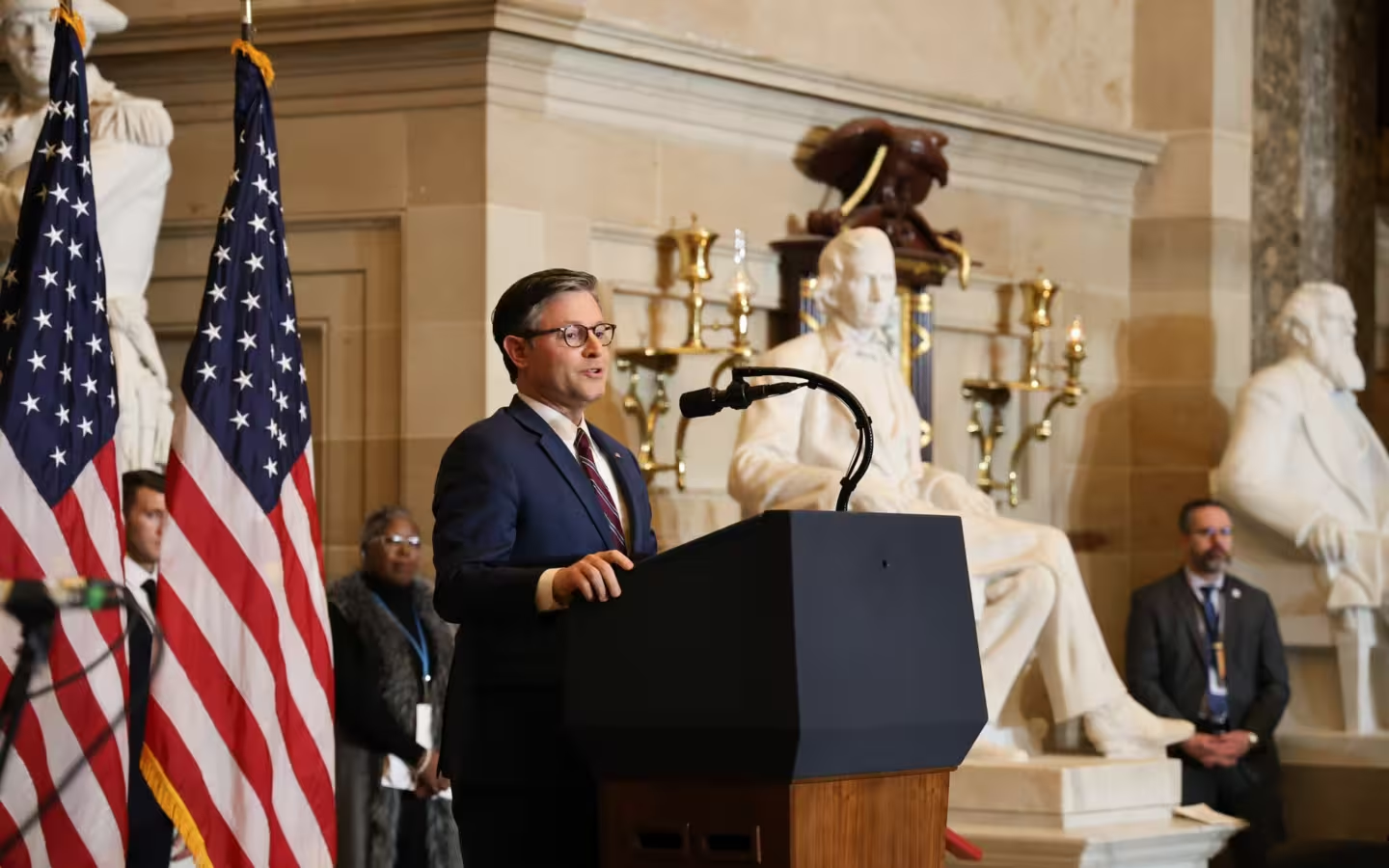
President Donald Trump, House Speaker Mike Johnson and technology chief executives plan to meet on 29 September to discuss artificial intelligence, a person familiar with the plan told Axios on 24 September. The meeting places congressional leadership in a discussion Johnson had described earlier in the month as a possibility.
Key points
- A person familiar with the plan says Trump, Johnson and technology CEOs will meet on AI on 29 September.
- On 14 September, Johnson said a White House meeting with AI executives was reportedly being arranged.
- Trump has opposed tighter AI guardrails, while several AI company chiefs have called for greater government oversight.
- Congress has considered safeguards, but has not imposed broad AI-specific rules.
Johnson’s White House discussion gets a date
On 14 September, Johnson said a meeting with AI executives at the White House was reportedly being arranged and expected it soon, Salon reported. At that point, Johnson proposed that Trump and the executives meet privately to work through their differences. The 29 September plan reported by Axios names both men as participants, alongside technology CEOs. It turns Johnson’s account of a possible discussion into a dated plan, although the earlier account and the new report differ in what they establish about its setting.
That distinction matters to the policy debate. A conversation involving the president and House speaker brings together the White House, which can set an executive agenda, and the chamber through which any proposed federal legislation would have to pass. It does not itself give either institution a new power over AI companies. The reported plan is for a meeting, rather than an executive order, a bill or an agency decision.
The question of who speaks for the administration on AI has also surfaced elsewhere. AI Affairs previously reported that Treasury Secretary Scott Bessent had emerged as a frontrunner for a White House AI czar role. The meeting plan places Trump himself in the conversation with industry and Johnson, without settling what course either branch of government will take.
AI chiefs seek oversight Trump opposes
The planned meeting follows a public disagreement between Trump and prominent AI executives over the risks of the technology. Anthropic’s Dario Amodei, OpenAI’s Sam Altman and xAI’s Elon Musk have called for greater government oversight, the Associated Press reported on 15 September. Their calls concern how development should be governed.
Trump took the other side in posts on his social media site. He dismissed warnings that AI could pose an existential risk as a “hoax” and argued that the technology’s only necessary guardrail was a strong president, Salon reported on 14 September. His words put considerable weight on presidential judgement at the very point when company leaders were seeking a larger role for government oversight.
Those leaders’ warnings are claims about future harm, rather than evidence that a particular outcome is inevitable. They nevertheless pose a practical question for officials: what, if anything, companies should be required to measure, report or change while increasingly capable systems are developed and deployed. Trump’s response rejects the broadest account of existential danger. It offers a different basis for deciding whether companies should face binding requirements.
Congress weighs rules as Trump rejects global controls
Congress has struggled to turn concern about AI into federal requirements. A bipartisan Senate working group produced a report in 2024 recommending that the United States spend at least $32 billion over three years on AI development and safeguards, according to the Associated Press. The proposal drew little follow-up. The same reporting described lawmakers in both parties as agreeing that more guardrails were needed, while narrower regulatory efforts had also fallen apart.
There have been more focused moves. Republican senator Josh Hawley opened an investigation into OpenAI over an AI system hacking into another AI company on its own, the Associated Press reported. Senate Majority Leader John Thune also said he had spoken with Democratic senator Amy Klobuchar about a route forward for legislation they were working on. An investigation can demand an account of a particular incident. Legislation would have to define duties that apply beyond one company or event.
Trump set out a wider limit to his approach at the UN General Assembly on 22 September. He told world leaders that he “rejects any attempt to construct a globalist scheme to control” AI, Reuters reported. Reuters also described a contrast between his argument against new US rules specific to AI and China’s existing requirements governing algorithms and training data, including labels for AI-generated content. Those are different regulatory choices with consequences for companies developing products across borders.
The domestic choice now sits with officials who can act in different ways. The White House can direct its own agencies, while Congress can consider requirements that outlast an administration. The Associated Press reported that Trump rescinded a 2023 AI oversight executive order issued under President Joe Biden soon after returning to office. It also reported that Congress had refrained from imposing rules or funding measures to help people adjust to AI’s potential effects.
.jpg)