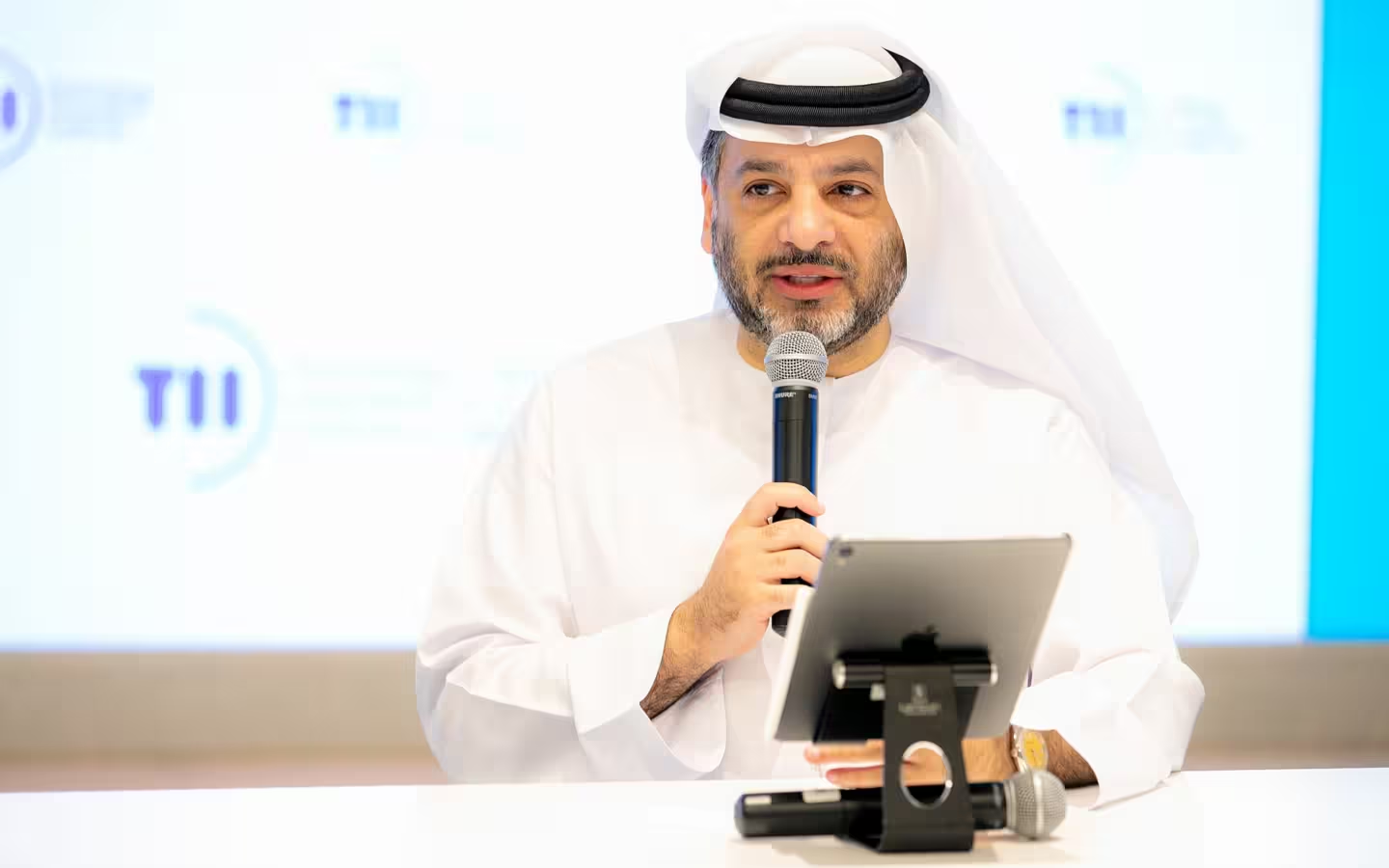
Faisal Al Bannai, adviser to the UAE President and secretary general of the Advanced Technology Research Council, called for independent safety checks on frontier AI models at AI Everything Abu Dhabi on 6 October. The organisation that builds a model should not be solely responsible for declaring it safe, he said, Khaleej Times reported. His proposal would put external assessors alongside developers in judging the risks of increasingly capable systems.
Key points
- Al Bannai called for independent reviews, common benchmarks and safety standards that change as AI develops.
- He said scrutiny should depend on a system’s use, distinguishing email writing from decisions affecting hospitals or traffic.
- The Technology Innovation Institute is developing AgentGuard, which he described as filters and circuit breakers for AI agents.
- Al Bannai said sovereign AI requires the ability to examine, test and modify technology, rather than ownership of intellectual property alone.
Al Bannai seeks tests outside the model builder
Al Bannai argued that governments and independent bodies need ways to test frontier models as their capabilities increase, particularly when those models enter critical systems. Countries should prepare to assess more powerful systems rather than expect the international competition to slow, he said. “Nobody is going to slow down,” he told CNN’s Becky Anderson during their conversation at the summit. “At the end of the day, everyone is pushing ahead at full steam.”
His proposed approach combines independent reviews with benchmarks shared across organisations and safety standards that can evolve alongside the technology. He contrasted that with conventional regulations written once and left unchanged for years. The proposal concerns who tests a model and how often the tests remain relevant, rather than asking its developer alone to make the safety judgement.
Al Bannai also distinguished between uses when describing the scrutiny a system should face. “It’s one thing having an AI write your email,” he said. “It’s another thing having an AI decide which tool goes in the hospital, what happens in traffic. That can really affect people’s lives.” His distinction would place more demanding checks around applications capable of affecting people beyond the model’s immediate user.
That concern extends to machines acting in the physical world. Al Bannai said a country might put another organisation’s model inside a robot and obtain the intended result, yet remain unable to understand fully where the system would fail or encounter dangerous edge cases. In that setting, access to a working product would leave the organisation using it dependent on what the developer knows about its limits.
Abu Dhabi’s regulator is also a builder
Al Bannai described the UAE’s regulatory agility as an advantage. He said regulators willing to understand risks and make decisions quickly could help companies and public bodies test applications as technology changes. Anderson put to him the tension created when a government can be an investor, regulator, customer and builder of AI. He acknowledged that tension but rejected waiting for a perfect approach to governance before acting.
Ahmed Tamim Hisham Al Kuttab, chairman of the Abu Dhabi Department of Government Enablement, set out the emirate’s ambition to become the world’s first AI-native government by 2027 at the same summit, Gulf News reported. He said Abu Dhabi and the UAE had brought together computing power, capital and customers prepared to adopt new technology early. The department hosts AI Everything Abu Dhabi, the two-day summit and exhibition at Adnec Centre on 6 and 7 October.
Al Bannai tied the ability to assess systems to his account of sovereign AI. Owning intellectual property was insufficient, he argued. A country also needs to understand the underlying technology and be able to change, test and develop it. “If you do not have the control of evolving it, testing it, modifying it, and really driving the destiny of that technology, it’s not sovereign,” he said.
He made the dependence more explicit when discussing access to a model’s code and weights. “If you don’t know what’s inside that code, if you’re unable to control the weights of that AI, then frankly, you’re a hostage to someone else giving you a black box,” he said. The UAE, he added, is using closed models from abroad while building its own open-source models.
AgentGuard and the smaller Falcon-H1 models
Al Bannai said the Technology Innovation Institute is developing AgentGuard, a product he described as a further layer of circuit breakers and filters intended to stop AI agents taking actions they should not take. He did not present those measures as comprehensive. “Will it cover all corner cases? No. It’s better than nothing, and you keep evolving it from there,” he said.
His account of the institute’s model work followed the same emphasis on particular uses. Al Bannai said it had initially competed at the frontier of large language models but had shifted more attention towards smaller, specialised systems. He argued that many enterprise tasks do not require an extremely large model and pointed instead to systems built around work in transport and other industries.
The Falcon-H1 family spans models from 500 million to 34 billion parameters. Later Falcon-H1-Tiny research has produced specialised models as small as 90 million parameters for uses sensitive to computing capacity, latency and energy use, Khaleej Times reported.