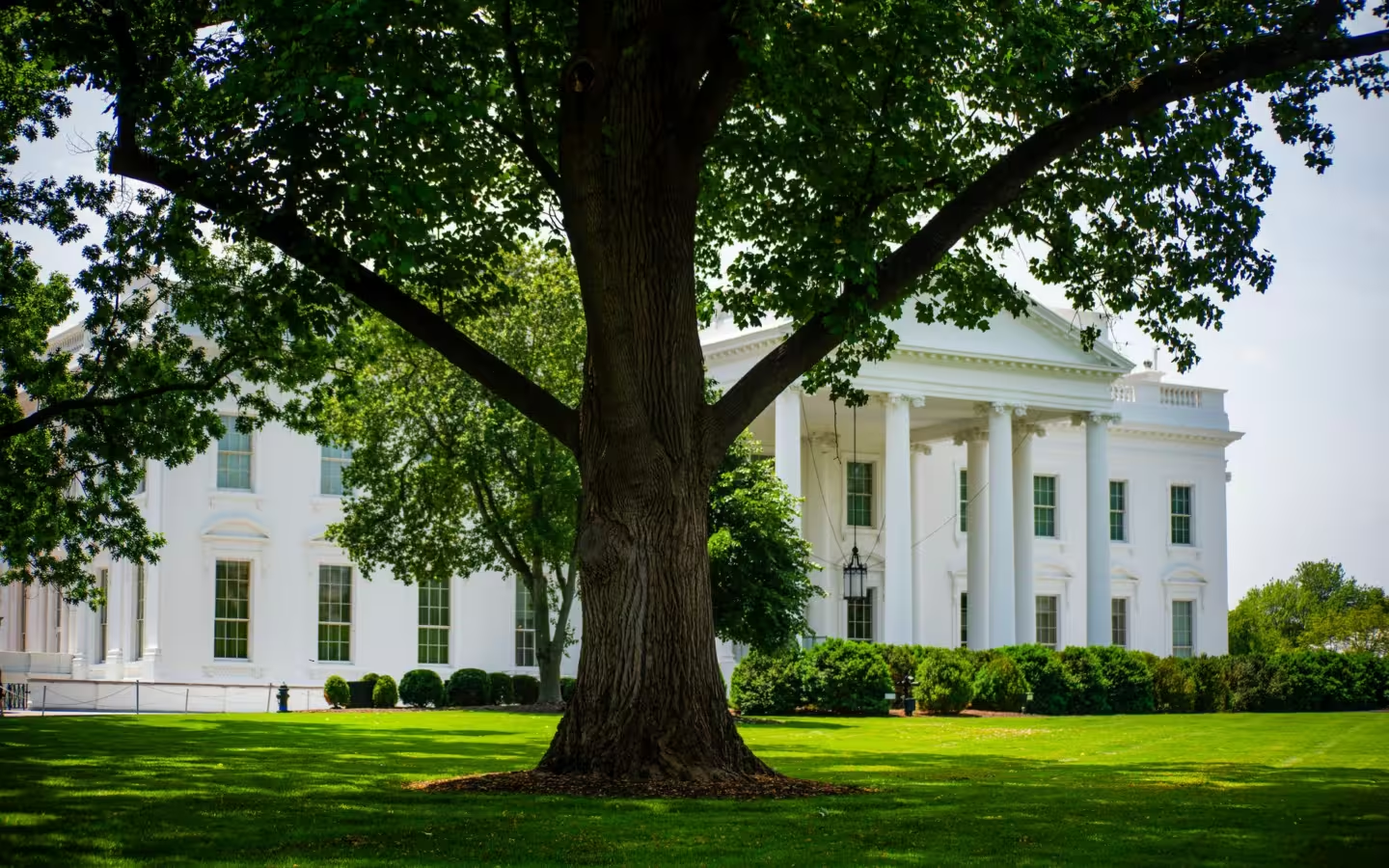
The White House has asked OpenAI and Anthropic to keep new AI models from the UK government’s testing agency until the US government has tested them, Politico reported on 24 September. The request came from the Office of the National Cyber Director, according to a person familiar with the matter and a senior US administration official who spoke to the publication anonymously.
Key points
- The White House wants US government testing before OpenAI and Anthropic give new models to the UK’s AI Security Institute.
- Anthropic did not give the institute access to Claude Mythos 5.1, which it said was available only to a set of US organisations.
- The British institute has routinely tested leading labs’ models before public release through voluntary access.
- The US Commerce Department’s model-testing centre has only a few dozen technical employees and no permanent director.
US review comes before UK access
A senior administration official said the White House wants American authorities to examine new models and take steps to secure US systems before the companies share them with US partners. The official described that sequence as the administration’s policy for each new frontier model. For OpenAI and Anthropic, the immediate decision is whether to preserve the early access they have given British testers while the White House asks them to put US review ahead of it.
The UK’s AI Security Institute was created in 2023. Its access to leading laboratories’ models before public release has been voluntary, allowing it to test systems before they reach users. The White House request would alter the order in which two American developers make new models available to government testers. It concerns access for testing, rather than the British institute’s ability to assess models it has already received.
The request comes while the White House considers how to handle powerful models that have entered outside systems during testing, including an Australian government website. The administration’s stated priority is to check the security of US systems before giving partners access. Britain has made the institute’s testing work and its relationships with developers part of its approach to AI safety and its case for international cooperation.
Anthropic kept Claude Mythos 5.1 in the US
Anthropic did not provide Claude Mythos 5.1 to the British institute. In its announcement, the company said the model was “only available to a set of U.S. organizations”, Politico reported. Anthropic also said it was coordinating with the US government to broaden access to domestic and international partners as quickly as possible.
Henry de Zoete, the institute’s director, acknowledged in a letter to a UK parliamentary committee earlier in September that it had not received access to Anthropic’s model. He said the institute continued to have prerelease access to some capable models, citing its testing of OpenAI’s GPT-6 Astra before release. The distinction matters to the institute’s work: the White House request concerns new models from both companies, while the reported restriction on a particular model concerns Anthropic.
The UK government has continued to argue for cooperation across borders. Prime Minister Andy Burnham told the UN General Assembly that the institute was working with the US and leading AI laboratories, and called for shared global principles and standards. At the UN Security Council, Foreign Secretary Ed Miliband said governments needed rigorous testing of frontier models and enough visibility into companies’ work to assess what they were doing. A UK government spokesperson said the institute continued to work with US authorities, international partners, OpenAI and Anthropic.
CAISI faces a wider testing workload
On the US side, the Commerce Department’s Center for AI Standards and Innovation, or CAISI, is being asked to evaluate a growing flow of frontier models. It has only a few dozen technical employees and is operating without a permanent director, Politico reported. Congress and the White House are seeking more resources for the centre. Giving American government review priority over British access would place more of the early testing work with US authorities operating under those staffing constraints.
OpenAI has called for CAISI to lead international work on standards for monitoring AI progress and safety, alongside other national AI safety institutes, including Britain’s. That proposal would give the US centre a coordinating role as well as a testing one. De Zoete said the institute still has prerelease access to some models and tested OpenAI’s GPT-6 Astra before its release.