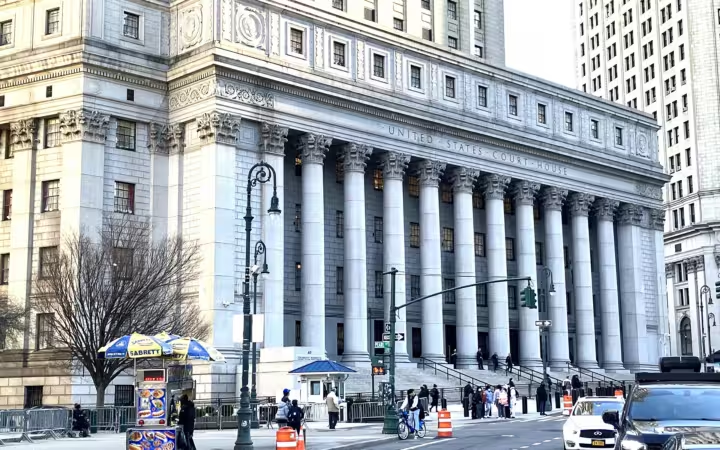
The Wikimedia Foundation filed a friend-of-the-court brief on 30 October 2026 in the US District Court for the Southern District of New York, asking judges in the consolidated OpenAI copyright litigation to distinguish model training from chatbot answers that reproduce protected work. Under the Foundation’s proposed approach, training on copyrighted material would qualify as fair use when it yields a model different from its sources, whereas chatbots retrieving and reproducing copyrighted work for users would have to comply with licensing terms. The Foundation, which operates Wikipedia, is taking neither side in the litigation.
Key points
- Wikimedia asks the court to treat training and retrieval-based answers as separate uses under fair use.
- Its proposed protection for training depends on the resulting model being new and different from the works used.
- For retrieved Wikipedia content, Wikimedia says companies should honour CC BY-SA 4.0’s attribution and share-alike requirements.
- The filing concerns litigation combining 12 lawsuits against OpenAI, including the case brought by The New York Times.
Two uses in the OpenAI litigation
The proceedings bring together 12 lawsuits against OpenAI, the Foundation says. The best known began when The New York Times sued OpenAI and Microsoft in 2023, alleging that they used its copyrighted material without permission. OpenAI and Microsoft argue that developing AI systems with publicly available material falls within fair use, which permits some uses of protected works without the copyright holder’s consent. The Southern District of New York will decide how that doctrine applies to the uses before it.
The Foundation argues that neither a narrow rule against training nor a broad exemption for AI companies would serve the open knowledge projects it runs. In its account, restricting training would limit the development of open-source tools, while allowing companies to disregard licences when they deliver source material to users would weaken the publishing and volunteer communities on which Wikipedia depends. It wants the court to assess the purpose and operation of each use separately.
Publishers’ objections extend across the acquisition of works, their use in training and their appearance in answers, Stephen LaPorte, the Foundation’s general counsel, wrote in a post explaining its position. He characterised OpenAI’s position as treating its uses of copyrighted work in developing and operating LLM systems as fair. The Foundation instead asks the court to protect training when the model produced is something new and different from the works it learned from. Under that approach, developers would not have to satisfy the works’ licensing terms for that training use.
Other submissions in this litigation have addressed training from different positions. AI Affairs has reported that Matthew Sag argued that training on copyrighted books is fair use, while entertainment unions sought to support the plaintiffs. Wikimedia’s proposed distinction would let developers train without a licence in the circumstances it describes, but would leave copyright holders’ licensing conditions in place when a product retrieves and reproduces their material for a user.
Wikipedia’s CC BY-SA 4.0 conditions
Retrieval-augmented generation, or RAG, brings outside material into a chatbot’s answer. LaPorte describes it as one way to connect responses to sources beyond what a model retained during training. The Foundation argues that retrieving and reproducing copyrighted content through RAG or similar methods should be subject to the source’s licence rather than covered by fair use. Its position concerns the material a service delivers to users, as distinct from using that material to develop the underlying model.
For Wikipedia, the relevant licence is Creative Commons CC BY-SA 4.0. It requires credit for the original creators and requires adaptations to remain under the same licence. The Foundation says AI companies that use Wikipedia content through RAG or comparable techniques must honour those conditions. Its concern is practical as well as legal: LaPorte says a rule allowing companies to avoid licensing terms would reduce the visibility on which Wikimedia and publishers rely for readers and new volunteers.
Wikipedia has more than 67 million articles in 300 languages, and nearly 250,000 volunteers contribute each month, according to the Foundation. Those contributors use published sources to build and improve articles. The Foundation also says language models can help its editors identify vandalism, copyright violations and articles needing work. It is asking the court to preserve access to tools developed from existing material while retaining the conditions attached to material supplied directly to chatbot users.
OpenAI, Microsoft and retrieved answers
OpenAI has described reproduction of work as a rare bug, The Verge reported. Microsoft said in a September filing that its expert analysis found Copilot rarely reproduced complete sentences from news material used to ground its answers. Wikimedia’s proposal addresses the legal treatment of retrieval and reproduction without asking the court to treat training itself as infringement whenever copyrighted material is involved.
The Foundation also wants companies collecting Wikipedia content to respect its public API rate limits or use its Wikimedia Enterprise API offerings, whether the material is gathered for training or for answers. That request sits alongside its copyright position: Wikimedia seeks licence compliance for retrieved content and limits on how companies access the systems that host it.