Armadin said on 1 October it had raised $255.5 million in a Series B round valuing the AI cybersecurity startup at over $2.5 billion, seven months after it emerged from stealth, according to the company’s announcement. Andreessen Horowitz and Accel co-led the financing, which Armadin said brought its total funding to $445 million.
Key points
- Armadin said its $255.5 million Series B valued it at over $2.5 billion.
- Andreessen Horowitz and Accel co-led the round; Bain Capital Ventures and Redpoint joined as new investors.
- The company says its AI-led attack campaigns are operating in production for Fortune 500 enterprises and government customers.
Armadin’s funding since its March launch
Armadin launched publicly on 10 March with $189.9 million in combined seed and Series A funding, Unite.AI reported. Accel led that earlier financing. Google Ventures, Kleiner Perkins, Menlo Ventures and In-Q-Tel participated, while 8VC and Ballistic Ventures made follow-on investments. The new round returns several of those backers to the company’s investor group.
Bain Capital Ventures and Redpoint joined the Series B as new investors, Armadin said. Returning investors were 8VC, Ballistic Ventures, Google Ventures, In-Q-Tel, Kleiner Perkins and Menlo Ventures. The round puts Andreessen Horowitz alongside Accel as a co-lead, while extending the participation of the investors named in the company’s earlier financing.
Accel partner Ping Li said his firm had led the Series A because it expected AI-powered offensive security to become more important against AI-enabled attackers. Andreessen Horowitz general partner David George described Armadin’s combination of security specialists and AI engineers as a reason for his firm’s investment. Those assessments are the investors’ case for the company, rather than reported results from its customers.
Armadin claims production use of AI attack campaigns
Armadin says it is running AI-led attack campaigns in production for Fortune 500 enterprises and government customers. The company describes a platform that sends specialised AI agents across an organisation’s systems to connect weaknesses that a scanner might assess separately. Its intended output is a tested route through those weaknesses that a security team can address.
The company says its agents can link lower-severity findings into paths that begin with remote code execution at the edge of a network, continue through movement inside it and reach cloud systems. Armadin says customers can then see both the route and the extent of access it could allow. These are descriptions of how the platform is intended to work, attributed to Armadin.
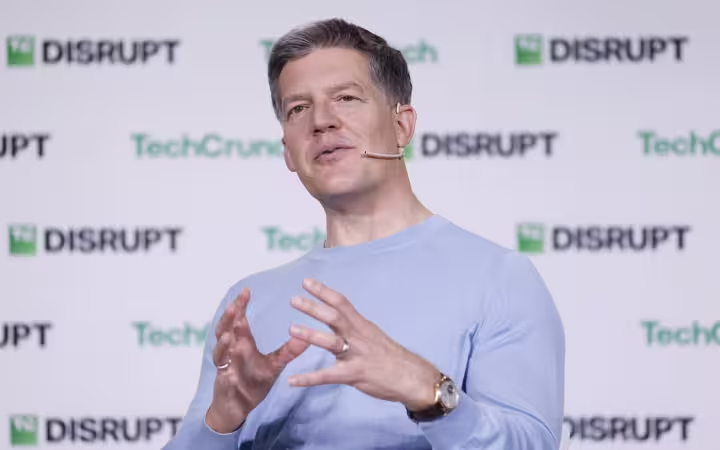
Kevin Mandia, Armadin’s chief executive, said AI helps attackers assemble chains of weaknesses faster than human teams can respond. Armadin presents continuous testing as its answer to that pace, contrasting its approach with periodic penetration tests and scanners that assess findings individually. Mandia founded Mandiant, which Google acquired in 2022, Pulse 2.0 reported.
Armadin says the campaigns are already in production, rather than confined to a trial. Its account identifies customers by category — Fortune 500 companies and government organisations — and describes the work being performed for them as attack campaigns. The company links that work to its broader aim of finding exploitable paths before an attacker uses them.
Series B proceeds target Armadin’s platform
The stated purpose of the $255.5 million raise is to expand Armadin’s platform, research, training and go-to-market operations, the company said. Those plans place spending on both the technology and the work of selling it. Armadin’s production-use claim concerns existing deployments; the proceeds are intended to support a wider operation.
Mandia said the company’s approach is to train defensive systems against capable AI-led attacks every day. Armadin describes the agents as working together across a customer’s systems, rather than issuing separate scores for each weakness. Its announced use of the new capital includes the research and training behind that approach, as well as the platform and go-to-market effort.