Samsung Electro-Mechanics said on 28 September it would spend W6.78 trillion ($5 billion) expanding chip package substrate capacity in South Korea and Vietnam, with customers helping to fund the Sejong project and committing to future purchases, The Korea Herald reported.
Key points
- The company plans to invest 4.27 trillion won in its Sejong plant through May 2028, equal to 43.6 percent of its consolidated equity at the end of 2025.
- Samsung Electro-Mechanics says global technology customers will contribute capital and guarantee medium- to long-term purchase volumes.
- Its Vietnamese subsidiary plans to spend 2.51 trillion won on a separate package substrate plant expansion by April 2028.
Sejong customers back 4.27 trillion won project
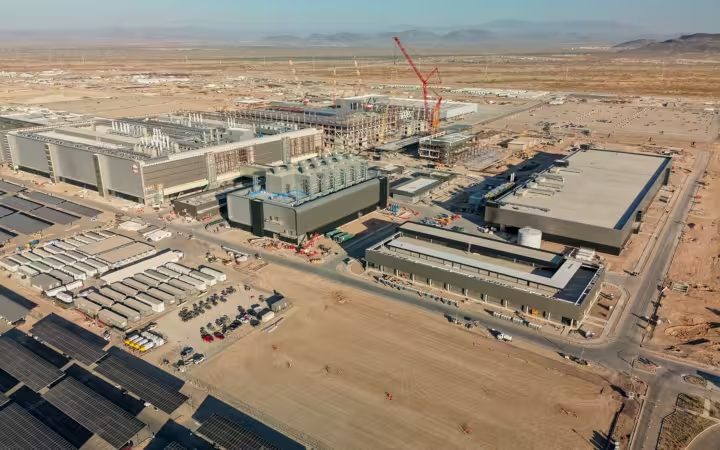
The Sejong expenditure will expand production of flip chip-ball grid array substrates, or FC-BGAs, used in AI accelerators and other high-performance chips. The company plans to spend 4.27 trillion won at the plant through May 2028. That sum amounts to 43.6 percent of Samsung Electro-Mechanics’ consolidated equity at the end of 2025.
Samsung Electro-Mechanics says global technology customers will provide part of the capital expenditure and guarantee medium- to long-term purchase volumes. The customer funding puts some of the cost of adding capacity on buyers seeking future supply, alongside the company’s own investment.
The Korea Herald reported that the company had not named those customers or stated how much they would contribute. Local media accounts cited by the newspaper put advance payments from Nvidia and other customers at trillions of won and said Nvidia had provided the largest share. Samsung Electro-Mechanics had not confirmed those accounts.
Samsung Electro-Mechanics outlined about 8 trillion won of spending in Sejong by 2040 in July, while the latest commitment sets an earlier timetable. FC-BGA production requires dense wiring and additional substrate layers as the chips it supports become larger and more complex. In March, chief executive Chang Duck-hyun said demand from server and data centre customers for FC-BGAs exceeded the company’s production capacity by more than 50 percent.
Vietnam subsidiary plans 2.51 trillion won expansion
Samsung Electro-Mechanics said its subsidiary in Vietnam would put 2.51 trillion won into enlarging a package substrate factory by April 2028. The Sejong and Vietnam projects cover different plants, with customer funding and volume guarantees reported for the Sejong line.
The company’s package substrate business already serves computer processor customers. Meritz Securities analyst Yang Seung-su estimated that CPU-related products, including those for personal computers, account for more than 45 percent of Samsung Electro-Mechanics’ ABF substrate sales, Chosunbiz reported on 23 September. Yang said shipments of sixth-generation server ABF from the Vietnam plant to a North American CPU customer were increasing.
Yang forecast third-quarter sales of 3.82 trillion won and operating profit of 657.1 billion won, increases of 32.2 percent and 152.4 percent respectively from a year earlier. His operating profit forecast was 9.3 percent above a market estimate of 601 billion won. He projected an ABF operating margin above 30 percent, citing high utilisation and greater supply of AI-chip and server-CPU substrates.
Doosan adds capacity for substrate materials
Other manufacturers are investing in materials used further along the chip packaging supply chain. Doosan announced on 17 September that it would invest about 970 billion won in copper-clad laminate capacity in South Korea and China, Maeil Business Newspaper reported. It allocated about 420 billion won to a Korean line for optical-module materials and about 550 billion won to a Chinese plant serving AI accelerators and network switches.
Samsung Electro-Mechanics has also secured longer-term orders for other components. Since May, it has disclosed 3.32 trillion won in contracts for silicon capacitors and AI-server multilayer ceramic capacitors. Those agreements include a 1.1 trillion won capacitor contract announced on 1 September for delivery in 2027.
Samsung Electro-Mechanics plans to begin mass production at the expanded Sejong plant in September 2028.