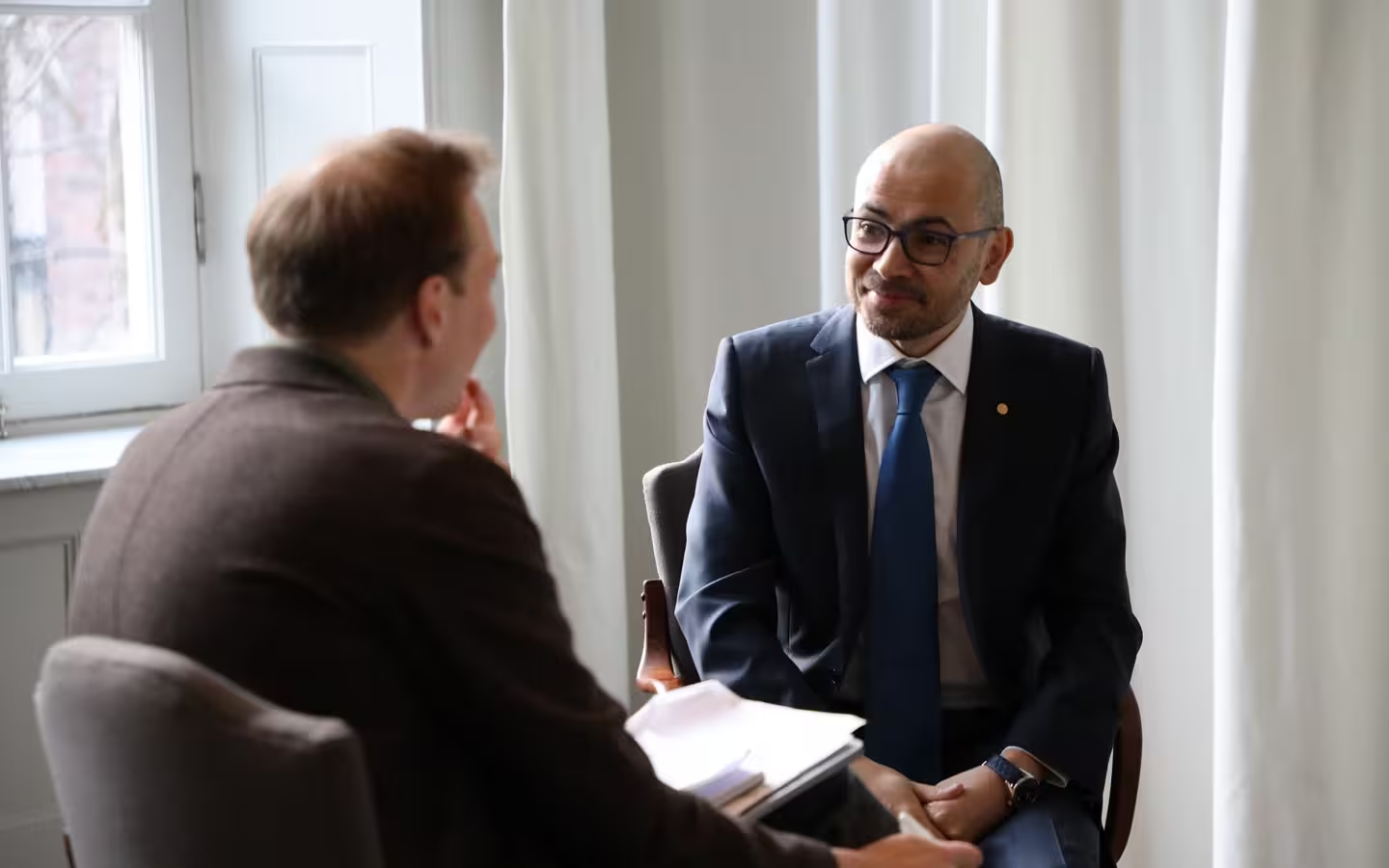
Google DeepMind chair Demis Hassabis cut his forecast for artificial general intelligence from three to five years to two to three years in a WSJ Magazine profile published on 21 October, Startup Fortune reported. Hassabis means a system with the full range of human cognitive abilities, rather than one that performs well on narrow tests, Free Press Journal reported.
Key points
- Hassabis now puts AGI two to three years away, down from an earlier three-to-five-year estimate.
- His proposed Einstein Test asks whether AI can independently derive general relativity from earlier knowledge.
- Hassabis is WSJ Magazine’s Innovator in Tech for 2026.
Hassabis’s forecast moves closer through 2026
At the World Economic Forum in Davos in January, Hassabis put AGI five to 10 years away and gave it roughly a 50 per cent chance of arriving by the end of the decade, according to Startup Fortune. At the India AI Impact Summit in February, he said it might arrive within five years.
His language had tightened again by Google I/O in May, where he called AGI “just a few years away” and described current AI agents as a dress rehearsal. The October estimate gives that shorter horizon a number: two to three years.
Anthropic CEO Dario Amodei has offered a similarly short window, though he used different words for the destination. He projected in January 2025 that AI would become “better than almost all humans at almost all tasks” within two to three years, Startup Fortune reported.
The Einstein Test sets Hassabis’s bar
Hassabis has proposed an Einstein Test for the kind of capability he has in mind. A system would learn from knowledge available up to 1911, then be tested on whether it could derive general relativity independently, as Einstein did in 1915, Free Press Journal reported.
He also wants to turn AGI towards physics, working with human scientists on fundamental questions. That ambition reaches beyond the narrow tests he rejects as a definition of AGI: the task is to produce a scientific insight from what was known before it existed.
Hassabis spoke about medicine too. Asked about using AI to cure cancer, he said he saw “hard things, but not impossible things”, according to t2ONLINE.
WSJ Magazine names Hassabis a 2026 innovator
Hassabis is one of seven people selected for WSJ Magazine’s 2026 Innovator Awards, and its honouree in technology. The awards began in 2011 and cover fields including art, literature, fashion and cuisine.
In the profile, Hassabis also argued against setting rules before the technology is better understood. “Wrong regulation is worse than no regulation,” he said, t2ONLINE reported. WSJ Magazine will hold the Innovator Awards in New York on 29 October, the publication reported.