AWS introduced the Physical AI Toolchain on AWS on 7 October 2026, bringing its cloud services together with Nvidia robotics software in an open-source stack for manufacturers building machines that sense and act in the physical world. Amazon says the toolchain covers development from generating training data to putting models on machines, with parts that can also be adopted separately.
Key points
- The toolchain provides reference architectures, infrastructure code and deployment automation.
- It connects Nvidia tools for synthetic data, training and simulation with AWS services for computing and deployment.
- Amazon names NEURA Robotics, RLWRLD and Config among companies working on robots and their training data.
Nvidia software meets AWS infrastructure
A robot model has to do more than return an answer. It takes information from its surroundings, chooses an action and controls hardware while the surroundings continue to change. AWS describes that process as a continuous loop: information gathered during operation can become material for later training, while a model directing physical movement must meet the timing and safety demands of the machine carrying it.
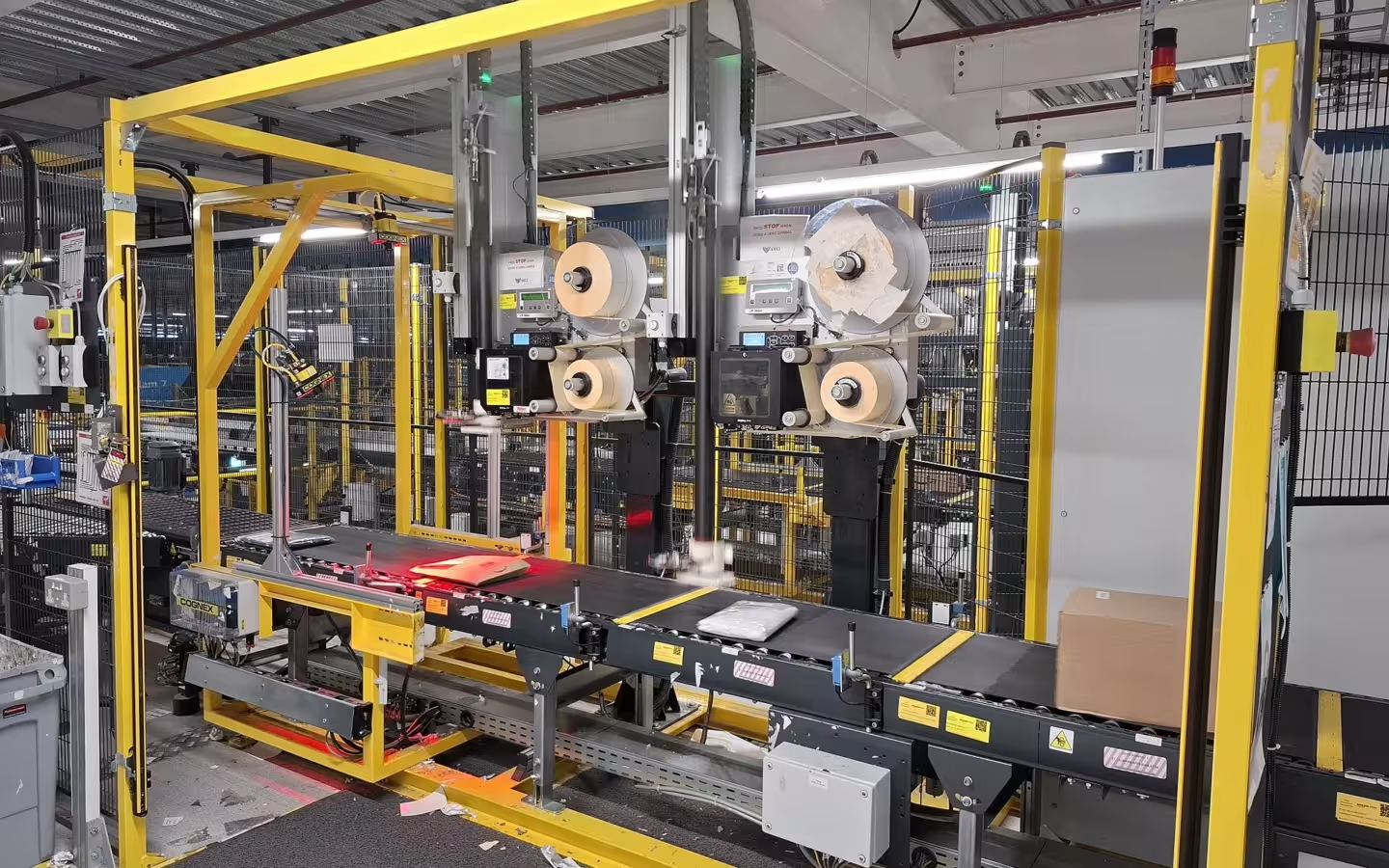
Sorting packages could therefore involve a machine adjusting its actions to what it senses, rather than repeating fixed instructions. Data from those movements could feed into later training, if the development cycle Amazon describes were used for that task.
In an AWS technical post dated 7 October, the company describes the toolchain as a collection of reference architectures, Infrastructure as Code and deployment automation. Infrastructure as Code lets a team define computing resources in configuration files instead of setting up each resource by hand. AWS says the components can be deployed individually or connected into a pipeline that moves data, models and simulation results between stages.
The Nvidia components have distinct jobs. Cosmos generates synthetic worlds that can supply training scenarios. Isaac Lab supports reinforcement learning, in which a model learns by practising a task and receiving feedback. Isaac GR00T is used for humanoid training, while Isaac Sim provides virtual environments for testing behaviour before a model reaches hardware. On the AWS side, SageMaker supports model training, EC2 GPU instances run simulation, IoT Greengrass handles deployment to machines, and Bedrock AgentCore provides orchestration, according to Amazon.
AWS maps the route to machines
Amazon divides the development cycle into five parts: synthetic data generation, model training, simulation and validation, edge deployment, and continuous improvement. Edge deployment puts an optimised model on the machine itself, where it can make decisions without a constant cloud connection. AWS says the cloud can coordinate training and fleet management, but cannot serve as the control loop for physical tasks whose safety depends on prompt responses.
That division matters because a convincing virtual run is only one stage of testing. AWS warns that a model scoring highly in an offline evaluation might fail when controlling a 6-axis arm at 200 Hz in a cluttered warehouse. Its technical post calls for progression through simulation, supervised testing on real hardware and controlled deployment, accounting for sensor noise, delays and the possibility of damage during physical trials.
The handoffs also involve more than transferring a model file. AWS lists recordings, descriptions of a robot’s structure, calibration data, simulation scenes and deployment packages among the materials that must travel through development. The toolchain accepts recordings in Zarr, standardises them into LeRobot format and uses tools including PyTorch, Gymnasium, URDF, ONNX and ROS 2 at later stages. AWS says these open formats allow data and models to remain portable.
Uwem Ukpong, vice president of AWS Industries, said customers had told Amazon they were spending too much engineering effort on infrastructure. The modular design addresses that complaint by letting developers take a simulation, training or deployment component without adopting the whole stack. Amazon also says its fleet-management capabilities can provision, secure and update machines over the air.
NEURA Robotics and RLWRLD pursue different tasks
Amazon names three companies building different parts of this field. NEURA Robotics is developing humanoid robots designed to learn from experience, with a goal of bringing millions to market by 2030. Its founder and chief executive, David Reger, said the toolchain helps the company move more quickly from refining models to deploying them on machines.
RLWRLD is building an 8.1-billion-parameter foundation model for dexterous manipulation: controlling robotic hands as they grasp, rotate and handle objects. The parameter count describes the size of the model RLWRLD is building, while Amazon’s description of the work concerns the intended handling capability.
Config has built a pipeline that captures more than 200,000 hours of robot action data and uses generative AI to turn that material into varied training scenarios, according to Amazon. Such scenarios fit the toolchain’s synthetic-data stage, where recorded actions can be supplemented before models are trained and tested. Amazon says it has deployed more than 1 million robots across its own operations network, where they sort, lift and carry packages.