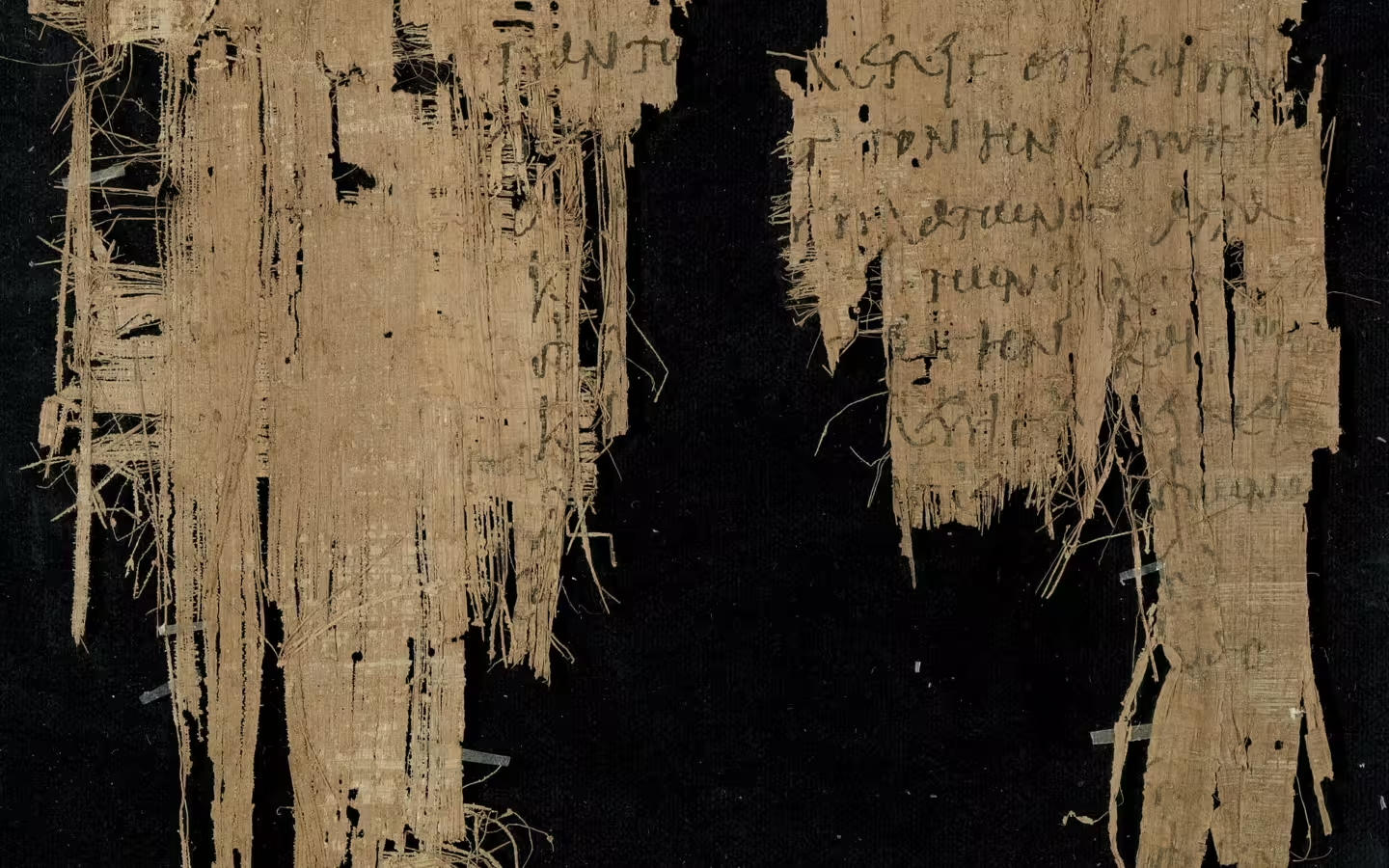
The Austrian Academy of Sciences unveiled Apollo, a language model for restoring ancient Greek texts, on 23 September 2026. Developed with Mistral AI and SAIL Reply, it proposes words for gaps in damaged papyri and inscriptions. The academy has made the first version freely available to researchers and the public, giving specialists a way to examine possible readings of material whose surviving words may offer only part of the answer.
Key points
- Apollo proposes missing Greek text from the words around a gap.
- The academy reports around 80 per cent accuracy on deliberately hidden papyrus passages.
- In a blind assessment, specialists also compared its suggestions with human restorations for genuinely unknown gaps.
- The first version is available as a free application.
Mistral Small supplies Apollo’s starting point
Apollo Restore builds on Mistral Small, a model with 24 billion parameters, and was trained on approximately 600 million words of Greek dating from antiquity through 1900, Greek Reporter reported. Parameters are the adjustable numerical settings a model acquires during training. The Greek material gives this one patterns to draw on when it proposes a passage that might fit a damaged document.
The academy contrasts that corpus with the roughly 40 billion words it says are typical for large language models. Anna Dolganov, a researcher at the academy’s Austrian Archaeological Institute, says Apollo uses sentence structure and vocabulary to distinguish forms of Greek from different periods. A passage resembling Homer’s Odyssey, for example, calls for different language from a document produced under Roman rule.
Greek Reporter describes Apollo’s method as “fill-in-the-middle”: it examines words preserved on both sides of a break and proposes what could go between them. The model does not need an exact count of the lost characters. That matters for papyrus, where handwriting and spacing vary and a torn section may give little indication of how much writing has vanished. It is rather like completing a sentence on a damaged page when its beginning and end remain, but the width of the tear is no reliable guide to the number of missing letters.
Reading a damaged birth record could begin with possible completions drawn from the words on either side of a gap. Those suggestions would still need checking against the writing that survives, because a plausible phrase would not, by itself, recover the words that were lost.
For those working with collections of fragments, the application offers suggestions that can be reviewed against the original material. According to the academy, museum and library collections contain over a million papyrus fragments and hundreds of thousands of ancient inscriptions, many of them incomplete. It also says 92 per cent of papyri remain undeciphered — a measure of the material awaiting study, rather than a count of gaps Apollo has restored.
Two tests put Apollo’s restorations to work
The academy reports accuracy of around 80 per cent when passages from existing papyrus texts were deliberately hidden and Apollo was asked to restore them. In that test, the original words provided an answer against which the model’s proposed text could be checked. Damage to an ancient document presents a different task: the missing words may never be known with certainty.
For genuinely unknown gaps, the academy says international experts assessed Apollo’s suggestions blind, rating them at least as good as human-generated completions in 77 per cent of cases and better in 16–20 per cent. Those are judgements about proposed readings, not matches against a surviving original. The academy says the suggestions are for specialists to review and verify.
A more narrowly defined test reported by Greek Reporter asked whether the correct reading appeared among Apollo Restore’s 20 suggestions for gaps of up to 10 characters. The correct answer appeared among those suggestions in 80.6% of cases involving records on papyrus, 54.6% involving papyrus works of literature, and 61% involving carved inscriptions. Finding an answer somewhere in a set of suggestions is a different measurement from getting a single proposed restoration right.
In a small experiment, the system helped specialists complete restoration tasks faster. Both the character-gap test and that experiment concern particular tasks; the academy’s open application puts the suggestions themselves in the hands of people examining damaged texts.
Roman Egypt and Vesuvius provide examples
At Apollo’s presentation, Dolganov demonstrated it on a Greek birth declaration from Roman Egypt dated 149 CE, a philosophical papyrus charred in the eruption of Vesuvius and a damaged inscription from the Black Sea. The academy says Apollo reconstructed the birth document and made important portions of the philosophical text legible. It says the inscription’s proposed reconstruction offered evidence that Roman law applied in the region, alongside a document concerning a Roman tax on prostitution.
The Vesuvius example also illustrates why a proposed reading can remain open to scrutiny. Greek Reporter reported that Apollo Restore offered an alternative to a published interpretation of a passage associated with the philosopher Philodemus. The researchers said their suggestion raised a possible problem with the existing reading, while the alternative remained subject to scholarly review.
The Austrian Academy of Sciences owns Apollo and says it funded the project with approximately 400,000 EUR in partnership with Mistral AI and SAIL Reply. Its first version is accessible as an open-access application.



.jpg)