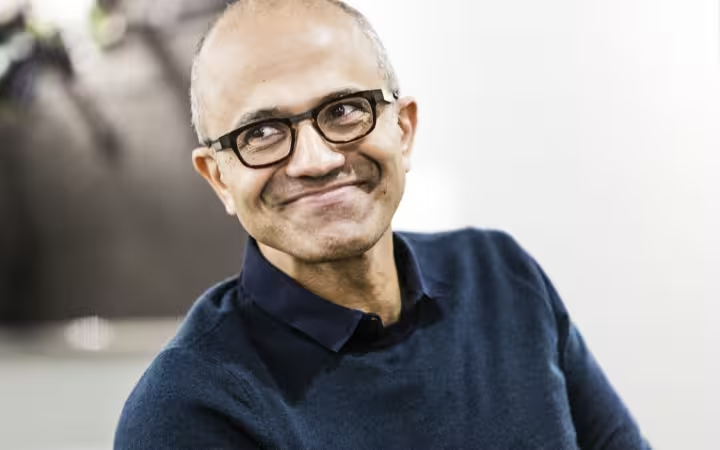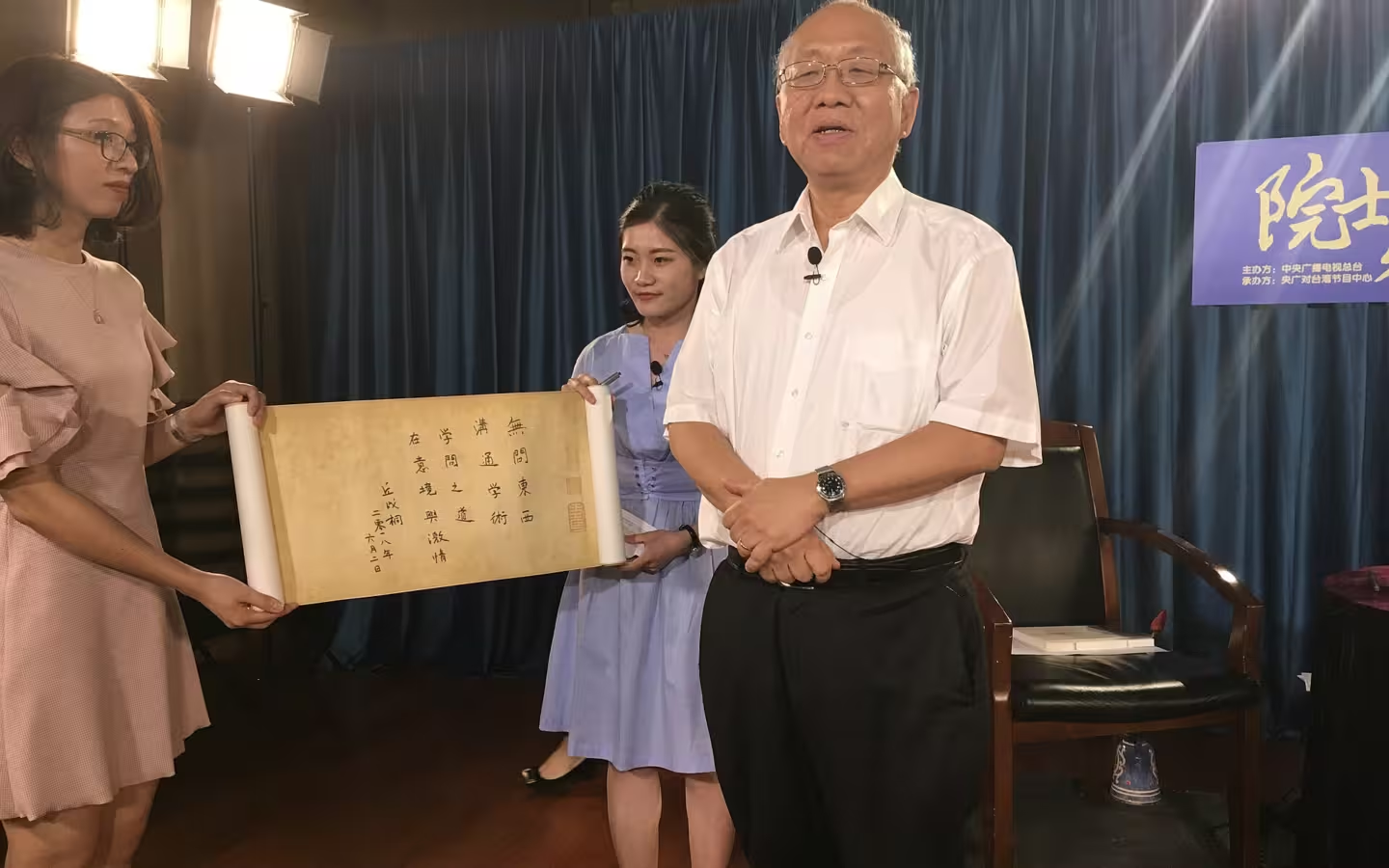
Chinese mathematicians launched the Yau Laboratory Alliance for Mathematics and Artificial Intelligence in Beijing on 11 October, bringing eight institutions together to develop AI for mathematical research, The Chosun Ilbo reported. Shing-Tung Yau, a Fields Medal laureate and director of the Yau Mathematical Sciences Center at Tsinghua University, leads the initiative.
Key points
- The alliance aims to connect more than 1,000 researchers across eight institutions.
- Its planned work includes maths-specific AI models, mathematical hypotheses, formal proofs and reasoning that is easier to interpret.
- Yau says China trails the United States in applying AI to advanced scientific research.
Yau’s network targets more than 1,000 researchers
The alliance aims to connect more than 1,000 mathematicians, according to The Chosun Ilbo. The scale matters to Yau’s argument: he wants researchers to work collectively on AI designed for mathematical problems, rather than leave the development of such systems to separate efforts. The planned network is a research undertaking, while the models it proposes remain work for its members to do.
Yau says China lags behind the United States in applying AI to advanced science, particularly mathematics and physics. American AI companies have recruited thousands of scientists and drawn substantial industrial investment to difficult scientific problems, while comparable work in China remains fragmented, UA.News reported. That is Yau’s assessment of the gap the alliance is intended to address.
Yau also described a change in his own view of the technology. A year earlier, he said, he had not expected AI to become so capable; over the following six to 12 months, he had seen it work on problems mathematicians found difficult. He argued that mathematicians should develop and use AI together rather than avoid it, a position that puts the alliance’s proposed research programme behind his call for cooperation.
The alliance’s plans for mathematical proofs
The institutions plan to develop models tailored to mathematics and use AI to propose hypotheses — possible mathematical rules that researchers could then investigate. They also want to turn proofs into forms that computers can verify and make AI systems’ reasoning easier for people to follow. These are distinct jobs: proposing a result supplies something to examine, while checking a formal proof tests the steps offered to justify it.
A formal proof puts an argument into a precise form so that a computer can check its steps. That gives a different kind of scrutiny from reading a model’s confident answer, but it requires the argument to be expressed in that checkable form. The alliance’s interest in interpretable reasoning addresses a related problem: a result is more useful for research when mathematicians can examine how a system arrived at it.
Checking a mathematical claim in a work report could involve a computer testing each step of its reasoning, if the claim were translated into a formal proof. A proposed answer alone would not receive that check. The distinction is why the alliance’s plans cover both generating possible results and putting arguments into a form that can be tested.
For organisations building AI for research, that agenda extends beyond making a model produce more answers. It includes the work of expressing mathematical arguments precisely enough to check them and making the path to an answer intelligible. Those goals reflect the tasks the alliance has set itself, rather than a measured result from a model it has built.
OpenAI’s 722 manuscripts and the verification dispute
The launch followed a large release of AI-generated mathematical work by OpenAI. The company released 722 manuscripts on 6 October, The Chosun Ilbo reported. Vocal put the release on 7 October. The manuscripts addressed open mathematical problems, but the release of a manuscript and the verification of its argument are separate events.
OpenAI claimed progress on hundreds of unresolved problems. The publication reported that OpenAI initially cautioned that the results were not all fully verified and that about 42% of proofs had undergone formal verification. It also reported that an error in one argument affected two related papers, after which OpenAI withdrew three manuscripts and revised 14 others.
The pace drew objections from mathematicians concerned about checking results, explaining them clearly and recognising earlier research. Terence Tao, also a Fields Medal laureate, called for slowing AI adoption because of its potential negative effects. Yau took a different view of how to respond: he said the dispute should not prevent mathematicians from working with AI developers.