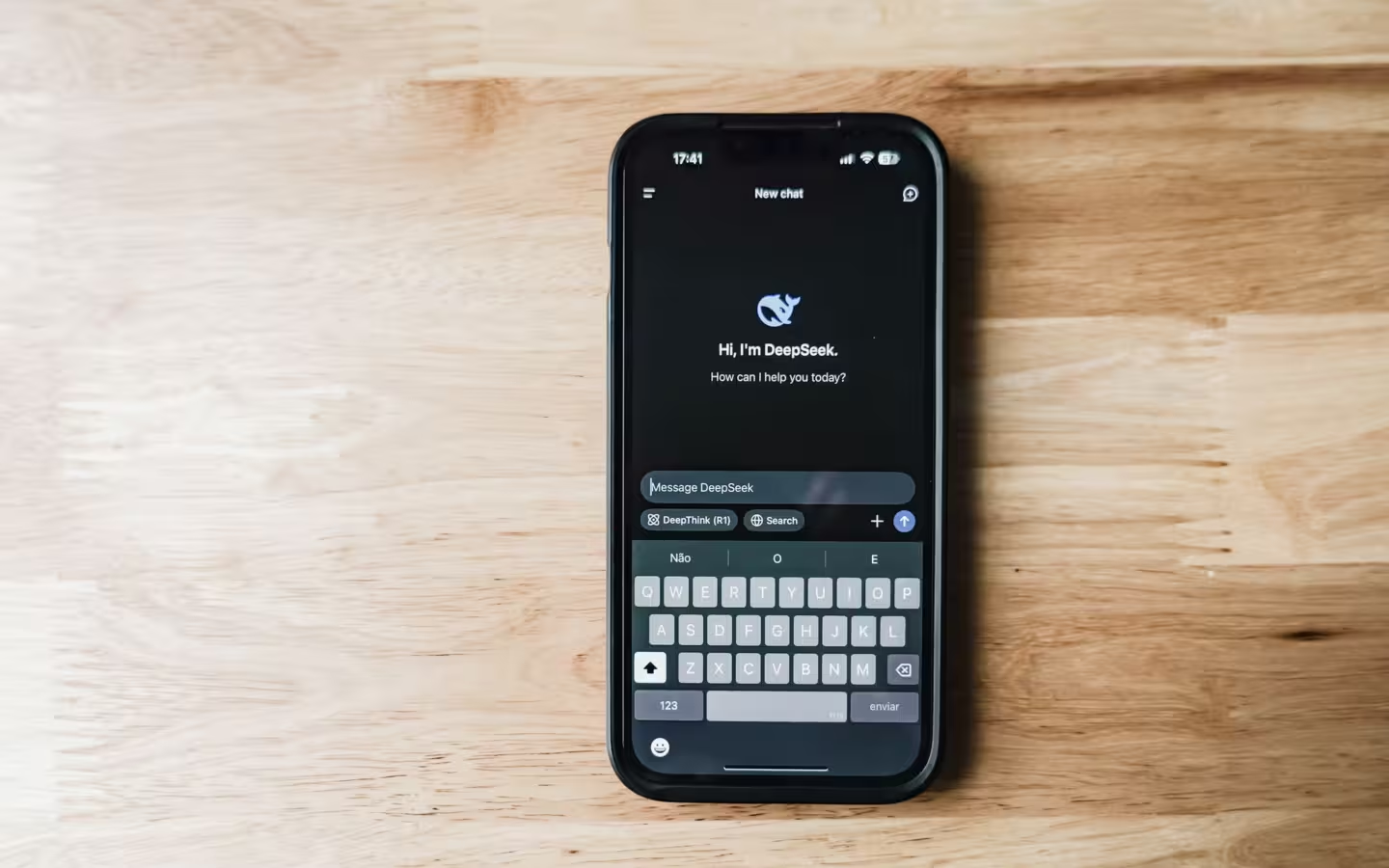
DeepSeek released its V4.1-Flash-1017 model checkpoint on 17 October 2026, making it available on its website, app and API while opening its Search and Fetch APIs to developers, MarkTechPost reported. The checkpoint replaces the earlier version behind the existing deepseek-flash API name. DeepSeek says it completes tasks faster and produces shorter responses than the September release, alongside higher scores in its own evaluations.
Key points
- DeepSeek’s benchmark table gives the new checkpoint 77.0 on DeepSWE v1.1, compared with 74.2 for the previous V4.1-Flash.
- The model remains available through the deepseek-flash API name and is tuned for DeepSeek Harness and Tencent tools.
- Search and Fetch each cost $0.75 per 1,000 successful requests, with a temporary free window for specified server-side calls.
DeepSWE scores for V4.1-Flash-1017
DeepSeek’s table puts V4.1-Flash-1017 at 77.0 on DeepSWE v1.1, against 74.2 for the previous checkpoint, according to MarkTechPost. DeepSeek ran that evaluation in Mini-SWE-V2, an agent environment for software-engineering tasks. The same company table gives the new checkpoint 42.3 on Terminal-Bench 4.0, run in Claude Code, against 31.2 for its predecessor. Those figures describe performance in the stated test environments, where the model’s surrounding software is part of the conditions under which it works.
The opening summary of a Startup Fortune report instead assigns a 74.2% pass rate on Deep-SWE v1.1 to the new 1017 model. MarkTechPost reports 77.0 for the new checkpoint on DeepSWE v1.1.
DeepSeek attributes its improvement in complete-project work to reinforcement learning with self-feedback. Its selected examples include creating a game and making 3D models. Separately, Kingy AI ran a hosted pilot on 17 October with seven fixed tasks repeated twice for each of four models. The test produced 56 first submissions and eight feedback revisions, judged against executable checks rather than by a human acceptance panel.
DeepSeek’s checkpoint passed all 14 of its first submissions in that pilot, as did the two other models that reached the test’s ceiling. Kingy AI measured a median of 2.47 seconds for DeepSeek on its ordinary tasks, excluding the repair sessions. Its requests ran serially through a gateway, and the publication says routing, network conditions, caching and providers’ serving systems affect those timings. The pilot supplies a small, independently run check on bounded tasks rather than a measure of the broader speed claim.
The V4.1-Flash backbone and DeepSeek Harness
The 1017 release is a post-training checkpoint of V4.1-Flash rather than a new underlying design. The V4.1-Flash technical specifications reported by MarkTechPost describe a mixture-of-experts model with a 552B-parameter backbone and 196B Engram parameters. It activates 8B parameters per token while processing an incoming prompt and 16B while generating an answer. Think of a large workshop in which a job goes to selected benches: the whole workshop exists, but every bench need not work on every item. The reported context window is 1M tokens, with output of up to 384K tokens.
DeepSeek says the checkpoint is optimised for DeepSeek Harness, Tencent CodeBuddy and WorkBuddy, and recommends Harness v0.2.1-rc.1 or later. That matters for developers assessing the release: the company’s benchmark environments and its recommended software are concrete configurations, while an application using a different agent setup would have its own tasks and timings. The September V4.1-Flash weights are MIT-licensed on Hugging Face. MarkTechPost says the 1017 checkpoint weights have not been disclosed.
Search and Fetch cost $0.75 per 1,000 calls
The Search API returns ranked web results for a query, while Fetch retrieves one page in Markdown, a text format an agent can process. They give developers two distinct operations alongside the model: finding a page and obtaining its contents. Each endpoint costs $0.75 per 1,000 successful requests. Empty results and failed requests are free, and the stated limit is 5 queries per second per account for each API.
Looking up a web page while preparing an answer could use Search to find relevant results and Fetch to retrieve one result’s contents. If both operations succeeded through the paid endpoints, each could contribute to the request charge. That would make the price of obtaining current page content a separate consideration from the price of generating the answer.
For the base model, peak API rates are $0.30 per 1M cache-miss input tokens and $1.20 per 1M output tokens, with off-peak rates at half those prices. Those token rates apply to model use rather than to Search or Fetch requests. Developers already calling deepseek-flash receive the updated checkpoint through the same model name, so the change in what runs behind that name can reach existing integrations as well as new ones.
DeepSeek will keep server-side Search and Fetch calls through DeepSeek Harness, Claude Code or Codex free until 1 November 2026.