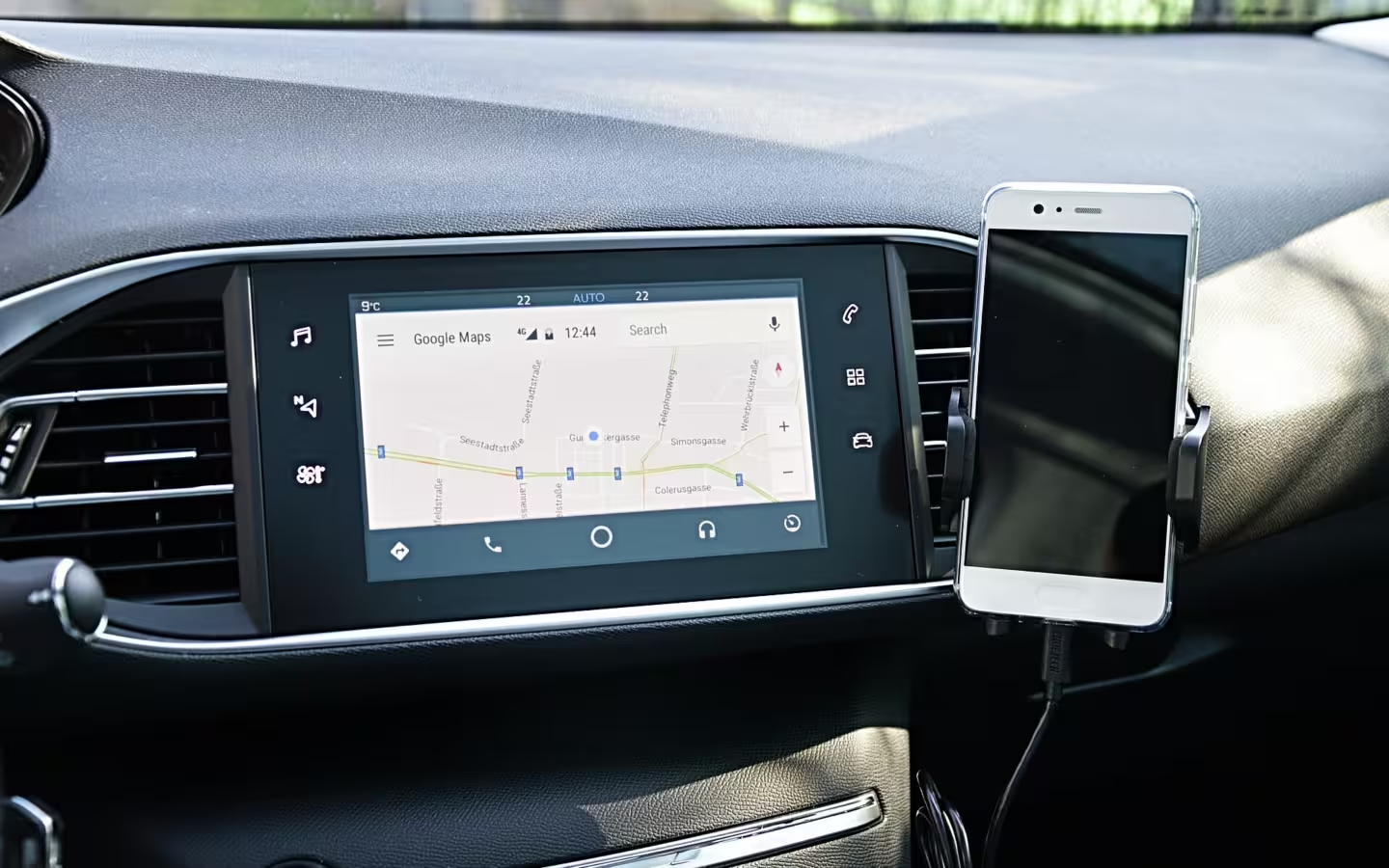
Google began rolling out Gemini Personal Intelligence on Android Auto on 20 October 2026, according to a company announcement published that day. The feature lets the assistant use information from a driver’s Google apps to answer spoken requests in the car, such as finding a destination from an appointment or a saved photograph. Google says cars with Google built-in will receive it in the coming months. Gemini was already available on both vehicle platforms; this release adds access to personal information when the feature is enabled.
Key points
- Google says Personal Intelligence began rolling out on Android Auto on 20 October.
- With permission, Gemini can draw on Workspace, Photos, Maps, YouTube and Search to answer requests in the car.
- Personal Intelligence is optional and can be turned off in Gemini settings.
- Google says cars with Google built-in will receive the feature in the coming months, with a connected phone required for personalised responses.
Gemini draws on emails, photos and Maps
Personal Intelligence connects information from Google Workspace, including Gmail and Calendar, as well as Google Photos, Google Maps, YouTube and Search, with the user’s permission. Google describes two uses for those connections: retrieving a particular detail, such as one in an email or a saved place, and combining information from different sources to answer a request. The distinction matters in a car, where a spoken question may depend on information that would otherwise have to be found in another app.
For a flight, Google says Gemini could find the gate from a confirmation email and answer a question about whether the flight is on time in the same exchange. It gives a different example for navigation: a request to go to a doctor’s appointment, without speaking the address. Those are Google’s examples of intended behaviour, rather than measurements of how often the assistant retrieves the right information during a drive.
Checking a flight gate on the way to the airport could become a spoken request instead of a search through a confirmation email followed by a separate question about flight status. Finding the address for an appointment could work the same way if the relevant details were available through the connected apps. In both cases, the change would be in what information the request could draw on, rather than in the words needed to ask it.
Google also proposes asking for directions to a car wash identified from a photograph, or for a restaurant along a route that fits a usual preference. The photograph example depends on retrieving a particular item from Photos and using it for navigation; the restaurant example asks Gemini to apply personal context to a recommendation. Both require more than recognising a destination named aloud, though the announcement presents them as examples rather than results from a road test.
Android Auto inherits Gemini’s opt-in setting
Personal Intelligence predates its arrival in cars. Google introduced the Gemini feature at the start of 2026 and extended it to free accounts in March, after initially limiting it to Google AI Pro and Ultra subscribers, Engadget reported. The Android Auto rollout therefore brings an existing set of app connections into another place where Gemini can respond, rather than requiring a separate kind of personal profile for driving.
Google says the apps remain unconnected until the user enables Personal Intelligence, and that the feature can be switched off in Gemini settings. People who have already enabled it in the Gemini app will carry that preference into the car. Engadget reported that users can also control which apps Gemini accesses. The choice covers the information available for tailored answers, not whether Gemini itself can be used while driving.
Without Personal Intelligence, Google says Gemini can still handle navigation, music, calls and general questions in the car, but its answers will not be tailored to the user. That leaves a practical boundary around the new capability: a request for directions can still be made, while a request that relies on an address in a personal appointment would need the relevant connection.
Google dates the start of the Android Auto rollout to 20 October. AndroidGuys reports a 19 October start. Engadget reports that availability excludes Switzerland, the European Economic Area, the UK and Nigeria.
Google built-in requires a connected phone
Google plans to bring Personal Intelligence to cars with Google built-in in the coming months. Google built-in is the other vehicle platform named in the announcement, alongside Android Auto, and Gemini is already available on both. For those building experiences around the assistant in cars, the staged rollout puts personalised spoken requests on Android Auto before the equivalent capability reaches vehicles with Google built-in.
The permission setting follows the user into the car if it has already been enabled in the Gemini app, according to Google. That makes the existing app preference consequential in a new setting: information connected for a personal response elsewhere can also inform a response during a drive. For cars with Google built-in, Google says personalised responses are shared only when the driver is in the car with their phone connected.