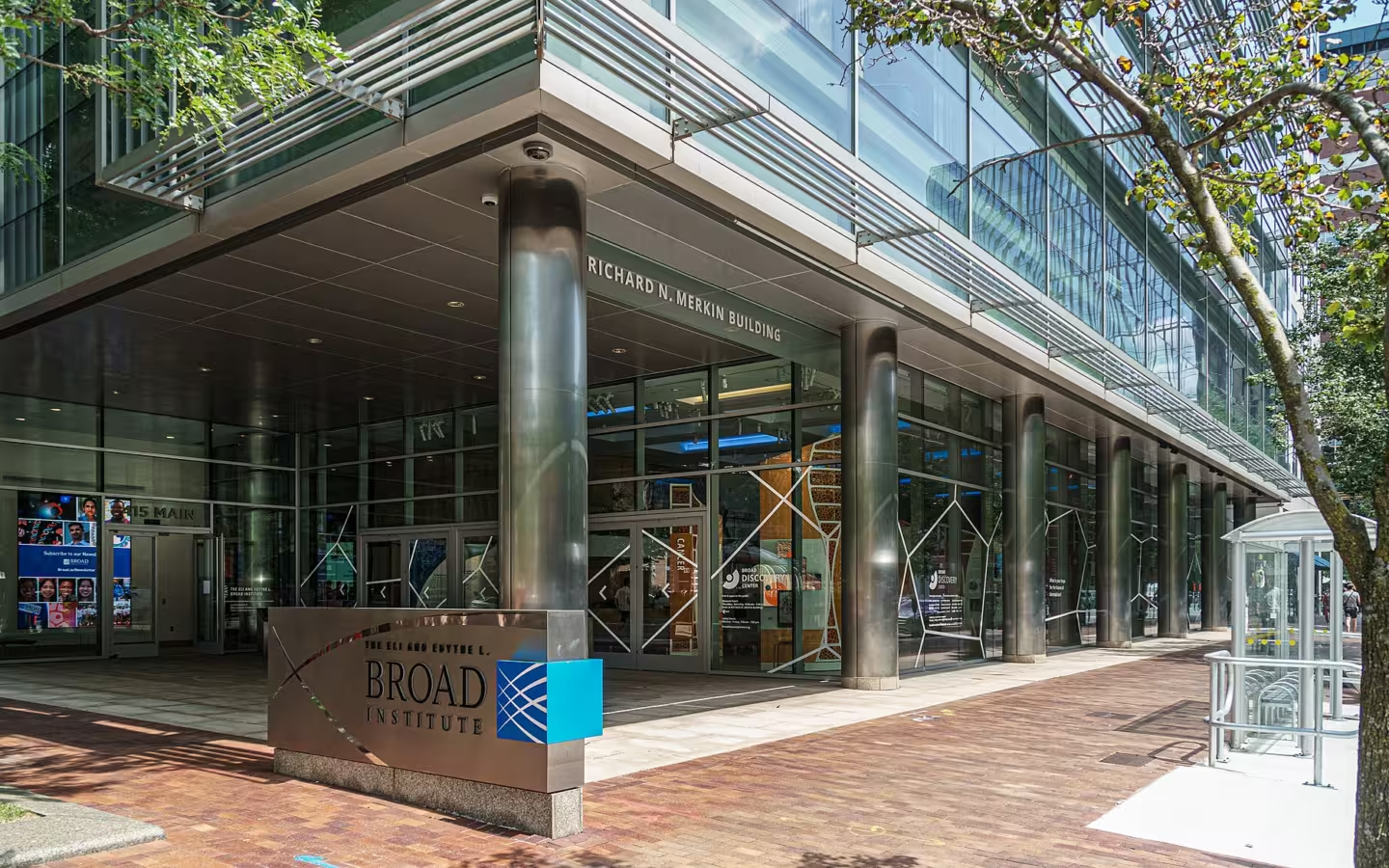
Microsoft Research introduced Quine on 29 September 2026, describing it as an experimental AI research system designed to connect different kinds of biological evidence. Microsoft used Quine in collaboration with researchers at the Broad Institute of Harvard and MIT to prioritise compounds and validate several leading candidates in laboratory assays.
Key points
- Microsoft says Quine learns from biological sequences, structures, functions, cellular states and images together.
- In pancreatic cancer experiments, the company says compounds ranked highest by Quine produced the largest intended shifts in tumour-cell state.
- Microsoft describes Quine as research technology whose outputs require scientific review and experimental validation.
Quine connects biological data across scales
Quine has two components. Microsoft calls one a world model of biology: a system intended to represent a biological state and predict how it might change following an intervention. The other is an interactive harness connecting the model to reasoning and orchestration models, scientific tools, published research and researchers. A question can lead to proposed experiments, whose measurements can then inform the next round of work.
Microsoft says the world model learns shared representations from sequence, structure, function, cellular-state and imaging data. These are different views of biology, from molecular information to observations of cells. Learning from them jointly is meant to let evidence in one form inform a prediction in another — rather like aligning maps of the same place drawn at different scales. The company says this approach improves the model’s ability to generalise across biological tasks.
Choosing what to test in a laboratory would still depend on experiments, but predictions drawn from several kinds of biological evidence could help put some candidates ahead of others for testing. That is the role Microsoft sets out for Quine: using computation to narrow possible paths before committing laboratory time, then bringing the measurements back into the research process.
The distinction matters because Microsoft describes a system for guiding experiments, rather than one that can derive their results without running them. In the company’s account, the model need only make experimental choices more useful; it need not represent biology perfectly. Its proposed cycle begins with a research question and returns to the researcher after an experiment produces measurements.
Pancreatic cancer compounds ranked in one weekend
Microsoft’s example comes from pancreatic ductal adenocarcinoma, or PDAC. The company and Broad Institute researchers have spent years investigating whether a tumour’s response to drugs depends partly on its transcriptional cell state, as well as its genetics. Those states describe patterns of activity within tumour cells. In PDAC, the researchers are interested in whether changing a state could offer a useful way to intervene.
Microsoft says it used Quine to predict and rank thousands of compounds by their potential to move tumour cells between states associated with treatment response. For laboratory studies of a transition from classical to basal states, the company says the highest-ranked compounds produced the largest intended changes across experimental assays. It reports validating several leading candidates in more than one wet-lab assay.
That measurement concerns changes in cell state under experimental conditions. Microsoft says the process of reducing the pool of compounds and selecting a handful for laboratory validation took one weekend, and estimates that it could save months of experimental work and significant research costs. The timing refers to prioritisation, while the reported assays test whether the predicted changes occurred.
The direction of the change also mattered. Microsoft says moving cells the other way, from basal to classical states, proved harder, and that Quine had predicted a weaker effect from the available compounds. Some of the stronger effects in its experiments came from compounds whose mechanisms of action the researchers had not expected, according to the company. It describes those results as early evidence for possible drug-repurposing and discovery opportunities.
Microsoft describes the work as an application of a longer collaboration using patient-derived models studied outside the body. In this example, Quine’s task was to select compounds worth examining for a particular change in tumour-cell state. The reported results concern those experiments and the state changes measured in them.
Quine Fellows and research-only use
Microsoft describes the Quine Fellows programme as a way for a cohort of scientists to gain access to the system, pursue their own research and provide feedback. The company also expects access to expand through products such as Microsoft Discovery as the technology matures.
The programme sits alongside a restriction on what the technology is for. Microsoft says Quine is experimental and intended only for research, not clinical or medical use. The company says its outputs may be incomplete or inaccurate and must be checked by suitably trained researchers through scientific scrutiny and experimental testing.