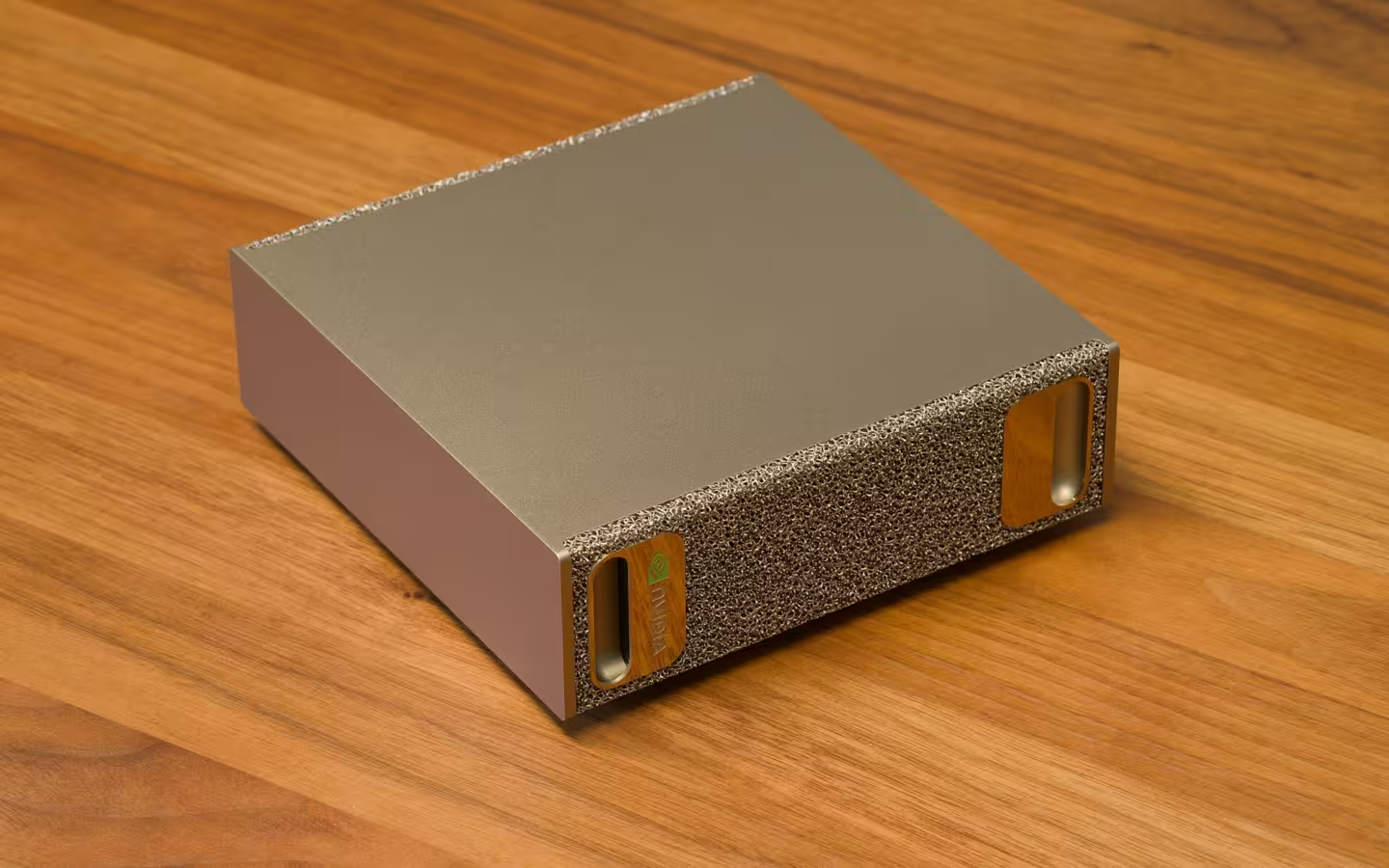
Nvidia introduced a 64GB DGX Spark configuration on 2 October 2026, saying in its announcement that it will be available from 23 October at a starting price of $4,999. The smaller-memory system retains the GB10 Grace Blackwell Superchip used in the 128GB version, while a software assistant lets two units share work across a direct connection.
Key points
- The 64GB model starts at $4,999 and is due from six hardware partners on 23 October.
- The 128GB DGX Spark rose to $6,950 on 2 October, The Register reported.
- Nvidia says one 64GB unit supports models with up to 100 billion parameters entirely on the device.
- Nvidia says two connected units pool 128GB of memory and support models with up to 200 billion parameters.
The 128GB DGX Spark reaches $6,950
The 128GB DGX Spark rose to $6,950 on 2 October, nearly 75 per cent above its launch price, The Register reported. It attributed the increase to rising memory prices. The new configuration offers a lower starting price than the current 128GB machine, though it has half as much working memory.
Price expectations for the platform have shifted before. When Nvidia presented the system as Project Digits at CES 2025, its expected price was around $3,000; the eventual selling price was approximately $4,000, according to The Register. The 64GB model’s $4,999 starting price is therefore a cheaper way into the range as it stands now, rather than a return to its original price.
Nvidia says Acer, ASUS, Dell, Gigabyte, HP and MSI will offer the 64GB configuration exclusively through their hardware ranges. The company positions it for local inference, agents and other development work, with the same DGX OS and AI software stack as the larger model. That common platform matters to work begun on one configuration and later run across connected systems.
GB10 runs models within 64GB of memory
The GB10 Grace Blackwell Superchip combines with unified memory and Nvidia’s CUDA-accelerated software in the compact DGX Spark system. Unified memory is working space shared by the system’s computing components: a model must have room there while it runs, much as a large document needs space on a desk before it can be laid out and examined. Nvidia says the 64GB configuration supports models with up to 100 billion parameters running wholly on the device.
Nvidia includes document analysis among the tasks it envisages for a locally running agent. It says the system can run such work without depending on a cloud instance for every request, provided the chosen model fits in its memory. The parameter count describes the size of a model, while the amount of memory available determines whether the system has room to run it.
Checking a document for details could take place on the device if the work fits in its memory, rather than depending on a cloud instance for each request. The analysis could remain with the local system while it processes the document.
The smaller memory capacity does change which work the machine suits. The 64GB version is less well suited to some tasks, including fine-tuning, while its memory bandwidth remains 273 GB/s. Nvidia lists inference software including Ollama, vLLM and PyTorch among the tools supported by DGX Spark, giving developers ways to run models on the device.
ConnectX-7 links two 64GB systems
Each DGX Spark has a ConnectX-7 network interface. Nvidia says two 64GB units can be joined directly with a QSFP cable, pooling their memory to 128GB and supporting models with up to 200 billion parameters. The machines remain separate systems connected by a network; Nvidia’s software arranges for a model to run across them when it needs the combined capacity.
Nvidia says the paired systems also provide twice the memory bandwidth. For performance, the company tested Qwen 3.8 27B on two clustered 64GB units against a single unit and reported up to 1.7 times the performance. That result concerns the named model and test arrangement, while the higher parameter limit describes the capacity Nvidia says the paired machines can support.
Nvidia Sync Cluster Assistant detects the connected machines, checks their configurations and sets up the ConnectX-7 network, the company says. The connection still requires a cable and the assistant to be launched. Previously, setting up clustering involved command-line work and adjustments to inference software launch commands, The Register reported.
Cluster Assistant itself was introduced in a June software update, CGMagazine reported. Nvidia says the software environment stays consistent as a project moves from one DGX Spark to two, allowing the additional memory and compute to serve work that has grown beyond a single unit.
Nvidia plans to make Sync Model Launcher available at the end of October. The company says it will let developers download and launch Qwen3.8 27B on one DGX Spark or a cluster, configure access from a laptop and set up OpenCode for coding in a browser.