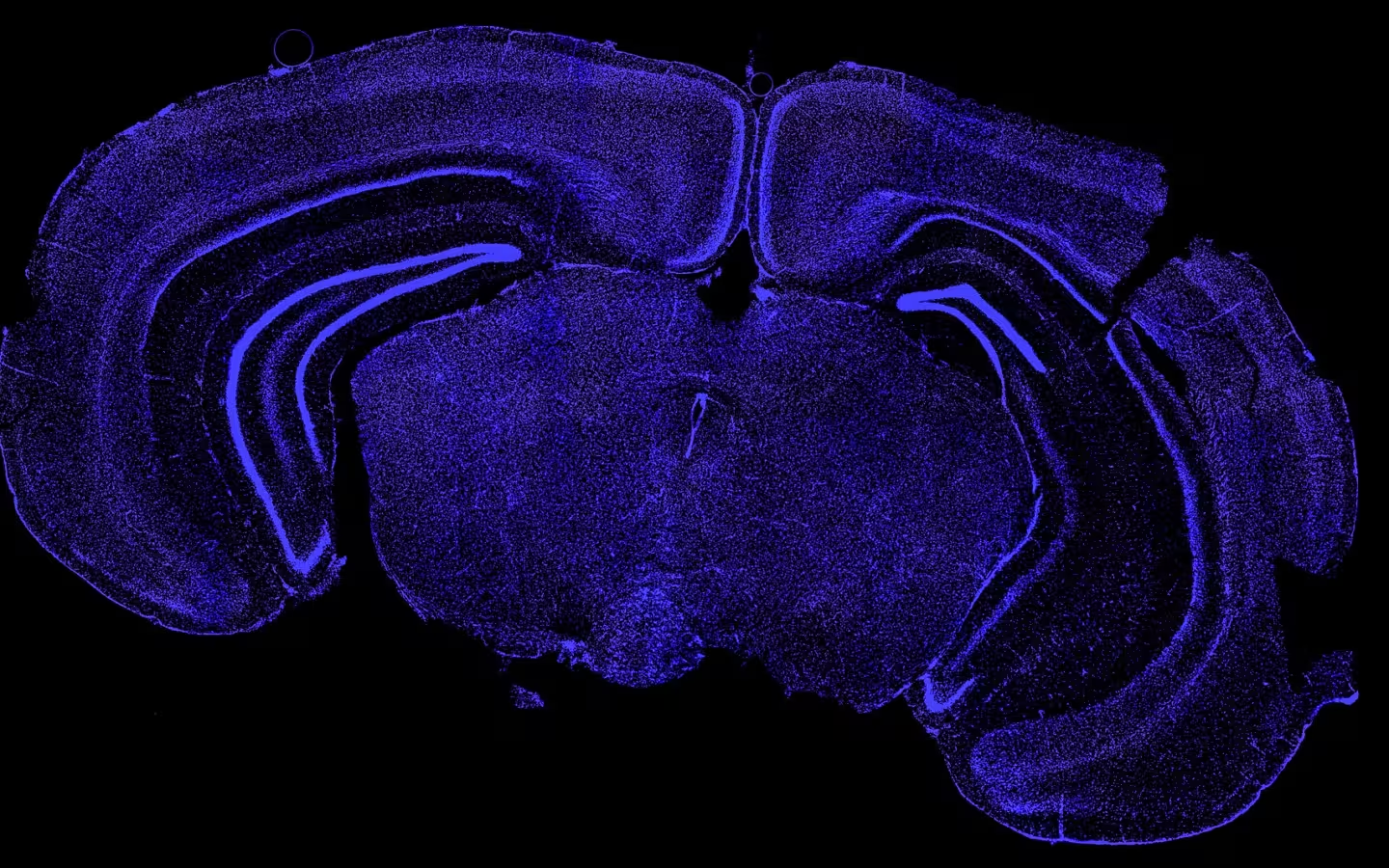
OpenAI, PerturbAI and Scripps Research said on 21 October 2026 that thousands of GPT-Rosalind agents had analysed experimental data from millions of mouse brain cells in 32 minutes. In its research announcement, OpenAI described an approach that assigns agents separate gene disruptions, then brings their findings together so scientists can investigate possible explanations for what happened in the cells.
Key points
- Agents examined cellular responses and scientific literature for separate gene disruptions.
- At the largest workload, OpenAI says the distributed agents cited more than 700 references, against 11 for one agent.
- Blinded experts preferred distributed-agent reports in 75% of comparisons, according to OpenAI.
- The resulting leads concern brain-cell responses to Tsc2 and Dctn1 disruption.
GPT-Rosalind divides the mouse brain atlas
The starting point was a whole-brain CRISPR atlas: experimental measurements of how disrupting genes affects different cell types across the mouse brain. CRISPR is a method for altering genes. OpenAI says each GPT-Rosalind agent took a gene disruption, examined the cells’ responses, searched published research and proposed an explanation. The team then assembled those reports into a separate “reasoning atlas” connecting genes, observed effects, publications and possible biological mechanisms.
Looking up why a result changed would begin with the measured change and the research that might explain it. Dividing that search among agents could bring together candidate explanations for many gene disruptions at once, while each proposed explanation would remain something to test rather than an experimental finding of its own.
The dataset contains 7.7 million cells, with single-nucleus profiling across 19,070 mRNAs and 8,588 sgRNAs, Unite.AI reported. Those measurements give the agents both the gene disruptions to investigate and the cellular responses to explain. OpenAI says the agents recovered findings from human analyses and produced additional leads; the 32-minute figure describes the agent analysis of existing experimental data.
OpenAI says the research team estimated that doing comparable analysis and literature review one disruption at a time would take months to a year. That estimate concerns a human workflow, while the timed run concerns agents working in parallel. The agents’ output is a set of interpretations drawn from measurements and published work, which OpenAI says can help researchers choose further experiments to test the proposed mechanisms.
More than 700 references at the largest workload
OpenAI also compared the distributed approach with a single agent given the entire dataset, keeping the model and resources fixed. At the largest workload, it says, the separate agents cited more than 700 references between them, while the single agent cited 11. As the workload grew, OpenAI says the single agent searched less of the literature. Giving separate agents separate disruptions is rather like handing out different folders from an archive: the searches can proceed at the same time, and their findings can be gathered afterwards.
In blinded comparisons reported by OpenAI, human experts preferred the distributed-agent reports to the single-agent reports 75% of the time. OpenAI also says expert judgments aligned with the agents’ assessments of novelty and scientific value. The preference result concerns the reports those experts reviewed; the references figure measures how much literature the two approaches cited at the largest tested workload.
A companion preprint was posted on bioRxiv on 16 October 2026 and has not been certified by peer review, Unite.AI reported. Its authors are affiliated with Scripps Research, OpenAI, PerturbAI, the Howard Hughes Medical Institute and the University of California San Diego. The preprint reports tests in which agents recovered conclusions without access to the source manuscript and predicted perturbation effects held back from them.
The work also extends OpenAI’s activity around Rosalind beyond this atlas. AI Affairs previously reported its acquisition of Orchestra Bio to add drug-development agents to Rosalind. Here, the agents’ assigned task was to connect cell measurements with scientific literature and produce leads for experimental follow-up.
Tsc2 and Dctn1 provide leads to test
One lead concerns Tsc1 and Tsc2, genes that work together to regulate mTOR, which is involved in cell growth and metabolism. OpenAI says disrupting either gene produced similar effects in several groups of neurons, but their responses diverged in the cerebellum. There, disrupting Tsc2 changed the activity of dozens of genes involved in neuronal communication, while disrupting Tsc1 produced little change.
OpenAI connects that difference to tuberous sclerosis: it says cerebellar abnormalities in people with the condition are strongly associated with TSC2 mutations. The agents identified a group of neurons and cellular changes for further investigation. OpenAI frames the next questions around which changes existing medicines might correct and which might require a different approach, rather than reporting that the agents tested a treatment.
Another lead starts with DCTN1, a gene involved in moving cargo inside neurons whose mutations cause Perry syndrome. OpenAI says disrupting Dctn1 in the atlas increased activity in genes involved in making cholesterol. The agents linked that observation to research on cholesterol transport and proposed testing whether the disruption changes where cholesterol sits within neurons, and whether such changes contribute to neurodegeneration. OpenAI says human experts considered the hypothesis worth following up.
The reasoning atlas and the underlying Distributed Agents framework are available in a repository under an MIT licence, Unite.AI reported. The repository includes notebooks for the manuscript’s analyses and figures, alongside instructions for running the framework locally through the Codex CLI.