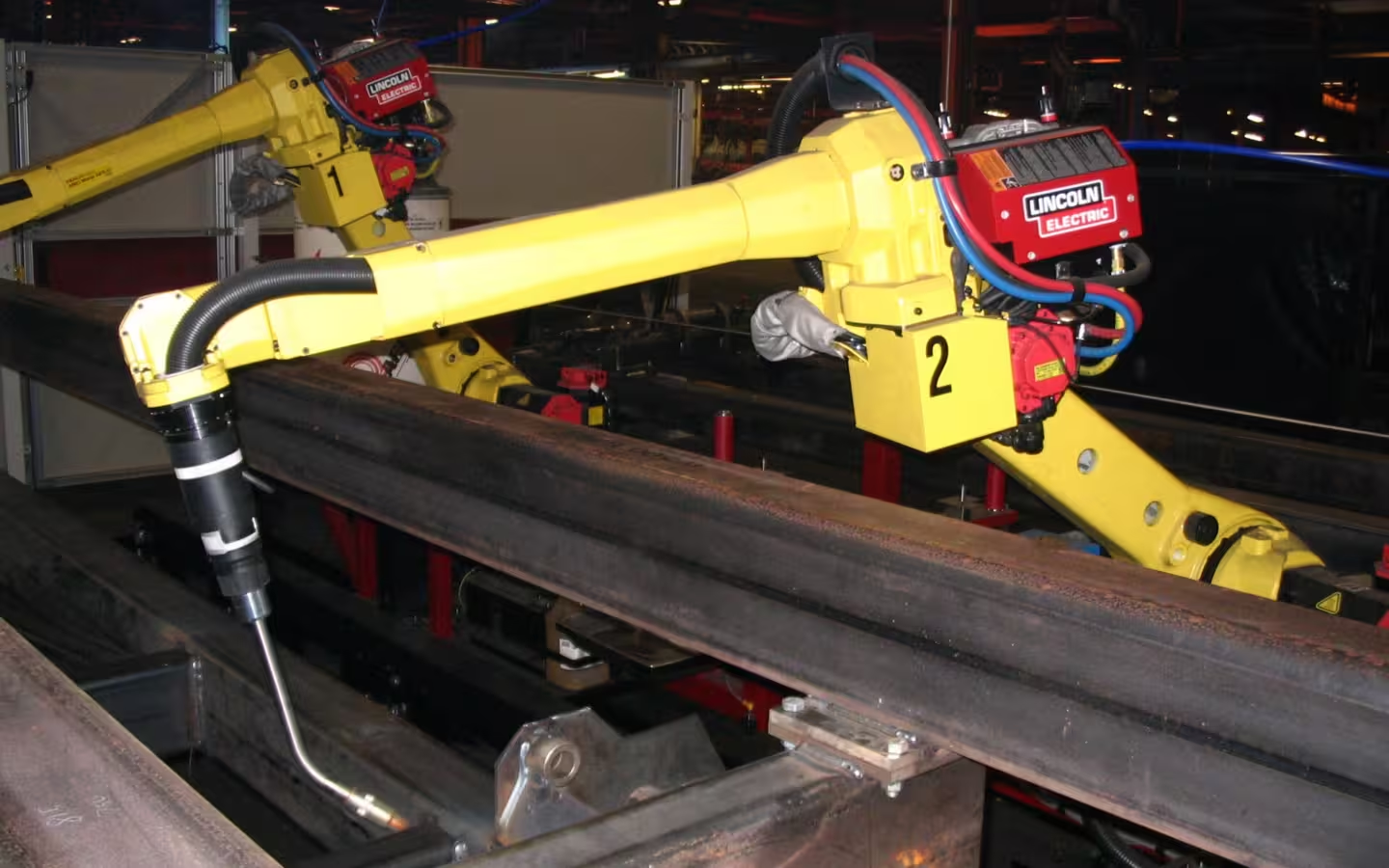
Hitachi and Fanuc signed a strategic partnership on 30 September to develop physical AI for manufacturing, with customer deployment planned from fiscal 2027, the companies said in a joint statement.
Key points
- Hitachi factories in Ibaraki will host trials using Fanuc industrial robots.
- The partners plan to establish technology for production sites by fiscal 2027 and begin deploying solutions to customers across nine sectors in that fiscal year.
- The trials will assess recognition accuracy, robot motion, production time and quality.
Hitachi’s Ibaraki factories host joint trials
Hitachi will use its manufacturing facilities in the Ibaraki region for the initial joint trials. The companies call these factories their “Customer Zero” sites: the planned system will learn rules specific to each production site while operating in a factory. Hitachi and Fanuc aim to establish technology suitable for use at manufacturing sites by fiscal 2027.
The work will include picking parts with different shapes and changing production equipment when a factory switches products. In the joint trials, the partners plan to assess recognition accuracy, robot motion, takt time — the allotted time for a product or task — and quality. They said they will use the results to improve the system.
Those tasks are central to the companies’ stated purpose. Hitachi and Fanuc said manufacturers still rely on workers’ judgement for parts handling and changeovers when conditions or workpieces vary. They intend to develop systems that can adapt to such changes, rather than repeat a fixed sequence of actions.
The factories will also be used to test whether learning from production activity helps the system handle conditions that imitation learning or digital-twin simulations alone cannot address, according to the companies. The agreement puts that work inside Hitachi’s own manufacturing operations before the partners begin their planned customer rollout.
HMAX Industry meets Fanuc’s industrial robots
Hitachi will contribute AI technologies including HMAX Industry and its physical AI models. Fanuc will supply industrial robots and robotics AI technology. The partners also plan to test Hitachi’s edge AI semiconductor with Fanuc robots as part of the validation work.
The planned system extends beyond a single robot task. Hitachi and Fanuc said they want machines to respond to changes across individual processes, production lines and factories. Their proposed applications include parts supply as well as changeovers when a production line moves to another model.
Hitachi President and CEO Toshiaki Tokunaga said the companies intend to support customers from installation through operation and continuing improvement. Fanuc President and CEO Kenji Yamaguchi said the use of Hitachi factories would help the partners develop systems that operate in production environments. Tokunaga cited labour shortages, while Yamaguchi cited labour shortages and skills transfer.
The partnership follows Japan’s launch of a cross-manufacturer data initiative for physical AI development. Hitachi and Fanuc are pursuing factory trials using their own technology and installed equipment before offering solutions to other manufacturers.
Fiscal 2027 rollout targets nine sectors
Hitachi recorded revenue of 10.5867 trillion yen ($67.4 billion) for the fiscal year ended March 2026, International Business Times reported. Fanuc recorded sales of 857.8 billion yen ($5.5 billion) for the same period. The companies plan to use their global installed bases to reach customers once the joint validation has advanced.
The agreement covers joint validation and deployment rather than a customer installation. Hitachi and Fanuc said the work is intended to help manufacturers automate activities that remain dependent on manual labour or skilled workers’ experience. Their factory trials will concentrate on whether the combined technologies can perform those activities under changing production conditions.
Hitachi and Fanuc plan to begin deploying solutions to customers in fiscal 2027 across semiconductors, pharmaceuticals, healthcare, advanced materials, automotive, logistics, food, shipbuilding and agriculture.