Samsung SDS said on 2 November that construction was under way on a 60 MW AI data centre in Gumi, South Korea, designed to expand to 120 MW in phases, the Korea Herald reported. The company plans to use the facility for Samsung affiliates’ AI computing and to offer GPU services and space for outside customers’ equipment.
Key points
- The Gumi centre is designed to expand from an initial 60 MW to as much as 120 MW.
- Samsung SDS approved a 427.3 billion won ($319 million) investment in January.
- The company was also selected as preferred bidder for a separate data centre project exceeding 200 MW.
Gumi design allows a 120 MW expansion
The facility will occupy a 46,000-square-metre site in Gumi, North Gyeongsang Province. Samsung SDS approved an investment of 427.3 billion won ($319 million) in January and signed an agreement that month with the provincial and municipal governments. The company said Gumi authorities approved construction in late August.
The proposed 120 MW capacity is a ceiling for phased expansion, rather than the power available when the centre first opens. Samsung SDS has not disclosed how much capacity it plans to assign to affiliates or outside customers, or when it intends to expand beyond 60 MW, the Korea Herald reported.
The Gumi project falls under Samsung Group’s 60 trillion won investment plan for advanced manufacturing industries in southeastern Korea, announced in July. The plan includes robotics, batteries and AI infrastructure. Samsung SDS intends the centre to supply computing for affiliates training AI-powered robots to perform precision manufacturing tasks.
Samsung SDS plans GPU and colocation services
Samsung SDS also plans to sell GPU computing services to outside customers. Under its proposed colocation arrangements, customers would install and operate their own graphics processors at the Gumi site. That would give the company two routes to serving external demand: operating its own computing equipment and housing equipment owned by customers.
The centre’s design combines liquid cooling for equipment that generates substantial heat with air cooling for less demanding systems. Samsung SDS plans redundant power equipment and emergency backup systems to support the servers. The cooling and power systems are intended to handle the dense GPU installations used for AI workloads.
Samsung SDS’s cloud revenue rose 18 percent from a year earlier to 796.1 billion won in the third quarter, supported by demand for GPU-as-a-service offerings, the Korea Herald reported. At its earnings announcement on 29 October, the company also disclosed its selection as preferred bidder for a separate data centre project developed by Pacific Asset Management.
LG CNS completes a 30 MW Jakarta centre
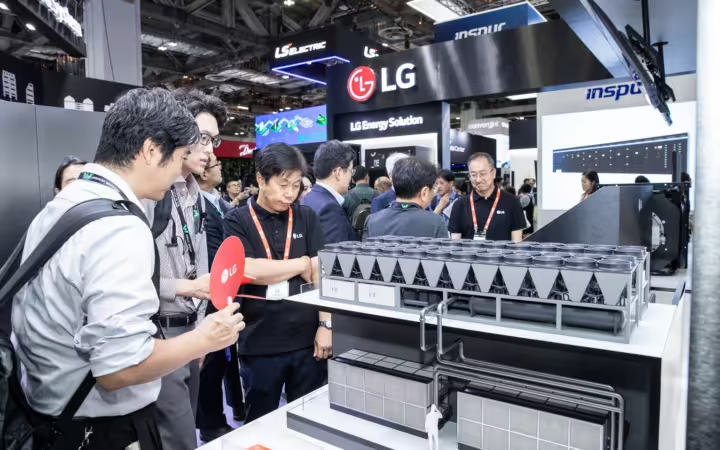
LG CNS has completed a 30 MW AI data centre in Jakarta, Indonesia, and secured customers for its entire capacity before completion, Chosun Ilbo reported. LG CNS provided design, construction and operation services for the overseas client. The project also uses cooling systems from LG Electronics and batteries from LG Energy Solution.
The Jakarta centre opened its first phase with air cooling. LG CNS plans to add liquid cooling in later phases and expects total power capacity to reach 400 MW once those phases are complete. Its power system is designed for equipment densities exceeding 300 kW per rack.
LG CNS plans to pursue further data centre business in the Asia-Pacific region, including Malaysia, Thailand, Vietnam, the Philippines and Japan. Its Jakarta project covers design, construction and operation, while Samsung SDS’s Gumi plans encompass both computing services and colocation.
Samsung SDS targets 500 MW by 2031
The Pacific Asset Management project for which Samsung SDS was selected as preferred bidder exceeds 200 MW. It is separate from Gumi, where the company has approved its own investment and begun construction. Samsung SDS aims to secure data centre design, construction and operation projects with a combined capacity of 500 MW by 2031.
Samsung SDS is scheduled to complete the Gumi facility by the end of 2028.