Carnegie China published a study of elite AI researchers on 23 September that puts China ahead of the United States as a workplace for authors in its 2025 cohort. It found 41% working in China and 34% in the US, reversing the order recorded for the 2022 cohort.
Key points
- In the 2022 cohort, 46% worked in the US and 27% in China.
- The share of Chinese-origin researchers working in China rose from 57% to 69%.
- The study defines its cohort through authorship of papers accepted at the NeurIPS conference.
- The US recorded a net gain of 2,145 researchers in the 2025 cohort, while China recorded a net loss of 1,729.
NeurIPS authors form the study’s sample
Damien Ma and Binyi Yang used authors of papers accepted at the Neural Information Processing Systems conference, known as NeurIPS, to compare where researchers were educated and where they worked. For the 2025 conference, NeurIPS accepted 5,823 papers listing 25,677 authors. The researchers used complete career histories for more than 10,000 authors, or 40% of the total, in their final results.
The study follows the approach of the earlier Global AI Talent Tracker produced by MacroPolo, which ceased operations in 2025. Its workplace measure is taken one year after each conference: 2023 for the 2022 cohort and 2026 for the 2025 cohort. The earlier cohort covers authors in the conference’s main and Datasets & Benchmarks tracks. The 2025 cohort also includes the Position Papers track.
Only authors with recorded undergraduate, graduate and employment histories entered the final sample. Carnegie China says that subset should not be assumed to be random, although its broader sample checks preserved the main US-China findings. The researchers used Claude Code and OpenAI Codex for much of the data processing and results generation, alongside human intervention and subsequent quality checks.
China retains 69% of Chinese-origin researchers
Carnegie China defines a researcher’s origin by the country in which they received their undergraduate degree. On that basis, Chinese-origin researchers accounted for 57% of the elite AI researchers in its 2025 results, an increase of 11 percentage points from 2022. The US-origin share fell to 13%. These figures concern where researchers began their higher education, rather than where they subsequently chose to work.
Among Chinese-origin researchers, the share working in China increased from 57% for the 2022 cohort to 69% for the 2025 cohort. Carnegie China puts the US retention rate at 89% and Europe’s at 60%. Ma and Yang suggest two likely contributors to China’s higher retention: jobs in its AI industry and tighter US visa restrictions, particularly for Chinese graduate students in science, technology, engineering and mathematics.
The US nevertheless remained a destination for researchers educated elsewhere. Its share of workers with undergraduate degrees from China rose by 4 percentage points in the 2025 results. Carnegie China recorded a net gain of 2,145 researchers for the US and a net loss of 1,729 for China. For every US-origin researcher working in China, there were 30 Chinese-origin researchers working in the US, compared with 46 in the 2022 results.
Peking University leads the institution ranking
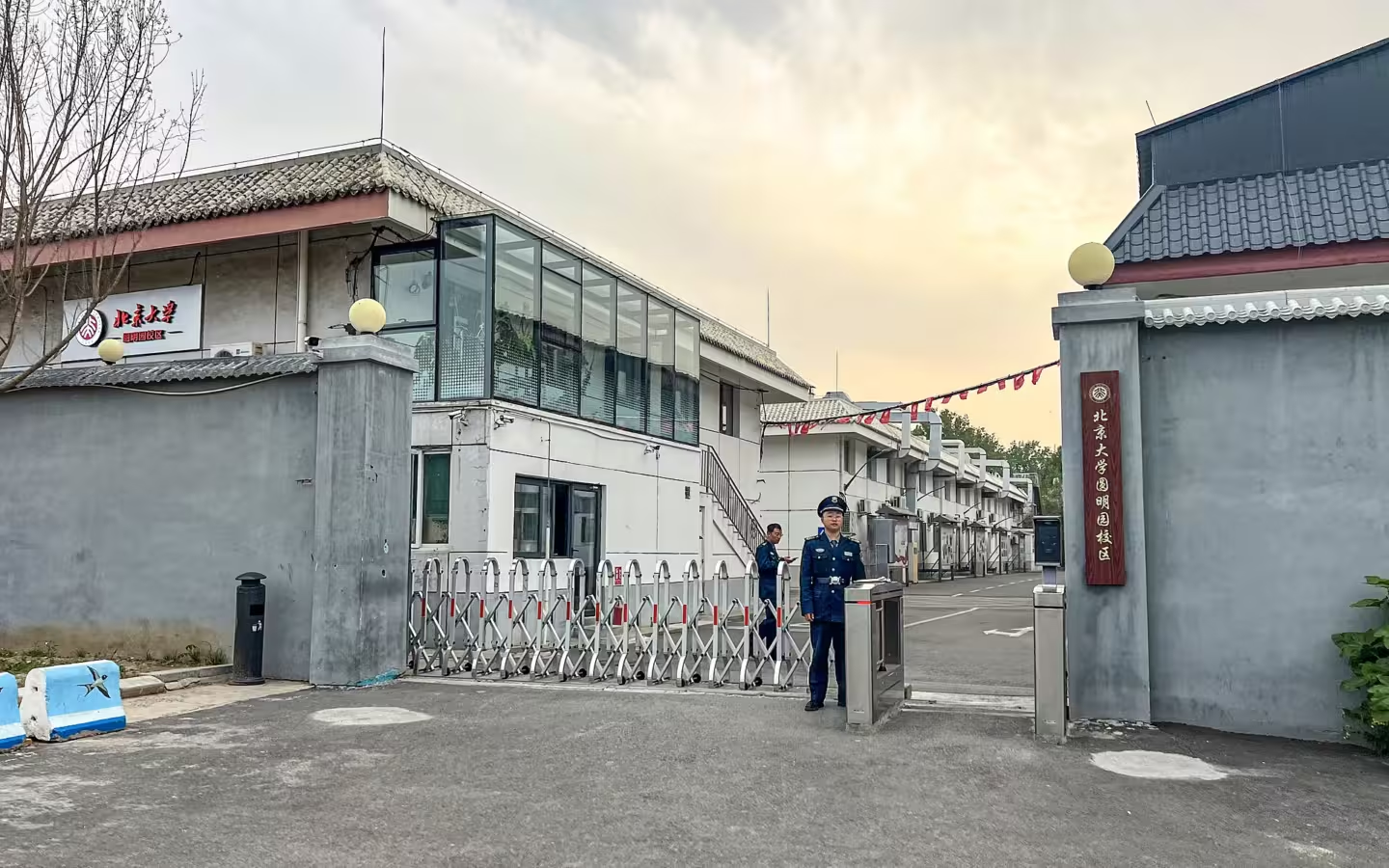
The institutional results also changed. Carnegie China places Peking University at No. 1 among its top 30 institutions for AI talent, with Google at No. 1 in 2022. South Korea’s KAIST rose twelve places to third. Carnegie China puts South Korea’s talent-retention rate at 77%, second only to the US among the places it ranked on that measure.
ETH Zurich and the University of Oxford both fell out of the ranking of leading institutions in 2025. Carnegie China found that Europe had become a slightly more attractive workplace for top researchers than it was in 2022, while its institutions lost ground in the ranking. India’s share of top AI talent fell by 2 percentage points, and the share of Indian-origin researchers working in the US also declined. No Indian institution appeared in the ranking in either year.
Singapore’s National University of Singapore and Nanyang Technological University both entered the top 20 institutions in the 2025 ranking. NUS placed 13th and NTU 16th, having ranked 25th and 29th respectively in 2022.


.jpg)