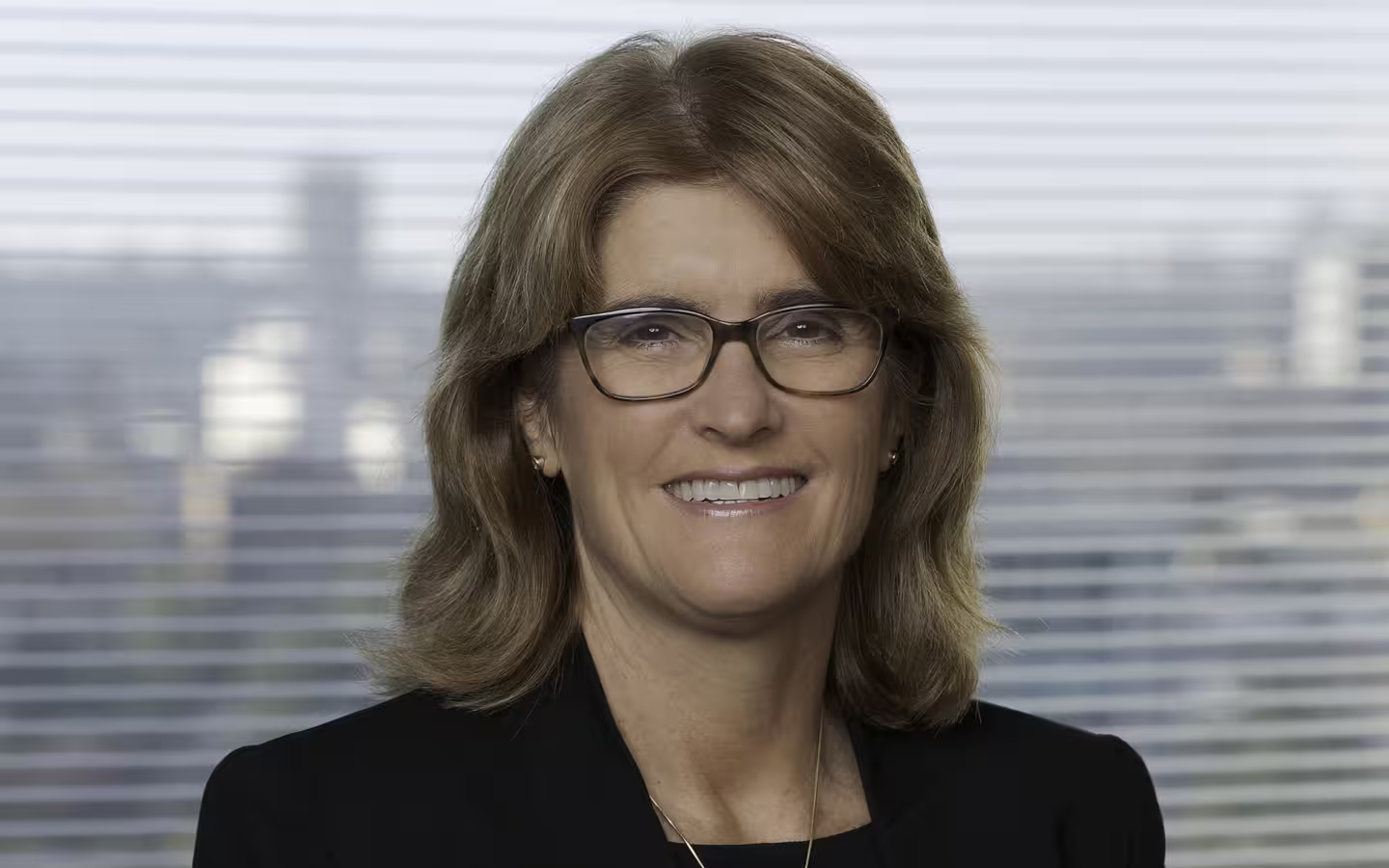
Reserve Bank of Australia governor Michele Bullock said on 22 September that AI investment was adding to demand in an economy already under inflationary pressure, while offering few signs of a productivity gain. Speaking at a CEDA event in Sydney, she also raised the possibility of an investment bubble, according to the Guardian’s account of her remarks. Her assessment came on the day the Australian government released a long-term economic report that placed considerable weight on AI’s potential benefits.
Key points
- Bullock said AI investment was adding to Australian demand ahead of any improvement in the economy’s supply capacity.
- She described an AI investment bubble as a risk central banks were watching, without taking a view on whether one exists.
- Reserve Bank staff estimated that Australian data centre operators had raised at least $35 billion so far in 2026, ABC News reported.
- The government’s intergenerational report projected higher per-person economic activity by 2066 on an assumption of stronger productivity growth.
Bullock puts demand ahead of productivity
Bullock said central banks had looked to AI as a way to make economies more productive, but had seen little effect so far. In Australia, she said, the speed of adoption and spending on data centres were adding to inflation instead. Her concern was about the order in which the costs and benefits might arrive: construction and other investment require resources now, while changes to the way businesses work may take longer.
“We’ve got this sort of awkward sequencing event at the moment where, in Australia at least, we are in a situation of excess demand and the AI boom is adding to that demand ahead of any potential supply impacts that it might have going forward,” Bullock said, according to ABC News. She told the Sydney event there were “very few signs yet” of an increase in the economy’s supply capacity.
Bullock cited research by the RBA’s South Korean counterpart in which employees adopting AI tended to produce the same output while working 1.5 hours less each week, the Guardian reported. She said productivity could decline while people experimented with the technology, but could improve once businesses redesigned their processes around it. The research she cited concerned employees’ output and hours, rather than a measured gain in Australian economy-wide productivity.
On valuations, Bullock was more guarded than the word bubble might imply. “Some people think it’s a bubble, some people don’t. I don’t have a particular view one way or the other, but it’s a risk that I think we’re watching,” she said. She also said a disorderly fall in technology values could damage economic activity.
Australian data centres raise at least $35 billion
A Reserve Bank staff note obtained by ABC News estimated that Australian data centre operators had raised at least $35 billion so far in 2026, compared with $24 billion across 2025. The note put the increase at 46 per cent and this year’s funding at more than seven times the annual average from 2020 to 2024. Its analysis covered Airtrunk, CDC, Firmus, Goodman, Macquarie Technology and subsidiaries of Stack Infrastructure and Equinix.
The note’s author, RBA analyst Bradley Speed, described the $35 billion estimate as conservative because some single-bank loans and private transactions might fall outside the data. The analysis covered syndicated loans, bonds, public and private equity, and some private transactions. Speed said the funding could serve as an early indicator of Australian data centre investment because operators generally obtain outside capital for large construction programmes.
Debt made up 85 per cent of the new funding obtained by Australian data centre operators in 2026, against estimates of 60 to 80 per cent in the United States, ABC News reported. Syndicated loans accounted for about $25 billion this year. Speed said long-term customer leases could provide operators with relatively predictable cash flows, while their real estate could be pledged as collateral.
The Reserve Bank’s August meeting minutes recorded the board discussing the possibility that AI and data centre investment could grow more than expected, with a risk of higher inflation. The staff note found little evidence so far that data centre borrowing had materially changed financing conditions for other Australian companies. Operators accounted for 16 per cent of funding raised by Australian non-financial companies across the markets included in its analysis.
The intergenerational report looks to 2066
The government’s 2026 intergenerational report described AI as a defining influence over the next 40 years. Released on 22 September, it allowed for a potentially “profound” contribution from AI in projecting that inflation-adjusted economic activity per person would rise from $99,200 to $157,300 by 2066, the Guardian reported.
That projection assumed productivity growth would return to its long-run rate of 1.2 per cent a year. Treasurer Jim Chalmers called AI “the most transformative thing that will happen in our lifetime” in an interview with the Guardian’s Australian Politics podcast. Bullock’s account of present conditions was narrower: investment was already raising demand, while the productivity improvement on which longer-term hopes rest had scarcely appeared.
Economists cited by the Guardian considered the report’s productivity assumption unlikely. If annual productivity growth reached only 0.8 per cent, inflation-adjusted economic activity per person would reach only $136,600 by 2066, the Guardian reported.