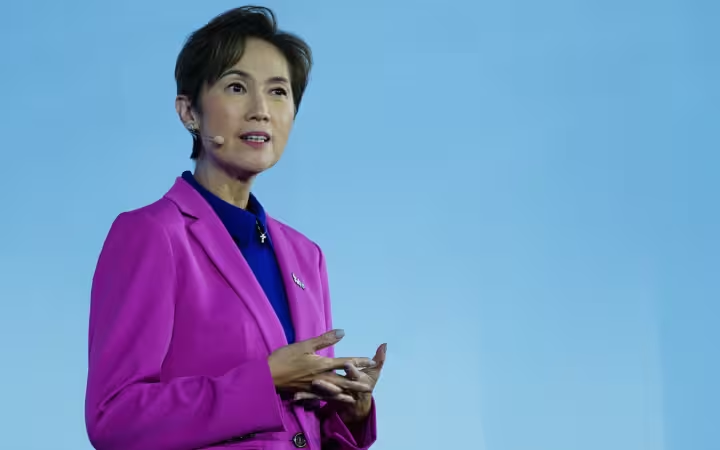
Singapore formed the Frontier AI Resilience and Security Taskforce and launched a kit for testing agentic AI systems on 14 October, CNA reported. The Infocomm Media Development Authority (IMDA) brought together more than 20 experts for the task force, while its Starter Kit for Testing Agentic AI Systems for Safety and Reliability is aimed at organisations deploying systems that can act on a user’s behalf. IMDA chief executive Ng Cher Pong announced both initiatives at the AI Assurance Exchange: Agentic Edition.
Key points
- The task force brings together more than 20 experts from telecommunications, media, cybersecurity and AI.
- IMDA’s kit sets out four stages for testing an agent’s actions, permissions and safeguards.
- The AI Verify Foundation named five firms accredited to provide third-party AI testing services.
- The task force is expected to publish practical guidance in the first half of 2027.
IMDA’s kit follows an agent’s actions
The first version of the starter kit is intended to help organisations assess the safety and reliability of agentic AI systems. Such systems can use tools, reach external services and sensitive information, and alter their surroundings while carrying out a user’s request. A test of the final answer alone would miss actions taken along the way. Ng said organisations should examine the tools an agent used, the information it accessed and whether it stayed within the permissions and boundaries set for it.
IMDA’s process begins with identifying risks, including mistakes and actions an agent was not authorised to take. Organisations then design realistic tests, analyse logs of the agent’s activity, and keep monitoring and re-testing the system. The kit also calls for examination of the agent’s full sequence of reasoning and actions, including whether safeguards worked as intended. That gives a deployer a way to investigate conduct that a correct final output could conceal.
More than 20 industry deployers and testers were consulted on the kit. They included Amazon, Google, Microsoft and Singtel, alongside Singapore’s AI Safety Institute, The Straits Times reported. The kit contains case studies showing how tests can be adapted to different systems and uses. IMDA plans to update it as testing methods develop and as it receives feedback.
The kit follows Singapore’s Model AI Governance Framework for Agentic AI and an earlier starter kit for applications built on large language models, both launched in January. Senior Minister of State for Digital Development and Information Tan Kiat How said the government was running trials to understand how to put agentic systems to use responsibly. He also said it was reviewing existing frameworks and systems as AI agents become more autonomous.
Five firms receive AI Verify accreditation
The AI Verify Foundation named AIDX Tech, Knovel Engineering, PwC Singapore, Resaro and Vulcan as the first five firms accredited under its AI Tester Accreditation Programme. Announced in May, the programme is meant to help businesses find third parties able to assess the safety and reliability of generative AI applications. It gives organisations seeking a tester a separate route from conducting their own checks with IMDA’s kit.
Applicants are assessed on technical competence, their record of work, delivery capability and financial sustainability. Accreditation lasts one year, allowing the programme’s standards to be reviewed as the technology changes. Ng said accreditation recognises the particular testing capabilities a firm has demonstrated rather than suggesting that any one provider can assess every kind of system.
Those distinctions matter when an organisation chooses outside help. A firm testing whether an agent respects access permissions is examining a different risk from one assessing the reliability of a generative AI application’s answers. Under the programme Ng described, the recognised competencies give businesses a basis for matching a tester to the risk they want examined.
FAIRS turns to shared cyber defences
The Frontier AI Resilience and Security Taskforce, known as FAIRS, addresses risks beyond an organisation’s individual AI application. Its members come from telecommunications, media, cybersecurity and AI. Ng said some risks could not be managed through application testing alone as frontier AI changes the cyber threat landscape. The task force’s remit covers faster responses to AI-accelerated attacks, stronger critical systems and the sharing of intelligence across the infocomm and media sector.
Among the matters FAIRS will examine are how to strengthen and segment networks so that a vulnerability does not cause wider disruption. It will also consider how network visibility and response capabilities can keep pace with faster-moving threats. Pooling intelligence is intended to help the sector recognise emerging attack techniques earlier. These are questions for operators acting together, rather than checks that a single deployer can complete on one agent.
Singapore launched a national cybersecurity strategy on 13 October aimed at earlier and faster responses to AI-enabled threats. Its plans include progressively using AI in national cyber defence operations. FAIRS addresses AI-related cyber threats across the infocomm and media sector, while IMDA’s testing kit addresses what organisations can examine in systems they deploy.
The Frontier AI Resilience and Security Taskforce is expected to publish a report containing practical guidelines and best practices in the first half of 2027.