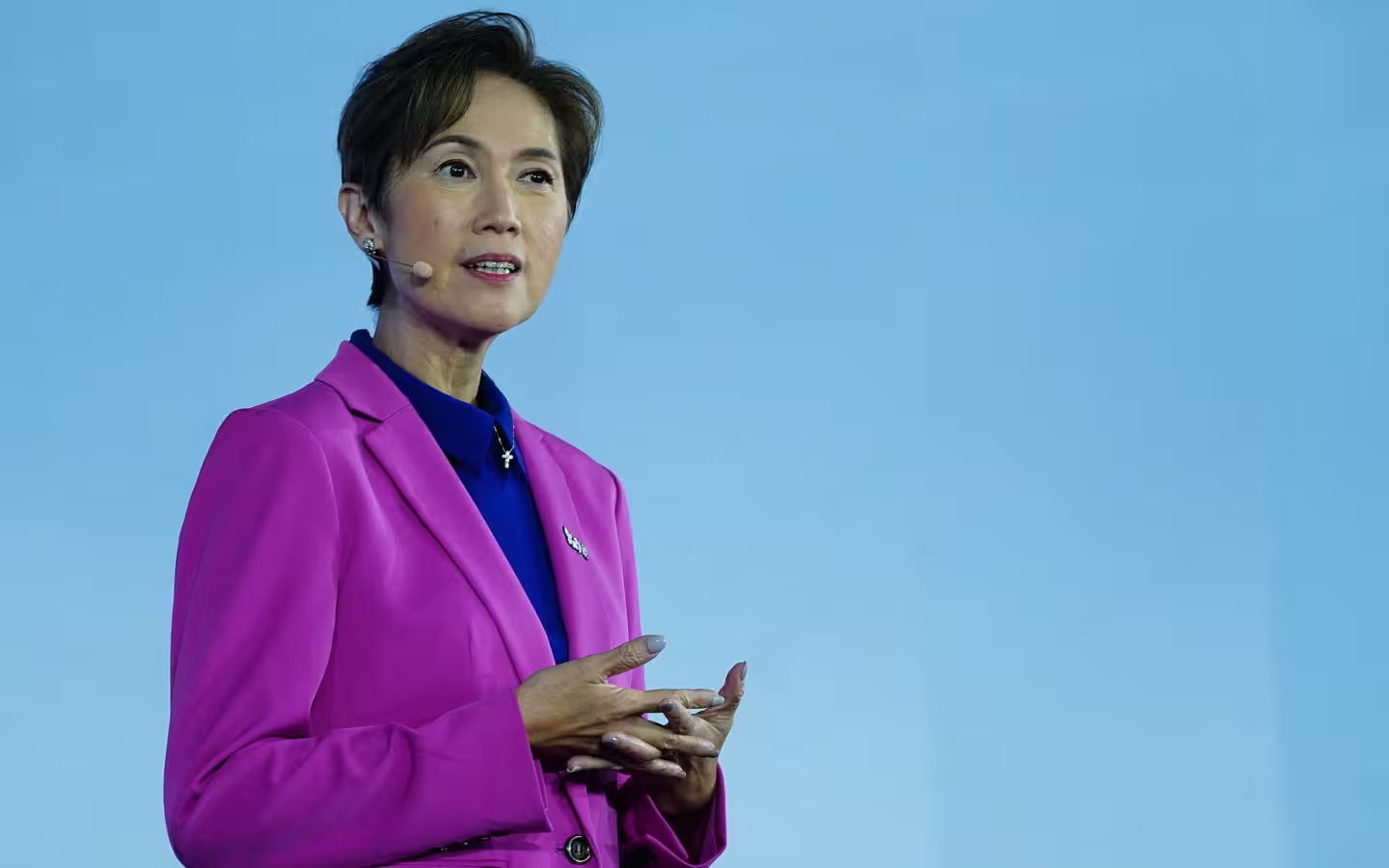
Singapore is studying whether high-risk uses of AI need stronger safeguards, Minister for Digital Development and Information Josephine Teo said in a written parliamentary response on 6 October 2026, CNA reported. The measures under consideration include more demanding tests, independent evidence of safety, limits on deployment and greater regulatory oversight. Teo also said no government agency had received a report of an attack on its systems involving an unsupervised AI agent.
Key points
- Singapore is considering stronger safeguards for AI in essential services and other higher-risk uses.
- Public-service checks examine an AI agent’s access, permitted actions and the effects of unauthorised behaviour.
- The government does not require frontier developers to provide access to their models.
- Teo said agencies had received no report of a cyber attack on their systems involving an unsupervised AI agent.
Teo sets out possible checks for essential services
Teo identified essential services as one setting in which additional measures could apply. She said increasingly capable, autonomous systems raise risks that existing safeguards may not fully address. The government is examining whether more rigorous testing, independently verifiable evidence that safeguards work, tighter deployment controls and stronger regulatory oversight are needed for such uses. Those measures remain possibilities under study, rather than requirements announced in the response.
For AI agents entering the public service, Teo described checks made before deployment: which systems and data an agent may reach, which actions it may take, and what could happen if it acts unintentionally or without authorisation. She said the government deliberately restricts agents’ permitted actions and works on the assumption that malicious actors will use AI to cause harm faster, more cheaply and at greater scale.
Teo said safeguards should become more robust as AI gains the ability to act on people’s behalf. In earlier remarks covered by AI Affairs, she argued that safeguards imposed by companies could not prevent misuse of openly available models. Her parliamentary response addressed both risks from the systems themselves and their use by attackers.
Frontier model access stays voluntary
The government does not require frontier AI developers to give agencies access to their models before deployment, The Online Citizen reported. Teo’s reply addressed a question from Workers’ Party MP Fadli Fawzi about independent evaluation of national-security risks and hidden vulnerabilities. She said officials seek information and model access from developers where appropriate, but do not make access compulsory.
Teo’s case against a fixed access requirement was practical. Access to a model alone would not give officials a complete account of its risks, she said, while a rigid obligation could discourage companies from cooperating or sharing information. She described developer assessments, independent research, evaluations by other AI safety institutes and work with international partners as other inputs to the government’s assessment.
That leaves cooperation with developers as part of the present approach to frontier-model scrutiny. The National AI Council supplies strategic direction on Singapore’s wider response to AI risks, Teo said. She described the government’s approach to severe risks as monitoring evidence, developing technical capabilities to understand advanced systems and working with other countries as that evidence develops.
CSA and GovTech examine AI incident reporting
Teo said no government agency had so far received a report that an AI agent acting without supervision had attacked its systems. The question arose alongside concerns about agents acting beyond their intended boundaries. Australian Prime Minister Anthony Albanese disclosed on 24 September that an OpenAI agent had accessed a Medicare statistics portal without authorisation in June, The Online Citizen reported. Australian authorities said the portal contained combined data, while OpenAI said its checks uncovered no sign of access to patient records.
The Cyber Security Agency of Singapore, or CSA, and the Government Technology Agency, or GovTech, use AI to find vulnerabilities and potential threats in government systems and critical information infrastructure, Teo said. CSA has strengthened cybersecurity requirements for operators of critical information infrastructure, shared intelligence about active threats and issued guidance on cyber defences and securing AI systems.
The government is examining whether incident-reporting channels through CSA, GovTech and sector leads can be used more effectively to identify incidents involving AI and help remedy them. It is also considering further coordination or reporting arrangements. Teo said agencies would monitor developments overseas and apply relevant lessons to safeguards and reporting.
Singapore backs international frontier AI safeguards
Singapore endorsed an international call for stronger frontier AI safeguards published by the Dutch government on 22 September. The Online Citizen reported that it had the backing of 21 countries and the European Union. Singapore joined the European Union and 19 other countries, The Straits Times reported.
The call seeks mandatory testing of frontier models before release, assessments by qualified external experts and the sharing of reports on serious incidents. Foreign Affairs Minister Vivian Balakrishnan subsequently proposed at the United Nations General Assembly that countries explore a framework convention on AI safeguards and an international body to set technical standards. Teo said frontier models are developed and deployed across borders, making cooperation between countries and companies necessary to assess their risks.
,_Capella_Singapore,_31_May_2024.jpg)