The World Economic Forum published its white paper on hyperscale data centres in the Middle East and North Africa on 14 October 2026. Prepared with SRMG Think Research and Advisory, it calls for changes to electricity planning, cooling and regulation as governments and sovereign wealth funds invest in AI infrastructure across the region.
Key points
- The Forum wants countries to classify AI data centres as “critical dynamic loads”.
- It says regional electricity capacity needs to grow by 40 per cent by 2030, against projected growth of 15 per cent.
- It proposes detailed demand forecasts for grid-connection applications from projects above 10 megawatts of IT load.
- The proposals also cover on-site power generation, cooling and water use.
A 40 per cent capacity requirement in MENA
The Forum called for AI data centres to be treated as “critical dynamic loads” rather than conventional industrial or commercial electricity customers, Nigeria Sun reported on 17 October. It also urged governments to change power planning so that developers, utilities, grid operators and regulators coordinate their decisions.
The Forum says electricity capacity across the region needs to rise by 40 per cent by 2030, while current projections point to growth of 15 per cent. Its warning concerns the ability of power systems to accommodate expanding AI facilities. The capacity requirement is the Forum’s assessment; the projected growth is the outlook against which it sets that requirement.
On the Forum’s account, electricity demand is already growing faster than supply. Extreme heat raises cooling needs, while scarce water increases reliance on energy-intensive desalination. Hyperscale facilities add concentrated computing equipment with sustained demand that can also vary sharply. The Forum argues that power, cooling and regulatory arrangements must develop alongside the data centres they support.
The proposed classification would give planners a way to distinguish these facilities when assessing connections and future capacity. The Forum’s accompanying call for coordination brings the data-centre developer into the same planning process as the organisations responsible for supplying and managing electricity. Both proposals concern how governments and grid operators would handle applications, rather than a change that has already taken effect.
Forecasts for projects above 10 megawatts
For projects exceeding 10 megawatts of IT load, the Forum proposes requiring detailed electricity-demand forecasts with grid-connection applications. That threshold concerns the load of the computing equipment. Under the proposal, developers above it would have to provide the expected pattern of demand when seeking a connection, giving grid operators information to use in planning for the facility.
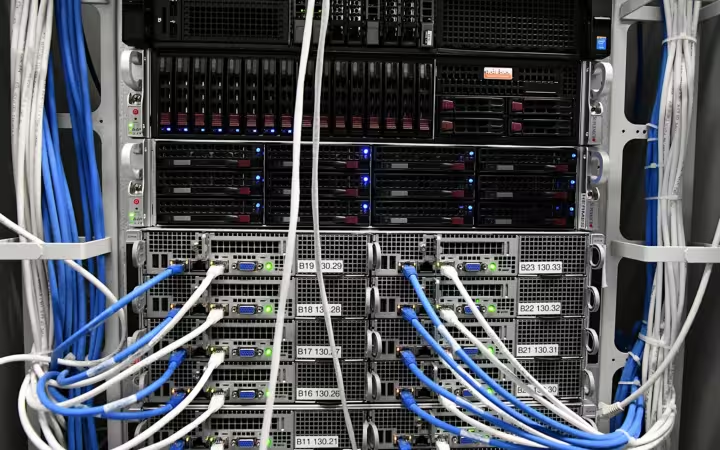
The Forum puts the power consumption of an AI server rack at between 30 and 100 kilowatts, against 3-10 kilowatts for a rack serving traditional web workloads. It also warns that simultaneous disconnections or reconnections at several facilities could produce sudden changes in demand capable of destabilising a grid. The concern extends beyond how much electricity a facility uses over time.
The Forum recommends mandatory demand forecasts as part of a wider planning change, alongside coordination among developers, utilities, grid operators and regulators. A forecast filed at the connection stage would place information from the prospective customer in front of the organisations planning supply. The proposed duty would therefore fall on developers, while the resulting planning work would sit with power-system bodies.
Cooling and power supply in MENA
Cooling accounts for more than 40 per cent of electricity use at the region’s data centres, according to the Forum. It recommends closed-loop cooling and treated wastewater, alongside changes in infrastructure design and energy management. Those proposals address both the power required to remove heat from equipment and the pressure that cooling can put on limited water supplies.
For electricity supply, the Forum recommends more solar generation paired with battery storage, on-site generation and AI-based energy management. It says generation behind the meter could bring forward data-centre deployment by 12-36 months by reducing dependence on a utility grid connection. That is an estimated acceleration in the Forum’s proposal, rather than a timetable for a particular project.
The Forum also identifies small modular nuclear reactors and enhanced geothermal systems as possible longer-term sources of power, while treating commercial viability as a constraint. Its recommendations span immediate choices about connections and cooling as well as power technologies whose role would depend on their ability to operate commercially.
At regional level, the Forum urges governments to align regulatory standards and cooperate across borders to improve infrastructure efficiency and investment confidence. It describes its recommendations as a working framework for the next five years.