Director of National Intelligence Jay Clayton told CNBC on 16 October that artificial intelligence magnifies existing cybersecurity risks across US digital infrastructure connected to public services, national defence and global communications, EconoTimes reported. Clayton also said the White House AI task force he leads had formed three subcommittees at its first meeting on 15 October, assigning work on incident reporting, critical infrastructure and law enforcement. His warning came during a discussion of a federal case involving a recording device allegedly placed in an OpenAI conference room.
Key points
- Clayton said AI amplifies existing cyber risks to infrastructure supporting public goods, defence and global communications.
- He urged companies and government agencies to be wary of commercial and state-sponsored espionage.
- Federal prosecutors allege a former OpenAI employee placed a recording device in a conference room. He has not been charged with espionage.
- The White House task force has divided work among three subcommittees covering reporting, infrastructure coordination and law enforcement.
Clayton calls for hardening US systems
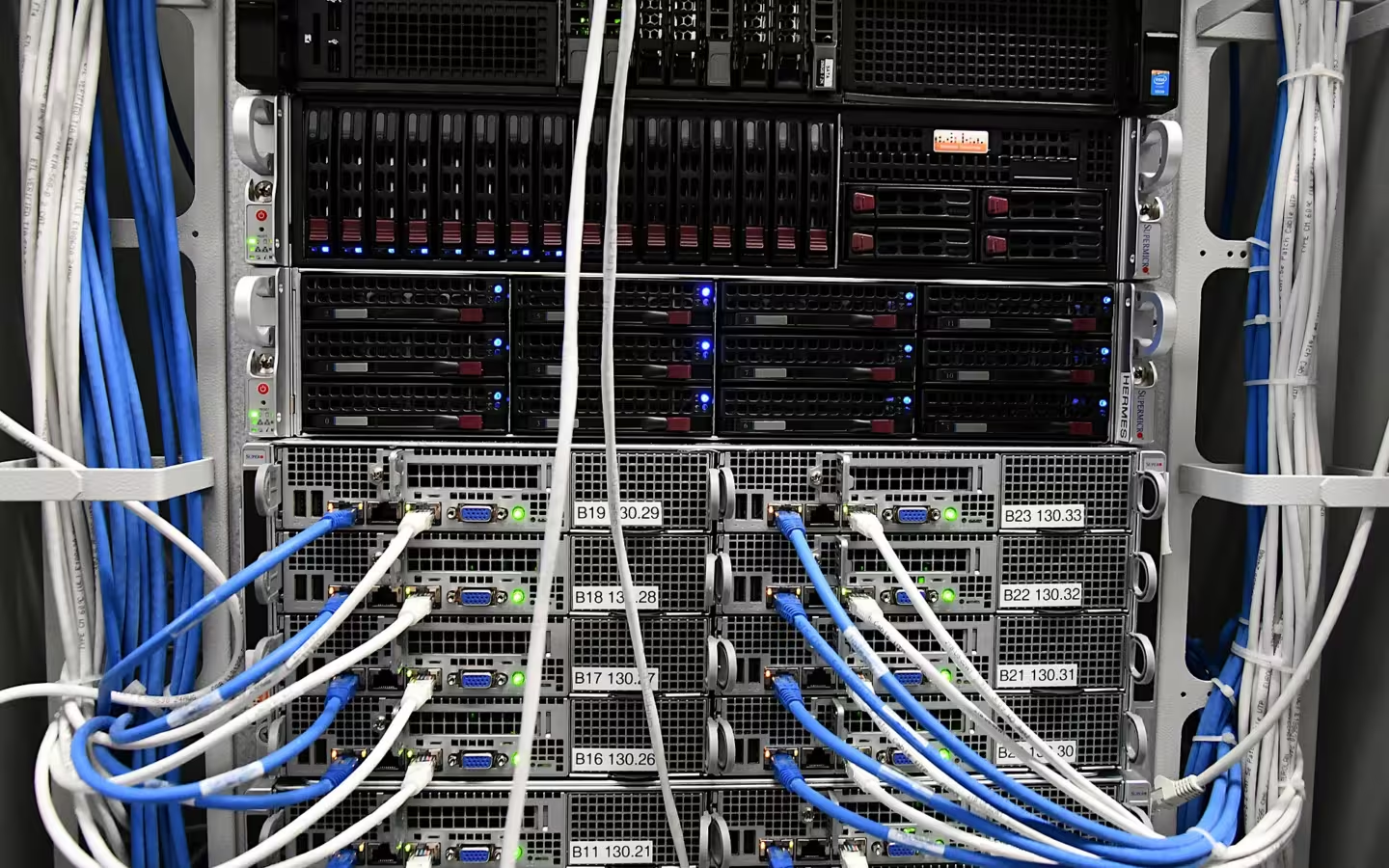
Clayton described commercial and state-sponsored espionage as “realities” and said both private companies and the government needed to be wary. In his account, AI intensifies risks that already affect interconnected systems rather than creating an entirely separate category of infrastructure. The systems he identified serve public goods, national defence and communications beyond the United States. He tied the administration’s attention to hardening them to its effort to maintain a lead over actors seeking to exploit those risks.
“It’s something that our private sector companies need to be wary of. We, as a government, need to be wary of,” Clayton told CNBC, according to Briefs. Clayton named China, Russia, Iran and North Korea as countries with “significant technical capability” in AI. He said the United States was not alone in developing the technology and referred to risks from competitors as well as adversaries.
Clayton’s description placed responsibility on two sets of organisations: companies operating or using the systems, and government agencies concerned with their protection. His stated focus was on strengthening infrastructure already used for public purposes and defence. The task force’s division of work gives one subcommittee the job of examining critical infrastructure in cooperation with the private sector, while the other two have different remits.
The OpenAI case concerns alleged interception
Clayton discussed the warning in connection with the case of Abdulrahman Alfozan, a Saudi national and former OpenAI employee. Federal prosecutors allege Alfozan installed a recording device in an OpenAI executive conference room. The federal charge concerns alleged interception of oral communications; Alfozan has not been charged with espionage. Clayton said the incident illustrated the lengths to which others might go to challenge or keep pace with US leadership in AI.
The distinction between the allegation and Clayton’s broader warning matters here. The conduct prosecutors allege concerns a device in a meeting room, while the charge concerns interception, not espionage. Clayton used the case while discussing commercial and state-sponsored spying, but the reported charge does not assign either of those purposes to Alfozan. His argument to CNBC ranged more widely, taking in the security of digital infrastructure connected to public goods, defence and global communications.
OpenAI had previously used staff training scenarios to warn about threats to its secrets, as AI Affairs reported in its account of the company’s espionage warnings. The allegation against Alfozan concerns a physical recording device in an executive meeting space. It is that alleged act, rather than a reported intrusion into an AI model or a public system, that Clayton invoked in his remarks on security.
The White House divides task force work
The White House task force held its first meeting on 15 October and established three subcommittees, TokenPost reported. One covers reporting and response. Another will examine critical infrastructure and coordinate with private companies. The third covers law enforcement and responsibility. These assignments put incident handling and infrastructure protection alongside questions of legal accountability within the group’s work.
Clayton leads the task force, whose formation with a 120-day mandate was previously reported by AI Affairs. The group has also adopted a charter for that review. Clayton’s account of the first meeting identifies who within the task force will take up reporting, infrastructure coordination and law enforcement, extending its work beyond the industry commitments on which it builds.
President Donald Trump and technology leaders signed an accord at the White House in September that included industry pledges to police AI risks. Trump described those commitments as “morally binding”. The task force’s work builds on that accord, according to TokenPost. Clayton’s account of its first meeting assigns the infrastructure and private-sector coordination work to a subcommittee, alongside separate groups for reporting and response and for law enforcement and responsibility.