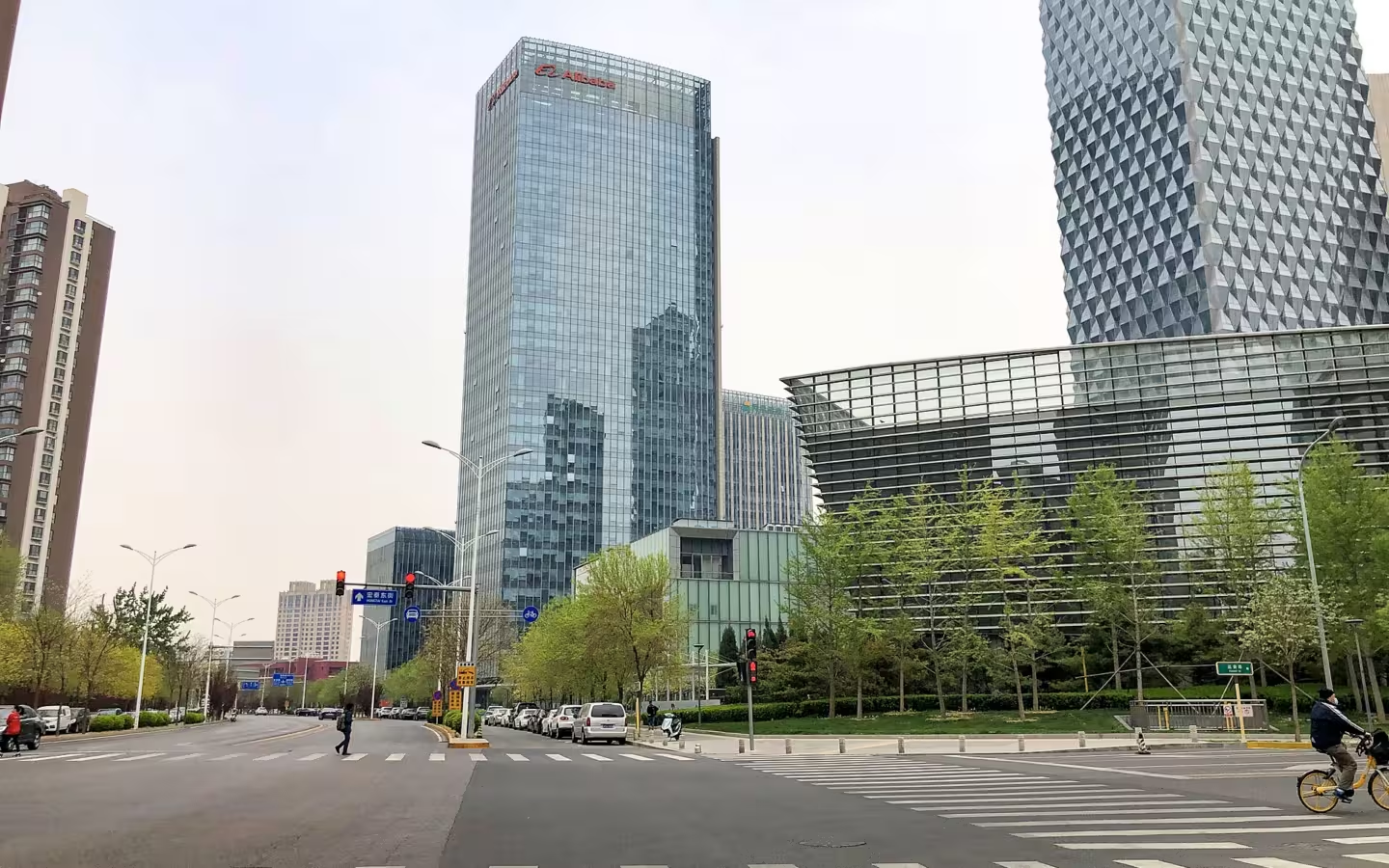
Alibaba Cloud said on 23 September it would establish its first cloud regions in Turkey, Finland and the Netherlands within 12 months, alongside data-centre expansion in five existing markets, Dow Jones Newswires reported. The plans were announced at the company’s annual Apsara Conference in Hangzhou.
Key points
- Alibaba Cloud plans its first cloud regions in Turkey, Finland and the Netherlands within 12 months.
- It also plans to expand its data-centre footprint in Malaysia, Germany, the United Arab Emirates, France and Hong Kong.
- Alibaba Group is targeting more than 20 gigawatts of global data-centre capacity by 2032.
- The Netherlands is expected to receive the first of the new facilities in October.
Three new markets for Alibaba Cloud
The new regions would extend a network that Alibaba Cloud says currently spans 107 availability zones in 31 regions worldwide, Quartz reported. The five other markets named in the announcement are places where Alibaba plans to add to its existing data-centre footprint rather than establish its first cloud regions. They cover Europe, Asia and the United Arab Emirates.
Feifei Li, Alibaba Cloud’s chief technology officer and president of international business, said the company was expanding its network to place computing resources nearer to customers and partners. She said Alibaba was also developing AI tools for enterprises deploying models, managing workloads across models and building applications.
Alibaba has opened facilities in Brazil and France in recent months. The planned Netherlands region adds another European location to the company’s network, while the proposed expansion in France would increase capacity in a market where it has already opened a facility.
Cybernews described the expansion as putting Alibaba into closer competition with Amazon, Microsoft and Google, particularly for cloud customers seeking nearby data centres. Alibaba’s announcement names countries and a delivery window for the three new regions. Its stated reason for bringing capacity closer to customers is an enterprise sales proposition, alongside the additional computing capacity it plans to build.
Alibaba targets more than 20GW by 2032
Alibaba Group chief executive Eddie Wu said the company’s target is to operate more than 20 gigawatts of global data-centre capacity by 2032, Euronews reported. The figure is a capacity goal for Alibaba Cloud’s worldwide network, while the announcement on 23 September identifies where some of its nearer-term construction and expansion is planned.
Alibaba committed in 2025 to a three-year $53 billion AI spending programme, Quartz reported. The programme covers the company’s effort to add AI capabilities to its core e-commerce business. The newly named cloud regions are part of a wider infrastructure push that also includes capacity additions in markets where Alibaba already operates.
At the Hangzhou conference, Alibaba also presented a new AI chip. AI Affairs reported its plans for a 5 trillion to 10 trillion parameter model and the unveiling of the Zhenwu V900 chip. The chip and model plans sit alongside the cloud buildout in Alibaba’s account of its AI investment.
Alibaba adds tools for enterprise workloads
Alibaba Cloud introduced three AI products at Apsara. Smart Studio is designed for companies building Model-as-a-Service platforms. Alibaba claims it can deliver up to 505% higher throughput than standard open-source frameworks running on the same hardware.
Smart Fusion routes tasks among AI models through one application programming interface. Alibaba says it can cut token costs by around 50%. Smart Video is aimed at advertisers and short-drama producers. The company says it can create videos of up to one hour from a text prompt and supports more than 20 languages.
Alibaba also pointed to enterprise use of its existing AI systems. Panasonic Digital said its work with Alibaba Cloud reduced documentation time by 80% and made contract reviews ten times more efficient, according to Quartz. Indonesian logistics provider Lion Parcel has deployed Alibaba’s Qwen-VL-Plus model to automate document processing in its finance operations.
The regional plan has a nearer delivery point than Alibaba’s 2032 capacity target. The Netherlands is expected to receive the first of the three new facilities in October, Cybernews reported.
.jpg)