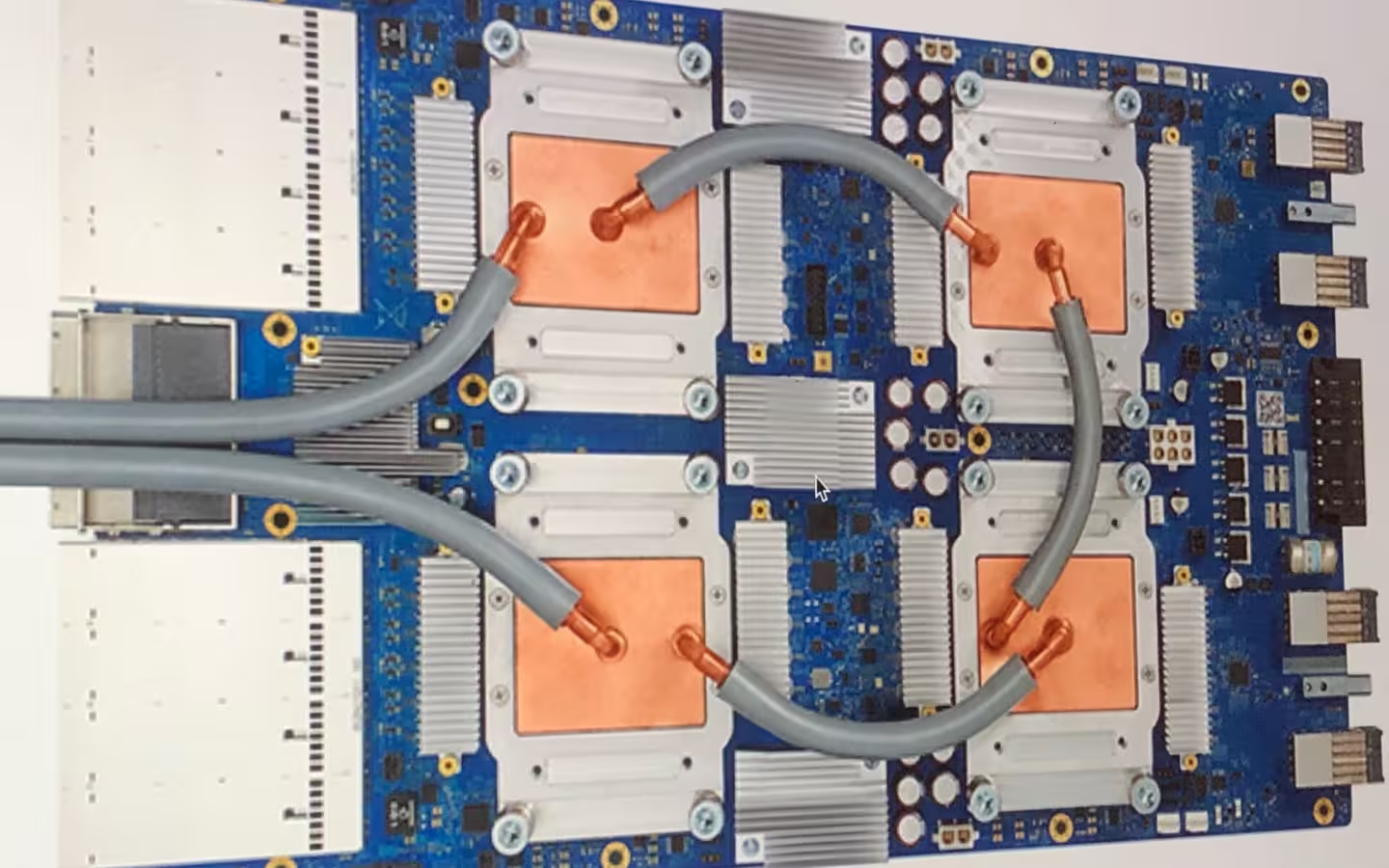
Google’s Project Suncatcher prototype returned an AI-generated response from orbit on 30 October after its Tensor Processing Unit, or TPU, booted aboard the spacecraft, The Verge reported. The response was a haiku from an onboard Gemma 4 model. For Google, which announced Project Suncatcher as research into solar-powered AI computing in space, the transmission marks a completed request and response using a chip aboard a satellite.
Key points
- Google says the satellite booted a TPU, ran a Gemma 4 prompt and returned the result to Earth.
- The spacecraft carries four TPUs, but its power supply allows one to run at a time.
- Google plans to test two interconnected satellites in 2027.
Gemma 4 answers during a Svalbard pass
The prompt went up during a ground-station pass, and the poem came down as the satellite passed Svalbard, Norway, Unite.AI reported. Travis Beals, Google’s Senior Director of Paradigms of Intelligence, described the result as the mission’s “Hello World” milestone. Google characterised it as the first AI response from a data-centre-class TPU in orbit.
The model was already loaded onto the satellite. Running it on a new prompt is called inference: the chip applies a model that has already been built, rather than doing the much longer work of building one. In this test, a command went up from Earth, the TPU started, Gemma 4 composed the response aboard the spacecraft, and the completed text came back down. The poem opened, “Blue marble below”.
Writing a short response to a request could therefore happen aboard a satellite during a ground-station pass: the request would go up, and the finished words would come down. Here, that activity was a request for a poem about space, rather than the larger workloads Google envisions for the project.
Google says it also tried space-themed limericks and prompts about the satellite’s operating conditions. Those requests put the same basic sequence to work on different kinds of output: generated text and information about the spacecraft itself. The response reported on 30 October was a completed exchange with Earth, rather than simply a chip powering on in orbit.
Four TPUs face a 1 kW limit
The prototype carries four TPUs and generates up to 1 kW of electricity, but power demand limits it to running one TPU for about twenty minutes at a time, TechCrunch reported. That makes the poem a test of a working processor in orbit under a particular power constraint, rather than a demonstration of four chips running together. The timing also matters when commands and results have to travel between the satellite and Earth.
Before the prompt, commissioning took about three weeks and included checks of the satellite’s subsystems. The spacecraft launched on 1 October aboard SpaceX’s Transporter-18 rideshare mission and was built with Planet. Ahead of that launch, AI Affairs reported Google’s plan to test its chips in orbit.
Space exposes the processor to conditions that a successful prompt cannot exercise by itself. Radiation can change a stored value in memory, known as a bit flip, and potentially corrupt data. Google’s ground tests suggested radiation would have less impact on inference than on model training, while the orbital campaign is examining what happens to the hardware under radiation exposure and thermal stress.
Heat poses a separate engineering problem. A TPU concentrates heat in a small area, and the vacuum outside a satellite offers no airflow to carry it away. Google has tested a proposed cooling arrangement using heat pipes and radiators in a chamber that reproduces vacuum and thermal conditions, according to Unite.AI. Ground testing puts the components through controlled conditions; the satellite gives Google a way to collect data during operation in orbit.
Project Suncatcher turns to satellite links
Google announced Project Suncatcher in November 2025 as research into whether solar-powered satellites equipped with TPUs could support machine-learning workloads in space. The prototype’s returned poem exercises one chip on one spacecraft. Google’s proposed larger system depends on satellites working together, which introduces communication between spacecraft alongside the questions of power, heat and radiation.
Those links are intended to let satellites exchange data for workloads distributed across a cluster. Google’s plans described by Unite.AI call for optical links, which use light to communicate between moving spacecraft. The immediate prototype test instead sent a prompt from a ground station and returned its answer to Earth, so the next hardware test concerns a different connection.
Google plans to test two interconnected satellites in 2027, with higher power generation and optical links between them.