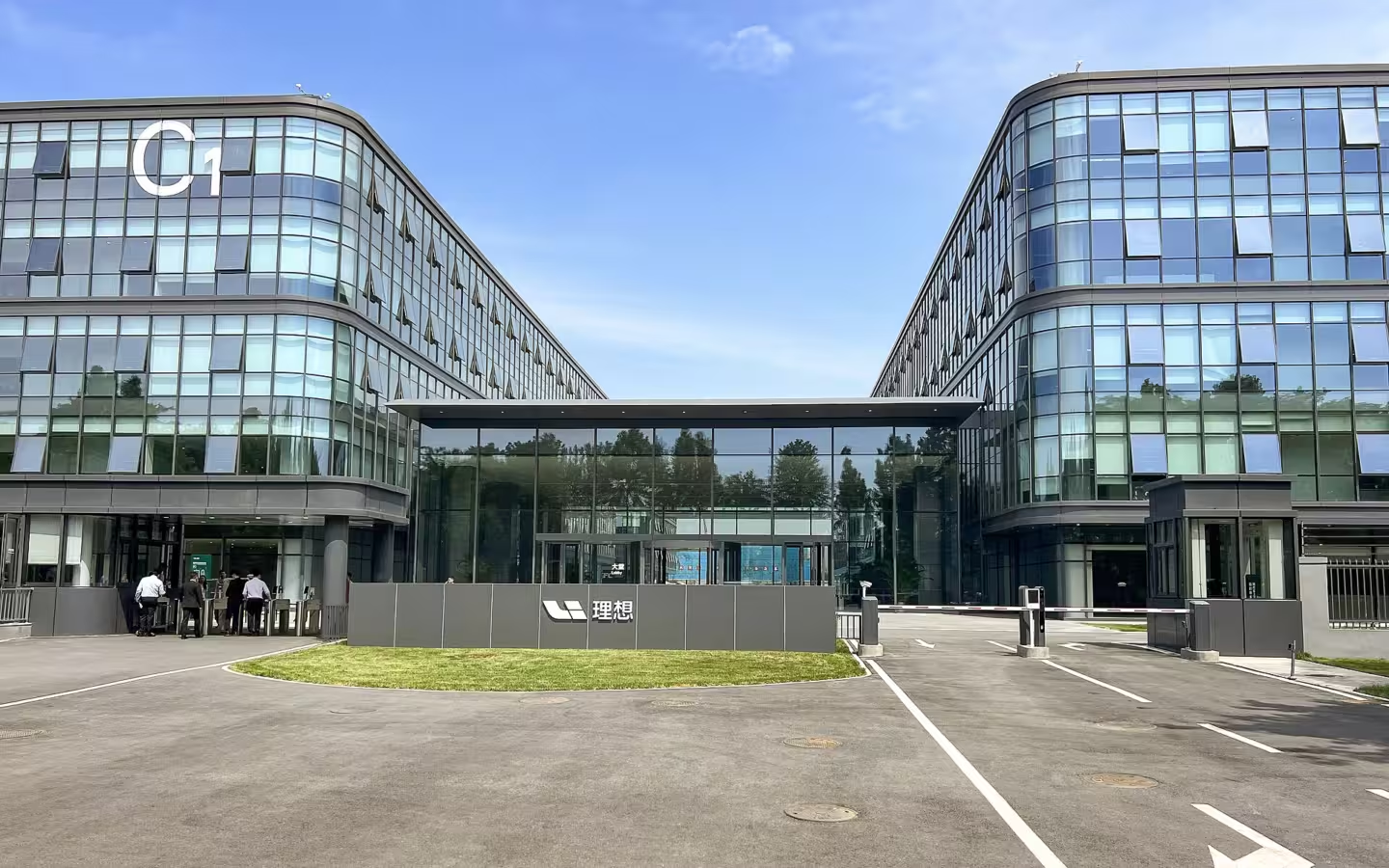
Li Auto’s Foundation Model team released the ME-Brain-1.0 system alongside the ME-U0 and ME-VLM models on 22 September, Pandaily reported. The package brings together a system for retaining experience, models for interpreting a scene and a model for generating actions, with a route to running parts of it on Li Auto’s M100 chip.
In Li Auto’s description, ME-Brain-1.0 links Evolvable Memory, a Cognitive Core and an event-driven Action Model. An action produces an experience that the system can store and draw on when updating a skill — much as a written note can preserve what went wrong during a practical task. The Cognitive Core comes in a 35B-A3B mixture-of-experts version and a smaller 4B edge version.
Picking up an object could become more dependable if an earlier failed grasp informed the next attempt. That is the practical possibility behind Li Auto’s memory-and-action loop, though its reported demo footage includes missed grasps.
Li Auto says ME-U0 was pretrained on about 4,200 hours selected from larger collections of robot and first-person recordings. Its company-reported results are 99.1% average success on standard LIBERO and 81.8% on LIBERO-Plus without dedicated adaptation. The model has separate components for understanding and generation, with its representation of images and actions arranged to keep their timing aligned.
For ME-VLM, Li Auto’s deployment figures put prefill latency on the M100 at 188 ms, down from roughly 400 ms, using token compression and W4A8 quantisation. Prefill is the work a model does on its input before producing a response, so that delay matters to a system expected to react to its surroundings.
The benchmark figures remain Li Auto’s results pending reproduction by outside laboratories, Pandaily reported. It also described third-party accounts of the demonstration videos that identified gripper pauses, occasional failed grasps and open-ended tasks left unfinished.


.jpg)