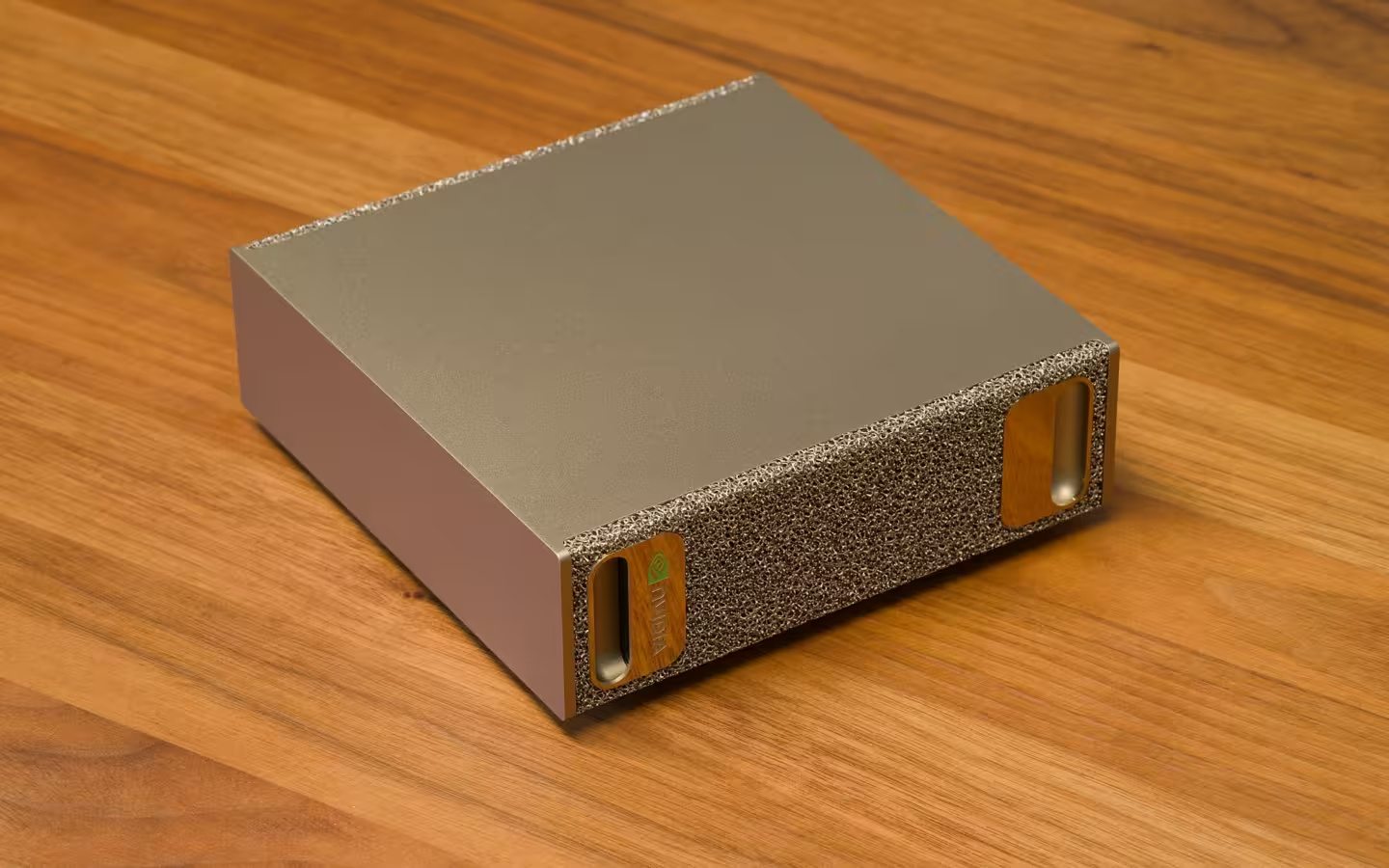
Nvidia introduced the DGX Spark HPC Developer Kit on 16 November at SC26, the annual supercomputing conference in Chicago. It connects four DGX Spark systems into a cluster that researchers and developers can use at a desk to work on applications designed to run across multiple computers.
Key points
- Four systems connect directly in a ring over ConnectX-7 networking, without a network switch.
- Nvidia says the cluster has 512GB of combined memory and 20TB of NVMe storage.
- Nvidia says NVFP4 quantisation allows models of up to 700 billion parameters to be deployed across the four systems.
- The kit is for sale, but Nvidia’s installation playbook for scientific computing software is still to come.
ConnectX-7 joins four systems in a ring
Each DGX Spark system contains a GB10 Grace Blackwell Superchip. In the kit, each system connects directly to two neighbours over Nvidia ConnectX-7 networking, forming a ring rather than connecting through a separate network switch. The arrangement lets the kit grow from one system to four without buying or setting up that additional piece of networking equipment, Nvidia says.
A calculation spread across several computers has to divide its work and pass information between them. The ring gives the four systems a way to do that locally, while Nvidia’s planned HPC SDK installation playbook is intended to supply the compilers, libraries and message-passing tools used to build and test such applications. The company says developers could check how computation and data are distributed before taking an application to a larger system.
Checking work before sending it on could therefore happen at a desk rather than after a wait for shared computing time. A calculation could be tried across the linked systems, with problems in how they divide the job caught before a larger run, if the planned software works as Nvidia describes.
Nvidia has already shown DGX Spark alongside RTX Spark and DGX Station at GTC Berlin. The SC26 kit groups DGX Spark systems for work that needs more than one node, rather than presenting another single-system configuration.
NVFP4 extends the four-node model capacity
Across four nodes, Nvidia says the kit supplies 512GB of combined memory and 20TB of NVMe storage. Those totals describe capacity spread across the cluster: using it for one workload requires the work or model to be distributed among the systems, with data passed over their connections as needed.
Nvidia says researchers can deploy models with up to 700 billion parameters across the four systems using NVFP4 quantisation, and gives DeepSeek V4.1 as an example. Quantisation represents a model’s numerical values at reduced precision, rather like rounding numbers to make a long set of figures take less room. That helps a model fit in available memory, though the stated parameter count is Nvidia’s deployment claim rather than a reported speed measurement.
For scientific computing, Nvidia names LAMMPS with Kokkos for materials simulation and NAMD for molecular dynamics among workloads demonstrated on four systems. It separately says the broader DGX Spark community has validated applications including GROMACS for molecular dynamics, OpenFOAM for fluid dynamics and WRF for weather modelling.
The company also describes local work with scientific AI models and agents. Its Nemotron science release packages a model and chemistry data for scientific agents. For the Spark kit, Nvidia says researchers could use agents to prepare simulation inputs, start runs and summarise results, leaving the setup and conclusions for scientists to validate.
Berkeley results concern a single DGX Spark
The Rubin Lab at the University of California, Berkeley used a single DGX Spark with Nvidia’s Evo 2 model to predict bacterial traits from genome sequences, according to Nvidia. It compared representations from genomic and protein language models with classical baselines. Nvidia says results arrived 15 times sooner when the lab avoided an 11-hour queue for shared cluster time; that account concerns one system, not a performance comparison involving the new four-node kit.
Another Berkeley group, the Hartwig Group, used one DGX Spark to fine-tune a chemistry model with 120 billion parameters, Nvidia says. Using NVFP4 quantisation, the group fitted the model on that device and ran successive training sessions lasting eight to 24 hours. These examples describe work on individual DGX Spark machines, while the kit’s demonstrations concern applications running across four.
Nvidia says its forthcoming HPC SDK playbook will bring GPU-accelerated C, C++ and Fortran compilers, libraries and message-passing tools to the cluster. The company describes testing scientific applications across four nodes and checking communication problems before moving to larger systems as intended uses for that software.
The developer kit is on display at SC26 and available for sale. Nvidia says DGX Spark products and cables can be bought through its Marketplace and partners including Acer, ASUS, Dell Technologies, GIGABYTE, H3C, HP, Lenovo, MSI and xFusion.