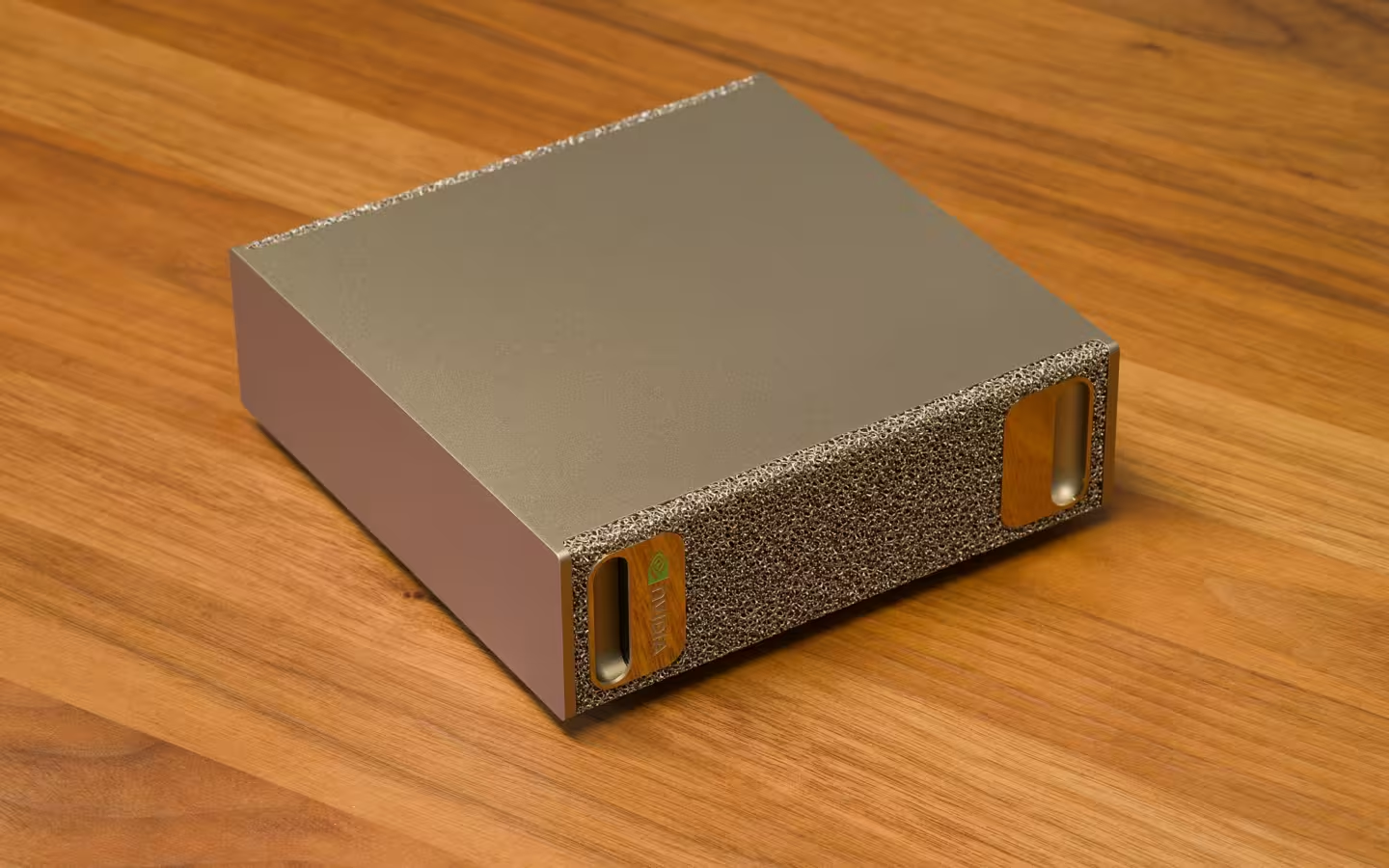
Nvidia is presenting RTX Spark, DGX Spark and DGX Station as a local AI hardware lineup at GTC Berlin, its European developer conference, on 21 October 2026. The systems put models and agents on Windows PCs for personal use, Linux machines for developers and larger Linux systems for enterprise teams. Alongside the hardware, Nvidia announced software for connecting machines, sharing models and running agents without sending their work to a remote model service.
Key points
- Partners are due to begin rolling out 64GB DGX Spark systems on 23 October.
- Nvidia says DGX Spark can be configured manually in clusters of up to eight units.
- Recursive Flint is a local coding model that Nvidia says runs at over 220 tokens per second on a 64GB RTX Spark.
- DGX Station for Windows is expected from system manufacturer partners in December.
RTX Spark runs agents on Windows PCs
RTX Spark, released on 16 October, is Nvidia’s Windows PC platform for local AI. Nvidia says configurations offer up to 128GB of unified memory, shared by the processor and graphics hardware, and up to 1 petaflop of AI compute. AI Affairs earlier reported Nvidia and Microsoft’s opening of RTX Spark laptop preorders for October delivery. The Berlin announcements turn from getting those machines into use to the software and models intended to run on them.
Underdog Desktop Agent is available for RTX Spark. Its Husky inference engine runs models entirely on the device, according to Nvidia, so the agent can work without sending user data away from the PC. Nvidia also says many RTX Spark laptops have unlocked bootloaders, allowing their software setup to be changed by developers and enthusiasts building local agents.
Recursive Superintelligence has released Recursive Flint, a coding model with 40 billion parameters, of which 2.5 billion are active. It uses a mixture-of-experts design: rather than bringing every part of the model to bear on each piece of text, it draws on a smaller active portion, much as a task might call for selected books from a shelf rather than the whole library. Nvidia reports output of over 220 tokens per second on a 64GB RTX Spark and describes the model as scoring strongly on agentic coding benchmarks including SWE-Bench Pro v2 and Terminal-Bench 2.1.
Writing code could involve asking a model on the same computer for suggestions and reviewing its output there. With the local coding model and on-device agent Nvidia describes, that part of the work would not require sending it to a remote model service.
DGX Spark expands from one machine to eight
DGX Spark runs Linux and is aimed at developers building AI applications. Partners are due to begin rolling out its 64GB version on Friday, 23 October. AI Affairs previously reported a $4,999 price for the 64GB system. Nvidia says that version can run models including Nemotron 3.5 Bolt 74B 24GB, Qwen3.8 27B and Gemma 4 26B-A4B.
For work needing more memory, Nvidia says DGX Spark systems can be linked through their built-in ConnectX-7 networking and its Sync Cluster Assistant. Clusters of up to eight units are supported in a manual configuration, giving a shared pool of 1TB of unified memory. The distinction matters for a model too large for one machine: its work can be spread across connected systems, while several developers can run sessions against the same cluster. Nvidia identifies larger models, longer contexts and concurrent agents as uses for that arrangement.
Nvidia plans to add Sync Model Launcher later in October. The software is intended to download a model and container suited to either a single DGX Spark or a cluster, connect the model to OpenCode and load DGX Spark Skills for troubleshooting and maintenance. An October software update also adds a Wi-Fi Assistant for changing networks while DGX Spark is running in appliance mode.
DGX Station adds shared enterprise access
DGX Station is Nvidia’s larger local system for enterprise teams. Nvidia specifies 748GB of coherent memory and up to 20 petaflops of AI performance, and says it can serve more than 30 users at speeds comparable to cloud models. Sync now supports connections between two Linux-based DGX Station systems. Seven new integrations, including Microsoft Intune, Splunk by Cisco and Tanium, are intended to bring the machines into existing enterprise management processes.
Nvidia has released three open source reference workflows for robotics on DGX Station. They use GPT-6 Astra, Isaac Lab, Isaac Lab-Arena and Cosmos for tasks including refining GR00T 1.7 models with reinforcement learning, training manipulation skills and producing synthetic data with post-trained world models. On the GTC Berlin show floor, Nvidia is also previewing DSX OS on DGX Station to simulate AI factory operations before full infrastructure is available.
Nvidia Cloud Functions is coming in early access to Linux-based DGX Station. It is designed to let a team register locally hosted models in a shared catalogue and reach them through a single OpenAI-compatible entry point. Under that setup, an application could keep using the same endpoint when its underlying model changes, while colleagues could access the shared model without logging directly into the machine.
Nvidia expects system manufacturer partners to supply DGX Station for Windows in December. It says the version will support Windows-native engineering applications from companies including Siemens, MathWorks and Dassault Systèmes, alongside agents running on premises.