CERN and Mistral signed a statement of intent on 15 October 2026 to develop a Large Physics Model trained on billions of simulated particle collisions, Reuters reported.
Key points
- The partners aim to develop one pretrained model for several collider-physics tasks.
- CERN holds about one exabyte of experimental data from the Large Hadron Collider.
- CERN expects collision volumes to rise tenfold with an upgrade expected around 2030.
CERN targets a single reconstruction model
The partners propose one pretrained collider-physics model to take on work now handled by a chain of specialised algorithms. CERN describes it as the first foundation model for the field. Training would use billions of simulated proton-proton collisions at CERN’s Large Hadron Collider, according to a joint release published by Mirage News.
The proposed work centres on reconstruction: converting detector signals from a collision into the particles and other objects physicists analyse. The partners say that process currently runs through a chain of specialised algorithms. Their model is intended to work across that chain and support several tasks within one system.
Those tasks would include reconstructing collisions and identifying particles, according to the release. The partners also envisage using the model to flag unexpected signals and assess designs for future detectors. Those are proposed applications of the model, rather than uses already in operation.
Machine learning already plays a part in the existing reconstruction process, the partners say. Their proposal would extend its use across the sequence of specialised tasks rather than introduce it to collider analysis for the first time. The statement of intent establishes a direction for joint work, while the model remains an ambition described by the partners.
CERN Chief Information Officer Enrica Porcari said high-energy physics provides a setting in which AI can be developed and tested rigorously. CERN’s aim, she said, is to develop capabilities that the wider physics community can use and share.
Mistral joins CERN’s scientific computing effort
The statement of intent sets out a long-term strategic partnership focused on foundation models for scientific discovery. CERN contributes its work in fundamental physics, scientific data and large-scale computing. Mistral contributes experience in training large-scale AI models, according to the joint release.
Mistral is a France-based developer of AI models. Its proposed work with CERN follows the company’s announcement of a 1-trillion-parameter Large 4 model on 6 October 2026, covered in an earlier AI Affairs report on the model trained on Nvidia GPUs.
Johannes Brandstetter, Mistral’s Vice-President of AI for Engineering, described the collaboration as an opportunity to explore how large models could address the complexity of particle physics. The partners say their initial focus is high-energy physics and that models developed through the work could later serve other scientific fields.
CERN holds about one exabyte of data
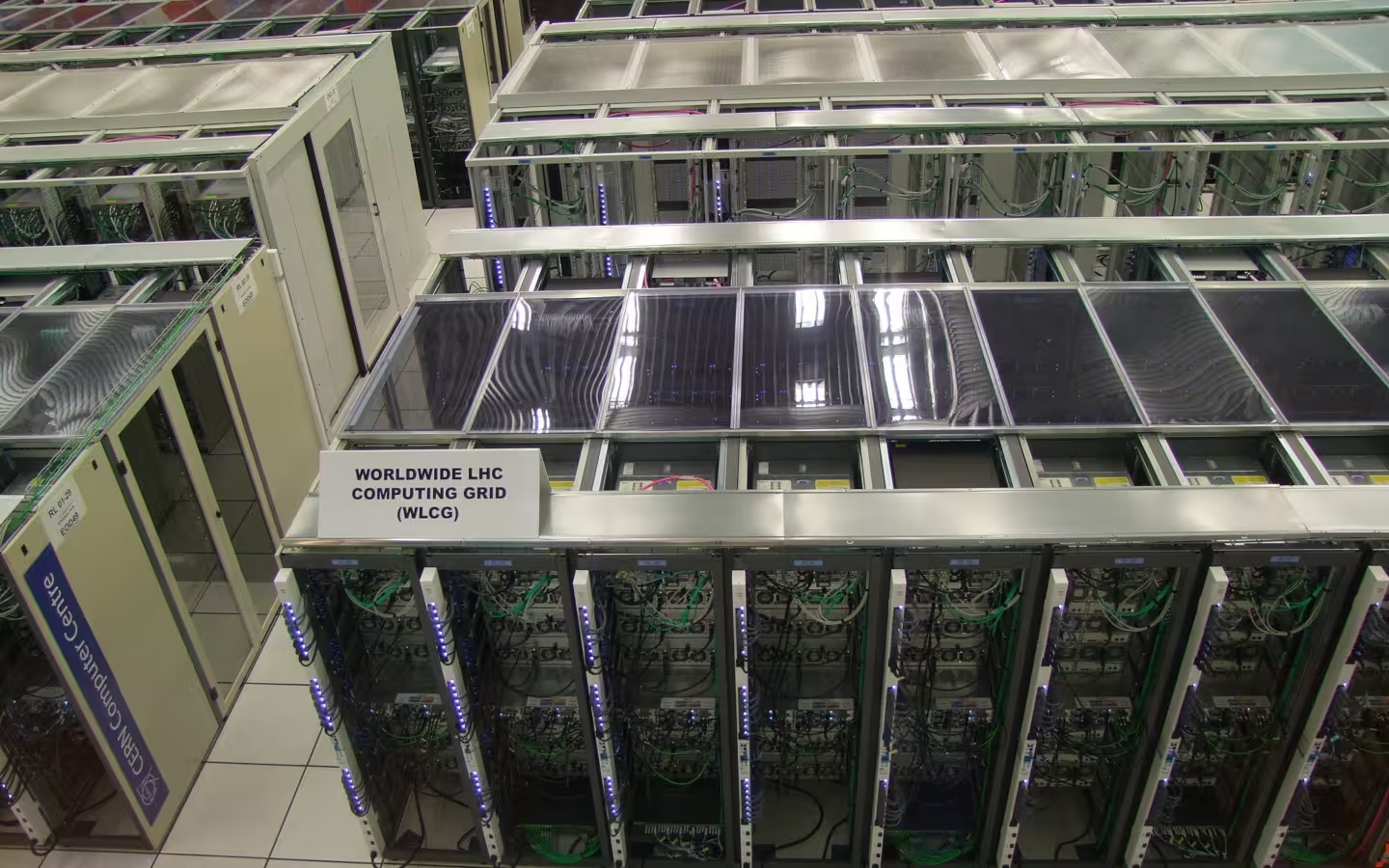
About one exabyte of Large Hadron Collider experimental data — one million terabytes — is in CERN’s stores, Reuters reported. The proposed training data are billions of simulated collisions. CERN’s stored experimental data and the planned simulation-based training therefore have distinct roles in the partnership as described.
The scale of the proposed training and the range of intended tasks are set out in the partners’ announcement. Reuters reported that no budget or timetable was disclosed. The signed document is a statement of intent, with the Large Physics Model described as a goal of the partnership.
CERN expects the High-Luminosity LHC to begin operating around 2030, according to the joint release. The organisation expects the number of collisions to increase tenfold with that upgrade.