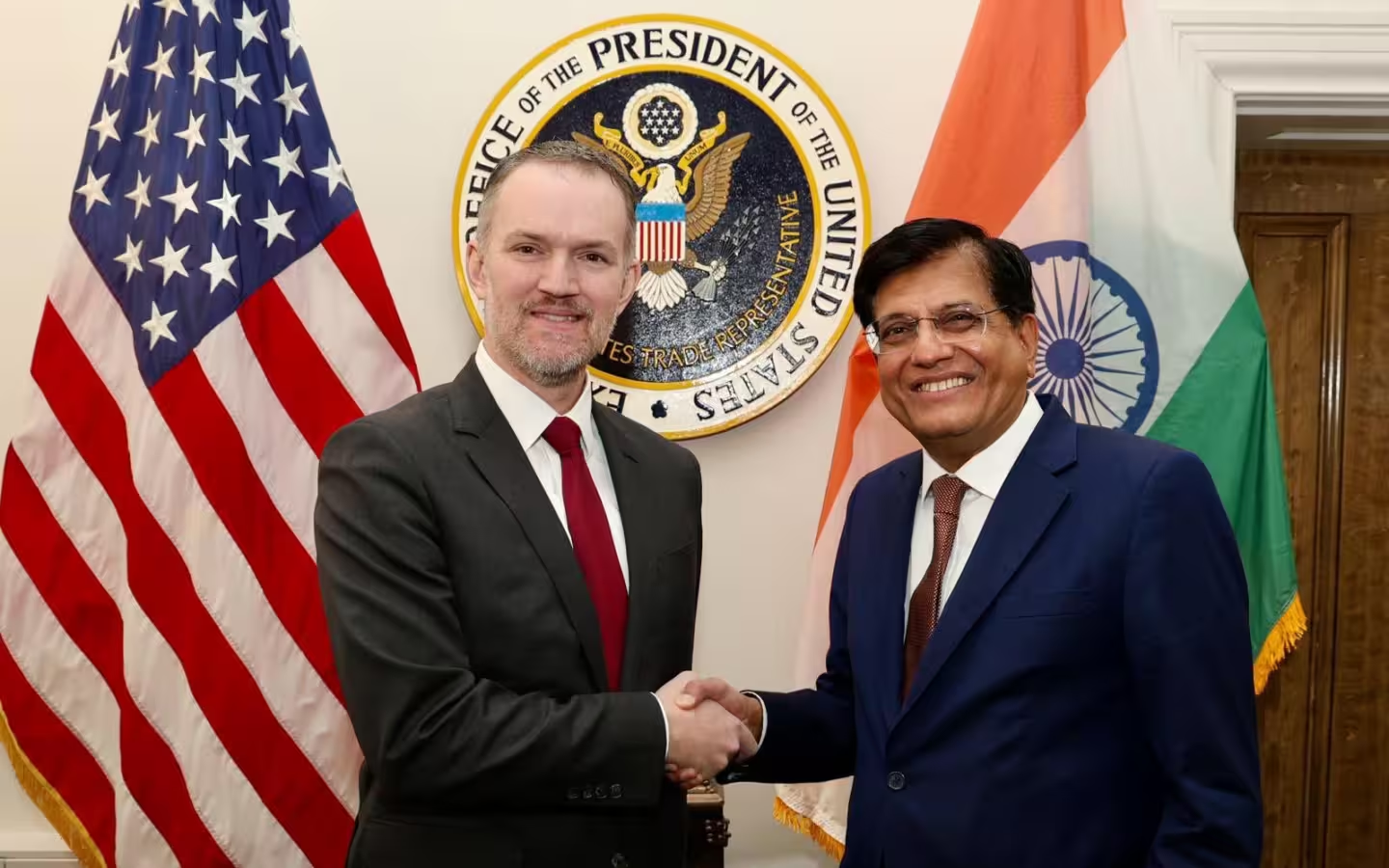
India’s commerce and industry minister Piyush Goyal said he had asked his ministry to identify professions less vulnerable to AI, PTI reported in a Berlin dispatch published on 24 October 2026. Addressing Indian science and technology researchers and students in Germany on 23 October, Goyal described the work as part of planning for employment across a large population. He named handicrafts, handlooms, culinary arts and tourism as areas in which he believes human skills will remain valuable.
Key points
- Goyal said he had instructed the commerce ministry to identify professions less exposed to AI-driven replacement.
- He named handicrafts, handlooms, culinary arts and tourism as areas where traditional skills and human creativity matter.
- Goyal said support for those sectors would depend on their needs and could involve government, private or other initiatives.
Goyal’s test for AI-proof professions
Goyal described the ministry’s task as finding work in which AI might improve efficiency without necessarily replacing people. “I got my ministry to start working on what are the AI-proof professions,” he said. His question, as he put it, was where the technology could “at max add to efficiency, not necessarily replace (human workforce)”. That is a narrower test than whether a sector uses AI at all: the minister’s emphasis was on the part of the work that people would continue to do.
For handicrafts and handlooms, Goyal pointed to skills acquired through Indian traditions. He also included culinary arts and tourism among areas in which, he said, human creativity remains important. His assessment was emphatic for the two craft sectors: “our handicraft, handloom… no amount of AI can replace that.” The remark was his judgement about their prospects, rather than a finding from the ministry’s mapping exercise.
Goyal tied the exercise to opportunities for India’s skilled workforce and young population. He said the country should develop areas in which it had particular strengths so that its 1.4 billion people could have better lives. The occupations he singled out span makers of physical goods and providers of services. His proposed test would therefore have to be applied to different kinds of work, rather than to a single industry or technology.
India’s announcement sits alongside a separate employment response in China: AI Affairs reported China’s call for government agencies to address AI-driven job displacement. Goyal’s account concerned an instruction to his own ministry to look for occupations that could retain human work as AI is adopted. The Chinese call was directed at government agencies dealing with displacement.
Support for India’s crafts and tourism
Asked whether the sectors he had named would receive incentives, Goyal said support would be offered where needed, while incentives would not be necessary for every activity. He envisaged “a mix of several initiatives, some privately led, some government led, some people led, some opportunity led”. That answer places potential action beyond a single ministry scheme. It also leaves each sector’s requirements to be considered separately, in line with his description of support depending on needs and opportunities.
Goyal was in Germany for discussions with government and private-sector leaders about trade and investment between the two countries. He travelled with a delegation of around 100 Indian businesses and start-ups, the Hindustan Times reported. The remarks on employment came during that trip, after his interaction with Indian researchers. He told the media that developing traditional strengths could help India make use of its talent while keeping the human expertise behind those goods and services.
Goyal asks researchers in Germany about returning
The minister also raised a second workforce question with the researchers and students: what would persuade Indian scientists and engineers working abroad to take up work in India? He said he had asked them what support they would need to consider returning. In his account, the answer involved the conditions for doing research as well as pay. He said attracting people depended on an enabling environment and support from the wider research ecosystem.
Goyal said he would speak with colleagues in government, public and private educational institutions, research organisations and industry about partnerships among researchers, academia and businesses. He described the Indian student community in Germany as interested in bringing its learning home. His request to those students and researchers was for their own account of what would make working in India possible.