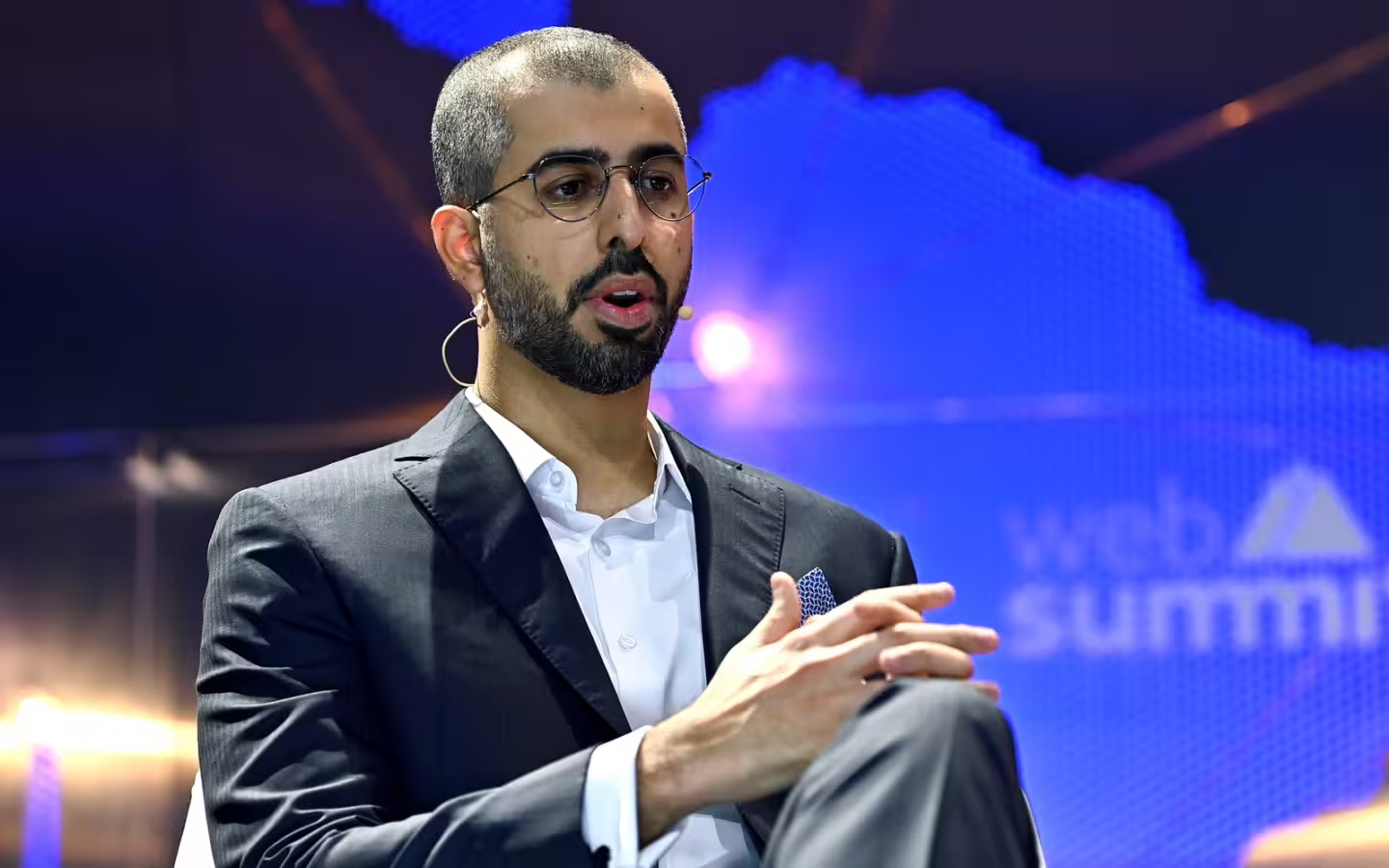
The UAE has an Agent Control Tower that every deployed AI agent must connect to, Omar Sultan Al Olama, Minister of State for Artificial Intelligence, said on 14 October at a meeting in Dubai, according to WAM. He said the connected agents undergo audits by both AI systems and people. The announcement concerned an existing oversight system for government deployment, rather than a newly announced law.
Key points
- Al Olama says federal AI agents must connect to a control tower that logs their actions and decisions.
- The minister describes continuous auditing by AI systems and humans.
- The Cabinet’s framework aims to put AI-based systems to work in at least 50 per cent of federal services and operations over two years.
- Al Olama says services involving risks to human life and livelihoods fall outside the government’s tolerance for deployment.
Every AI agent deployed across the federal government will have to connect to the tower, which records its actions and decision-making process, Gulf News reported, attributing the account to Al Olama. The minister said the audits are continuous and are intended to prevent agents from exceeding their assigned authority.
Federal agents connect to one control tower
Al Olama described the tower as a federal-government system. In his account, it records each agent’s actions and the steps behind its decisions, allowing overseers to examine how an outcome was reached. His description places the connection requirement on the government bodies deploying agents, rather than on citizens using a service. The auditing he described combines checks performed by other agents with human review.
That oversight will apply to more than a proposed service. The government has launched initial agents for procurement, tax auditing, customer happiness and technical support, Gulf News reported. Al Olama’s account makes the tower a shared point of supervision for such deployments: an agent’s assigned task may differ by department, but its activity is meant to enter the same monitoring system. The minister did not present the audits as a substitute for deciding which tasks an agent should be allowed to perform.
Al Olama said agents cannot currently be given complete authority over critical decisions affecting people’s lives and opportunities, Emirates 24|7 reported. He gave proactive passport renewal as an example of a lower-risk service and said people might delegate small payments to AI where decisions are subject to clear controls and oversight. The distinction is consequential for departments designing services: connecting an agent to the tower does not, in his account, give it the same discretion in every task.
Cabinet targets 50 per cent of federal services
In May, the UAE Cabinet approved a framework under which AI-based systems would take on at least 50 per cent of federal services and operations over two years, Gulf News reported. It provides for dedicated teams in government entities, performance indicators and measures of the effects of the change. The Cabinet also approved training for 80,000 federal employees. Those measures put the work of introducing agents inside departments as well as inside the shared oversight infrastructure.
Prime Minister Sheikh Mohammed bin Rashid Al Maktoum had announced the 50 per cent target in April. He described AI as an “executive partner” for government that could monitor developments, analyse them, make recommendations, manage operations and carry out sequences of actions without human intervention. The control tower described by Al Olama would sit alongside that proposed transfer of work, recording what deployed agents do while ministries and other federal bodies expand their use.
The government has begun developing the Federal Agentic AI Technology Platform, or FedAI, as common infrastructure for federal entities building and adopting agents. A National AI Gateway is intended to give them secure access to AI platforms, including commercial and open-source models hosted on sovereign infrastructure. Together with the department-level teams and training programme, those projects give federal bodies tools for deployment as well as a route into central oversight.
Al Olama draws a line at livelihoods
Al Olama said the government had mapped its services by the consequences of an agent making a mistake. About 70 per cent had some tolerance for AI deployment, he said, while the risk associated with the other 30 per cent exceeded the government’s tolerance. He linked that assessment to the 50 per cent target: the administration is selecting among services it considers suitable rather than seeking to place agents across all of them.
“If it affects human life and livelihood, then it is a red line,” Al Olama said. His account of risk places a limit on what monitoring alone can permit. An audit can follow a decision, but the government’s stated approach also requires a decision in advance about whether an agent should make it. AI Affairs has previously reported a UAE official’s call for independent safety checks on frontier AI models; Al Olama’s description concerns the continuing supervision of agents after they are deployed.
Mark-Alexandre Doumba, Gabon’s Minister of Digital Economy and Innovation, argued at the Dubai meeting that an agent’s permissions and the ability to reverse its actions should be built into the system from the start. He placed responsibility for harm to a citizen with the institution that deployed the agent, rather than with the agent itself.