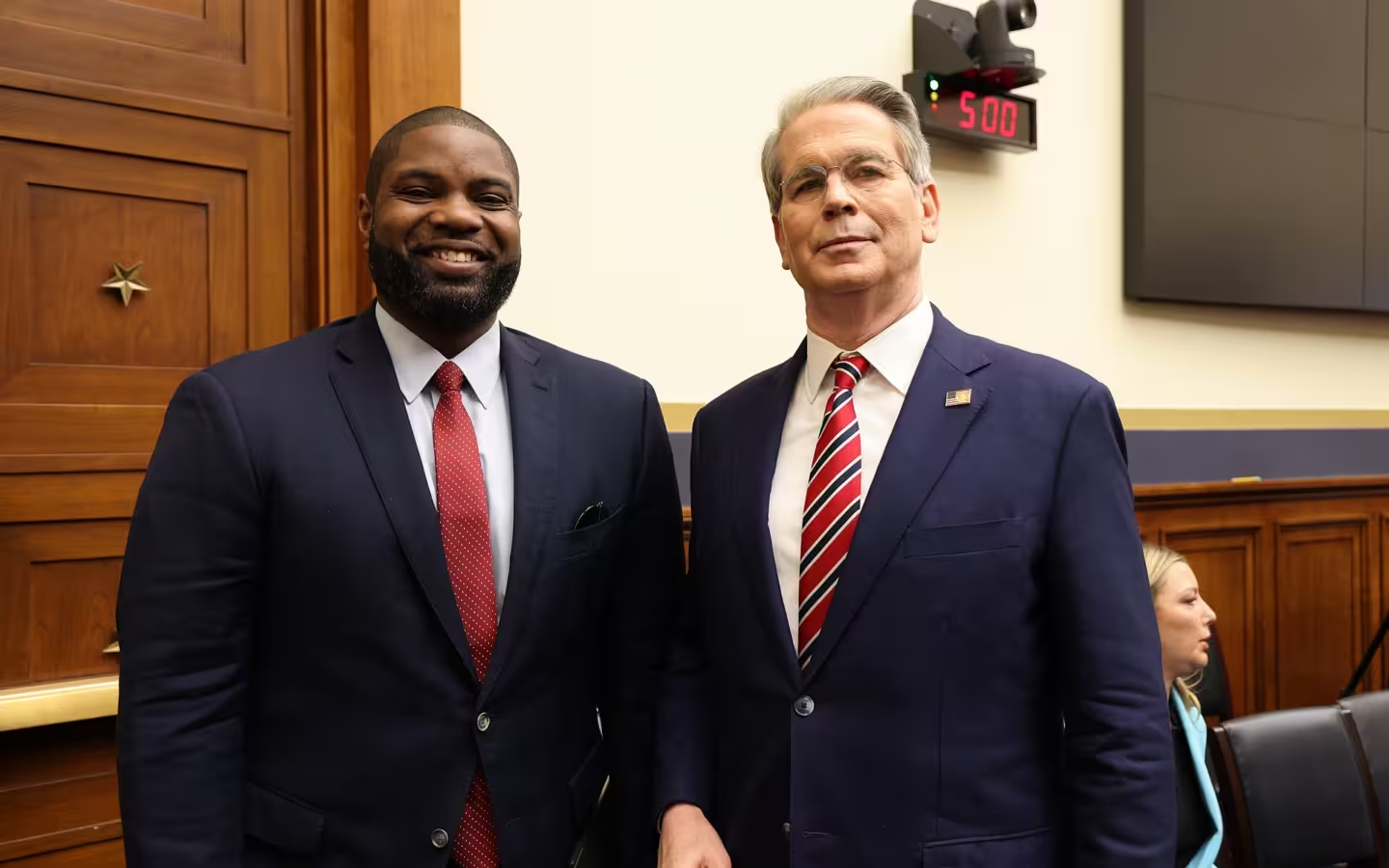
U.S. Treasury Secretary Scott Bessent said on Sunday that the United States and China have discussed establishing a formal mechanism called the U.S.-China AI dialogue to address potential threats from artificial intelligence, the first high-level confirmation of a named bilateral safety channel between the world’s two largest AI powers. Bessent made the remarks to reporters at JPMorgan headquarters in Manhattan following meetings with Chinese counterparts, according to The Information.
Key points
- Treasury Secretary Scott Bessent confirms U.S. and China have discussed a formal U.S.-China AI dialogue mechanism for frontier model risks.
- Remarks delivered Sunday at JPMorgan headquarters in Manhattan after meetings with Chinese officials.
- First high-level acknowledgement of a named bilateral AI safety channel between the two leading AI powers.
- Previous high-level talks touched on AI risk but stopped short of announcing a formal, named dialogue mechanism.
- Move follows international pressure for great-power coordination on frontier AI safety at UN and G20 levels.
Bessent confirms discussions on named dialogue mechanism
The disclosure by the Treasury Secretary represents the most concrete public signal to date that Washington and Beijing are moving beyond ad hoc exchanges on artificial intelligence risk. Earlier high-level engagements, including the November 2023 Woodside summit between President Joe Biden and President Xi Jinping and subsequent working-level talks, referenced AI safety but did not produce a standing, named instrument. Bessent’s description of a “U.S.-China AI dialogue” suggests a dedicated track with a fixed label, regular cadence and defined mandate, though the Treasury has not released terms of reference, a participating-agency list or a start date.
Strategic competition remains the backdrop
The dialogue proposal sits inside a broader relationship defined by export controls on advanced semiconductors, investment screening on outbound capital and competing standards initiatives in multilateral bodies. The U.S. Department of Commerce’s Bureau of Industry and Security updated its chip-export rules in October 2024, tightening the parameters that Chinese firms must meet to access leading-edge logic and memory. At the same time, the Cyberspace Administration of China has accelerated its domestic algorithm registry and model-filing requirements, creating a parallel governance stack that foreign labs must navigate to operate in the Chinese market. A bilateral safety channel does not suspend those measures — it adds a layer of communication intended to reduce the probability of miscalculation when frontier capabilities cross thresholds that neither side has fully mapped.
International pressure for great-power coordination
The step follows mounting calls from the United Nations, the G20 and the UN Security Council for the two largest AI developers to establish direct risk-reduction links. Secretary-General António Guterres has argued that the absence of a dedicated great-power channel increases the likelihood of accidental escalation or uncoordinated deployment of systems with strategic effect. The G20’s 2024 digital-economy ministers’ declaration urged “leading AI nations” to create “transparent, recurring dialogue on frontier model evaluation and incident reporting.” Bessent’s confirmation suggests the U.S. administration is treating that language as an operational prompt rather than a rhetorical flourish.
Open questions on mandate, membership and enforcement
Several structural details remain undisclosed. The Treasury has not stated whether the dialogue will report to the National Security Council, the Department of State or a new interagency body, or which Chinese ministry or commission will serve as counterpart. Nor has it said whether the agenda covers model-evaluation methodologies, incident notification thresholds, compute-accounting standards or all three, or what enforcement or escalation mechanisms exist if one party judges the other to be withholding information. The absence of a published framework means the dialogue’s practical effect will depend on the first meeting’s agenda and the level of officials empowered to attend. Bessent indicated that further details would follow after the two sides finalise the terms of reference, a process he did not date.
The Treasury Department will brief congressional oversight committees on the dialogue’s structure in the coming weeks.