Apollo Global Management intends to help finance an AI infrastructure project in Japan expected to require more than $15 billion across land, power, construction and computing, Bloomberg reported on 2 October, citing a statement issued on 1 October.
Key points
- Apollo plans to act as an investment and financing partner to UK developer RHAELM Holdings.
- RHAELM, Jera and Dell signed a memorandum of understanding for a Chiba facility of up to 400 megawatts.
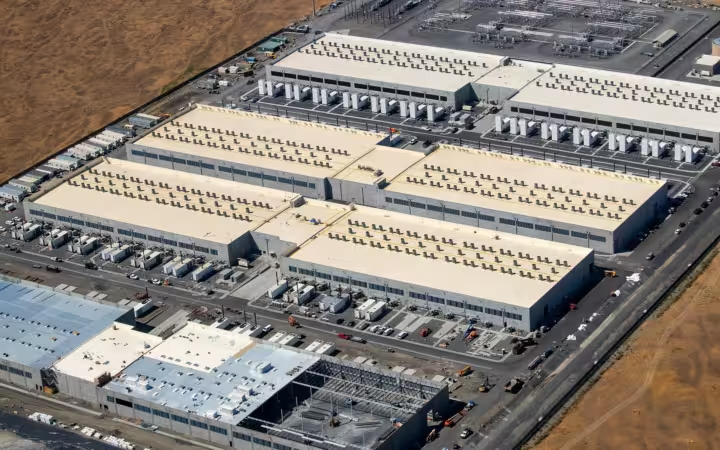
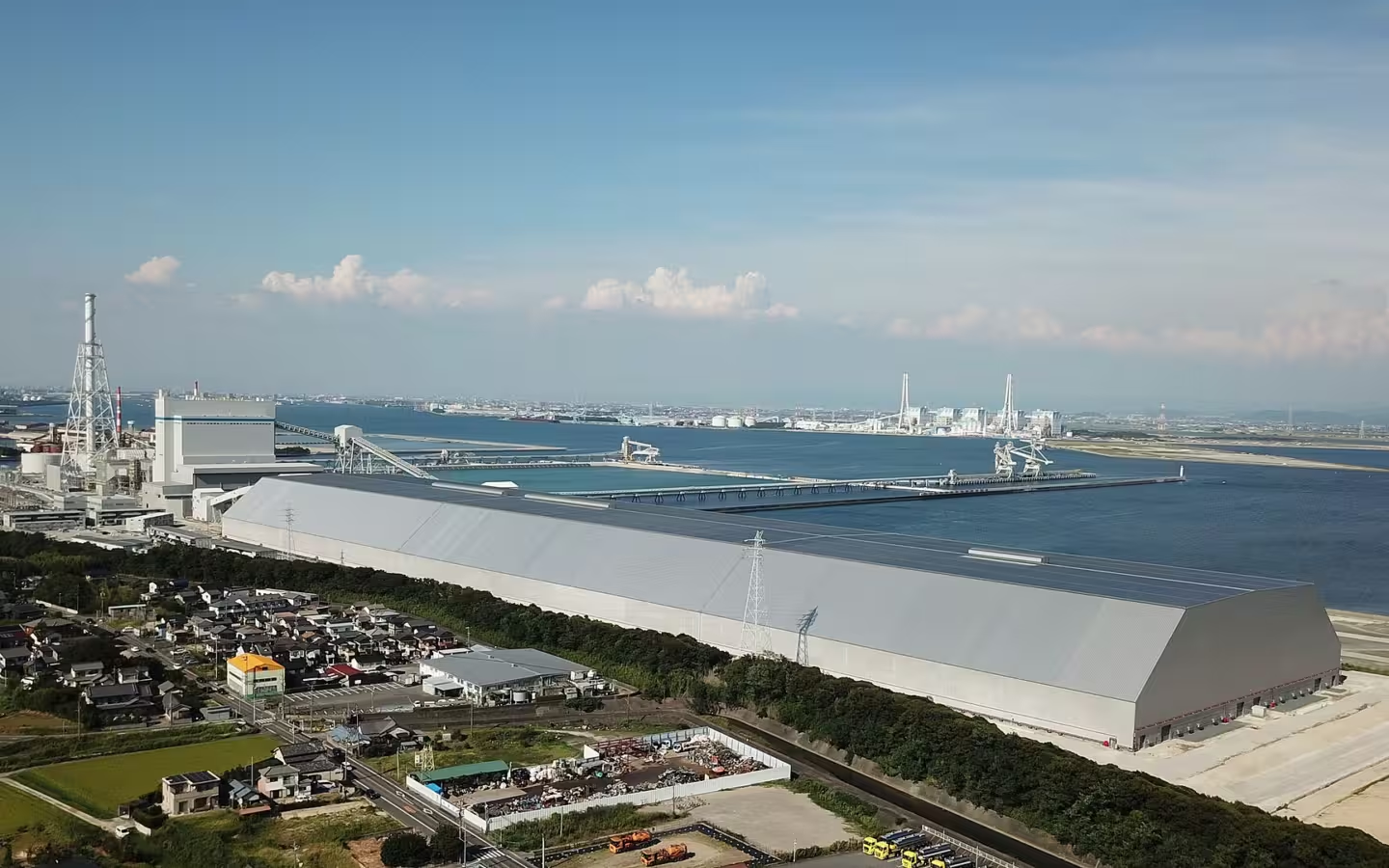
- The proposed centre would sit beside Jera’s existing thermal power station, with Dell supplying rack-scale computing infrastructure.
- The partners target operations around 2028 and full capacity in 2029.
Apollo’s financing role with RHAELM
Apollo plans to serve as a strategic investment and financing partner to RHAELM Holdings, the UK developer working with Jera and Dell Technologies on the venture in Chiba Prefecture. The proposed capital deployment covers the site, its electricity infrastructure, construction and computing equipment. It is a project-wide figure rather than the value of Dell’s supply role.
RHAELM, Jera and Dell signed a memorandum of understanding covering a data centre of up to 400 megawatts, Benzinga reported. Apollo’s stated role is to support RHAELM with investment and financing. The three signatories would bring the developer, power generator and computing supplier together at the proposed site.
Apollo has financed AI infrastructure projects involving Nvidia, Broadcom and Anthropic. Its planned role in Chiba extends that activity into a project combining computing equipment with land and power infrastructure. Eiji Ueda, Apollo’s Asia-Pacific chief, described the announcement in the statement as part of the firm’s interest in AI infrastructure and long-term investment in Japan.
Apollo also increased a loan to SoftBank Group to $9.2 billion to help finance the Japanese company’s stake in OpenAI, Bloomberg reported in September, citing people with knowledge of the matter. That loan and the Chiba proposal place Apollo in separate financing arrangements involving Japanese companies and AI investment.
Japan’s ¥102 trillion investment plan
Prime Minister Sanae Takaichi has pledged to strengthen Japan’s AI supply chain as part of an effort to support manufacturing. Earlier in 2026, her government set out a ¥102 trillion ($644 billion) plan for investment in AI and semiconductors. The Chiba venture is a proposed private investment alongside that government programme.
For the Chiba partners, the proposed spending spans more than servers. Land, electricity infrastructure and construction are included in the more than $15 billion estimate, alongside computing. RHAELM’s development plans and Apollo’s financing role therefore depend on bringing the physical site and its equipment together.
Dell’s rack-scale role in Chiba
Dell would provide rack-scale computing infrastructure for the proposed centre. The memorandum brings it into the Chiba development with RHAELM and Jera, while Apollo plans to support the developer financially. The more than $15 billion estimate encompasses the wider project, including land and power works, rather than a computing-equipment contract alone.
Dell’s AI-server orders reached $60.9 billion in its latest quarter, while AI-server revenue was $16.4 billion, Benzinga reported. Its AI-server backlog stood at $95 billion at the end of that period. Orders, revenue and backlog measure different stages of Dell’s existing AI-server business; its Chiba role concerns equipment for a proposed facility.
Dell expects $74 billion in AI-server revenue in fiscal 2027. Its proposed Chiba supply role would add another project to a business for which the company has set that revenue expectation. At the site itself, the computing equipment would be paired with electricity supplied from Jera’s neighbouring power station.
Jera’s 4,380 MW Chiba power station
The planned data centre would be built beside Jera’s existing 4,380 MW Chiba Thermal Power Station. It could draw up to 400 megawatts directly from the station, tying the proposed computing capacity to a nearby source of electricity. Power access is central to the partners’ choice of location.
Jera says drawing power from the site could bring computing capacity into service years sooner than a development using a conventional grid connection. The company’s global chief executive, Yukio Kani, called speed of access to power the priority in remarks reported by Benzinga.
Jera, RHAELM and Dell want to use Chiba as a standardised model for possible developments at other Jera power stations. Their broader ambition is for multiple gigawatts of AI infrastructure across Japan. That expansion remains a plan built around the power-station model proposed for Chiba.
RHAELM, Jera and Dell plan to start operations at the Chiba centre around 2028 and expect it to reach full capacity in 2029.