On 14 October, ASML put its third-quarter net sales at €11.7 billion and net profit at €4.96 billion, while lifting its annual sales forecast from at least €43 billion to a range of €44 billion to €45 billion, Reuters reported.
Key points
- ASML forecasts fourth-quarter sales of €14.2 billion to €15.2 billion.
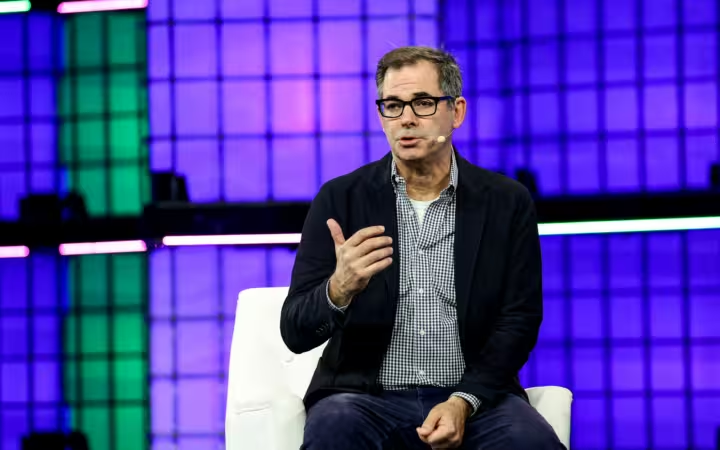
- Chief executive Christophe Fouquet said customers were placing orders for 2028 and expressing interest in equipment for 2029 and 2030.
- Fouquet said planned capacity increases of 30% in each of 2027 and 2028 would not meet demand.
- ASML plans to raise prices from 2027, with the full effect visible from 2028.
ASML forecasts €14.2 billion to €15.2 billion
ASML expects fourth-quarter net sales of €14.2 billion to €15.2 billion. Its higher full-year forecast followed the third-quarter results and customer discussions about equipment deliveries extending towards the end of the decade. AI Affairs previously reported that the fourth-quarter sales forecast exceeded analysts’ expectations.
Third-quarter profit exceeded the €4.05 billion expected by analysts polled by LSEG, while net sales were broadly in line with expectations, Tekedia reported. ASML expects a fourth-quarter gross margin of around 57%, according to the same report.
ASML shares rose 2% on 14 October and had gained almost 70% since the start of the year. At about €586 billion, the company was Europe’s largest by market value, Reuters reported. Gordon Kerr, European macro strategist at KBRA, said ASML’s results indicated that spending on chip infrastructure was likely to continue well into 2027.
Fouquet sees demand beyond ASML’s 2028 orders
ASML chief executive Christophe Fouquet said the company was receiving substantial orders for 2028, alongside strong interest from customers seeking to place orders for 2029 and, in some cases, 2030. The distinction puts the later years at an earlier stage of the sales process than the orders already coming in for 2028.
In July, ASML set out plans to increase capacity by 30% in 2027 and by another 30% in 2028. Fouquet said on 14 October that those increases would not be sufficient to meet the demand the company now sees. ASML is looking for further ways to raise capacity.
Its customers include TSMC, which makes chips for Nvidia, as well as Samsung, Intel, SK Hynix and Micron. Those chipmakers have been investing in additional production capacity. ASML’s customer base also includes Elon Musk’s TeraFab, though chief financial officer Roger Dassen said the company was still assessing the size of that opportunity.
Ben Barringer, head of technology research at Quilter Cheviot, said he expected durable growth in 2027 and 2028. He said investors would begin to ask whether a downturn might emerge from 2029 and what that would mean for ASML.
Eindhoven expansion has a 2029 first phase
ASML broke ground on a major expansion in Eindhoven, the Netherlands, in September. The first phase is due to be completed in 2029. Until then, Dassen said, the company would address the capacity shortage by upgrading equipment already in use and selling new versions of its machines with higher throughput.
Those measures target output before the Eindhoven expansion’s first phase is complete. ASML’s existing equipment upgrades and higher-throughput machines would give customers ways to add capacity while the company works on its own production plans. Dassen said the changes would significantly increase customers’ capacity.
ASML will begin increasing prices in 2027, with the full effect becoming visible from 2028, Dassen said, according to Reuters.