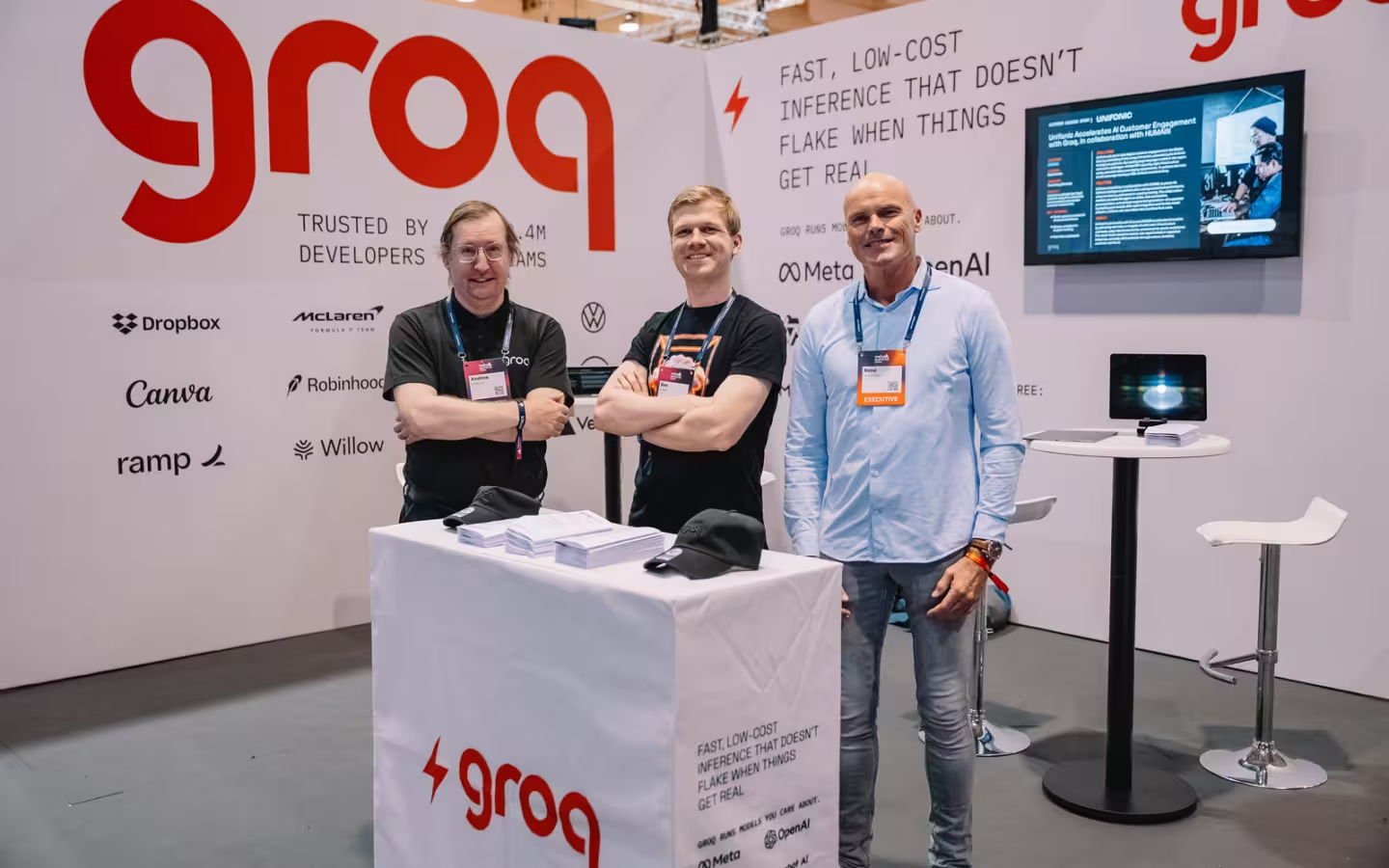
Two former Groq engineers filed a Delaware lawsuit on 2 October challenging shareholder payouts from its 2025 arrangement with Nvidia, a transaction described as worth $20bn in licensing and stock incentives, Traders Union reported.
Key points
- The plaintiffs challenge how a $17bn licensing payment and a separate $3bn Nvidia stock bonus pool were allocated.
- They allege common shareholders received too little while selected employees could receive compensation for joining Nvidia.
- The plaintiffs acknowledge that their proposed merger-style review of the arrangement has no direct precedent in Delaware case law.
Groq’s $17bn licence and Nvidia’s stock pool
Nvidia described the arrangement as a non-exclusive technology licence under which Groq would remain independent. Former Groq engineers Benjamin Serebrin and Joshua Rubin argue in their complaint that its effect was different: Groq transferred its core technology and leading employees to Nvidia while other shareholders retained an interest in a diminished business.
The complaint describes a $17bn payment for the licence alongside a separate $3bn pool of Nvidia stock bonuses for selected engineers who joined the chipmaker. It alleges Nvidia hired nearly all of Groq’s engineers under the arrangement, with the number estimated at as many as 200 workers.
That separation of payments is central to the challenge. The plaintiffs allege common shareholders were bought out too cheaply, while founder and board member Jonathan Ross and other senior employees could accept lower prices for their shares and receive compensation for moving to Nvidia. The complaint also criticises the structure for leaving the $17bn licensing payment taxable at Groq rather than treating it as part of a full acquisition.
Groq developed a language processing unit, or LPU. Groq said its chips could process certain AI models with greater speed and efficiency than Nvidia’s graphics processing units. The plaintiffs argue that payments to excluded shareholders failed to reflect potential future gains from that technology and from its use by Nvidia.
Serebrin and Rubin contest Groq board’s decision
Serebrin and Rubin allege that some investors could not vote on the transaction. They accuse Groq’s board of failing to obtain the best available price and deal structure for all shareholders, according to the complaint as reported by Traders Union. Their case asks a Delaware court to examine an arrangement Nvidia presented as a licence through a framework associated with mergers.
The plaintiffs acknowledge that existing Delaware case law provides no direct precedent for applying traditional merger-style review to an acqui-hire. That legal argument sits alongside their claim about the allocation of proceeds: employees who moved to Nvidia could receive stock bonuses, while common shareholders received what the plaintiffs consider an inadequate buyout price.
The complaint names BlackRock, Social Capital, Infinitum and Disruptive as funds that remained affiliated with the surviving Groq and allegedly benefited from the outcome. The four funds are not defendants. Nvidia subsequently joined a financing round valuing Groq at $3.5bn, compared with the lower buyout valuation alleged by the plaintiffs.
Groq’s $3.5bn valuation and Nvidia’s production
The remaining Groq shifted towards AI cloud computing and stopped designing chips. Nvidia declined to comment on the lawsuit, while Groq did not immediately respond to a request for comment, Traders Union reported. The reported $3.5bn valuation concerns the business that continued after the licensing arrangement, rather than the technology and employees covered by the plaintiffs’ challenge.
The dispute comes amid US examination of acqui-hire structures. Senators Elizabeth Warren, Richard Blumenthal and Ron Wyden said in 2026 that such arrangements appeared designed to avoid antitrust scrutiny. Federal Trade Commission chair Andrew Ferguson said the agency would examine whether deal structures were being used to avoid merger review.
Nvidia unveiled its first new chip based on Groq technology in March 2026. The product entered full production in August.