Samsung Electro-Mechanics brought its disclosed AI-component supply agreements in 2026 to about 3.6 trillion won ($2.6 billion) with a roughly 290 billion won order announced on 29 September, The Korea Herald reported on 2 October.
Key points
- The latest agreement covers multilayer ceramic capacitors and inductors for delivery throughout 2027.
- It is Samsung Electro-Mechanics’ fifth disclosed long-term supply agreement of 2026.
- The company plans 6.78 trillion won of package-substrate expansion in Sejong and Vietnam, with customers helping fund the Sejong project.
The 290 billion won order covers 2027
The buyer is a global company that agreed to purchase multilayer ceramic capacitors, or MLCCs, and inductors for AI servers. The contract runs from 1 January to 31 December 2027 and is equivalent to 2.5 percent of Samsung Electro-Mechanics’ consolidated revenue in 2025, The Elec reported.
The customer requested that its identity be withheld to protect business secrets, The Elec reported. Announced on 29 September 2026, the agreement covers deliveries throughout 2027, starting about three months later. Other agreements in the company’s disclosed total also cover supply scheduled for 2027 or later.
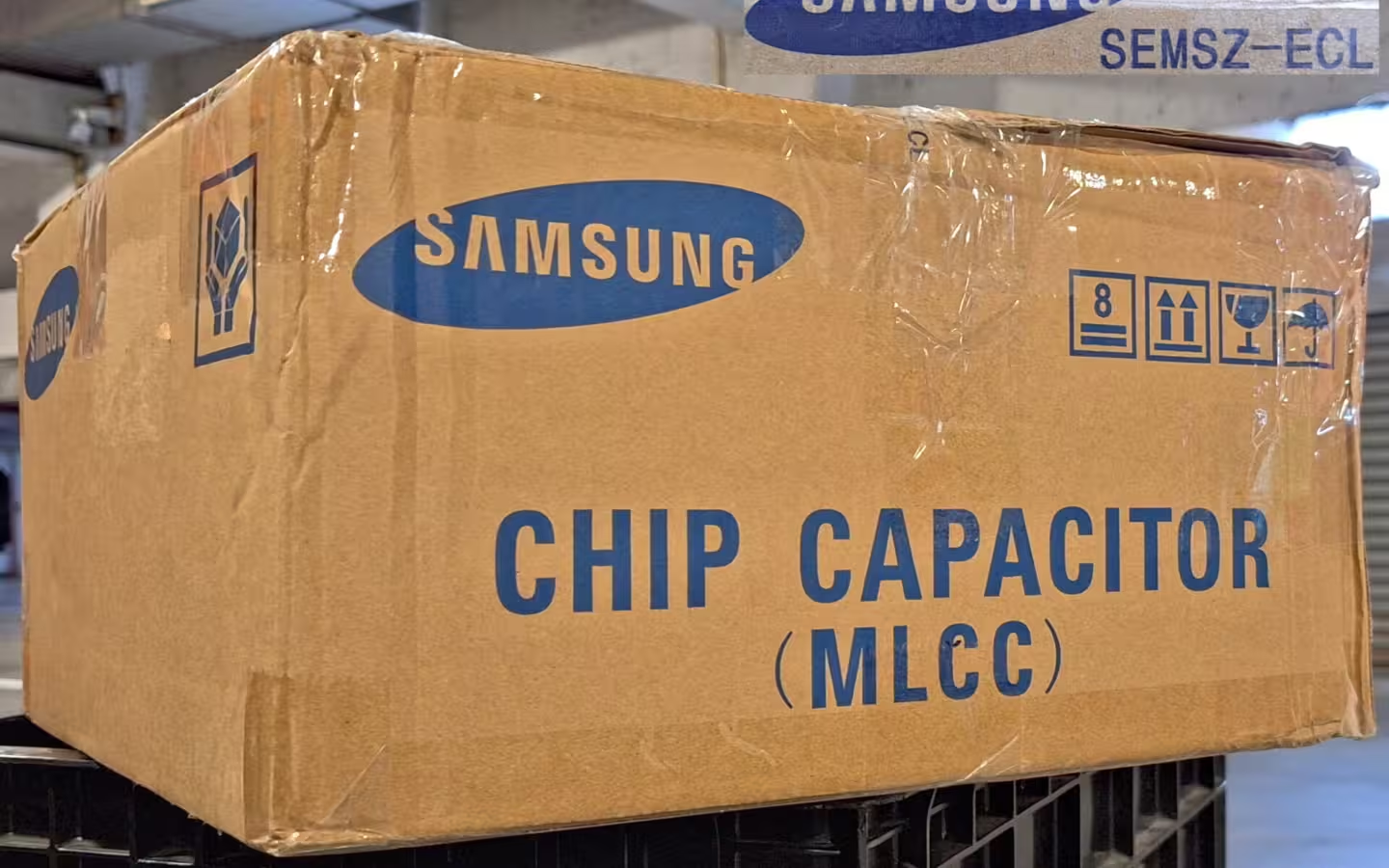
MLCCs regulate current and limit interference between components in electronic circuits. Inductors help steady the power supply during changes in current and reduce noise during power conversion. Both serve AI servers whose processors place heavier demands on power delivery.
Business Korea reported that AI servers are understood to use more than 10 times as many MLCCs as general servers. That increases the number of components buyers need to secure for each machine, alongside requirements for capacitors with greater capacity and reliability.
Five agreements build a 3.6 trillion won total
The sequence began in May with a 1.56 trillion won silicon-capacitor agreement covering 2027 through 2028. A 454 billion won MLCC deal followed in June. The company also disclosed an AI-server MLCC agreement in July, The Elec reported.
On 1 September, Samsung Electro-Mechanics signed a 1.07 trillion won MLCC agreement for delivery in 2027. It was the company’s largest MLCC contract to date, The Korea Herald reported. The 29 September order brought the number of long-term agreements disclosed this year to five.
Samsung Electro-Mechanics says it has long-term MLCC agreements with more than 10 global customers. The contracts cover different components and delivery periods: the May silicon-capacitor order extends through 2028, while the two September MLCC agreements provide for supply in 2027.
The company holds more than 40 percent of the AI-server MLCC market. Goldman Sachs expects that market to grow from $1.4 billion in 2025 to $5.8 billion in 2030, an average annual rate of about 34 percent.
Sejong and Vietnam carry substrate expansion
Samsung Electro-Mechanics is expanding a separate component line used beneath high-performance processors: FC-BGA package substrates. Kim Min-kyung, an analyst at Hana Securities, estimated lead times for the substrates at 48 to 56 weeks, against a more normal 12 weeks.
Kim said the company was negotiating MLCC prices with direct customers and that AI-server buyers had relatively “high price tolerance”. She saw scope for increases above market expectations and expected package-substrate margins to improve as prices rose, The Korea Herald reported.
Samsung Electro-Mechanics plans to spend 4.27 trillion won on AI-server FC-BGA capacity in Sejong and another 2.51 trillion won on package-substrate expansion in Vietnam. AI Affairs previously reported the 6.78 trillion won expansion with customer backing. Global customers are helping fund the Sejong project and committing to future volumes.