
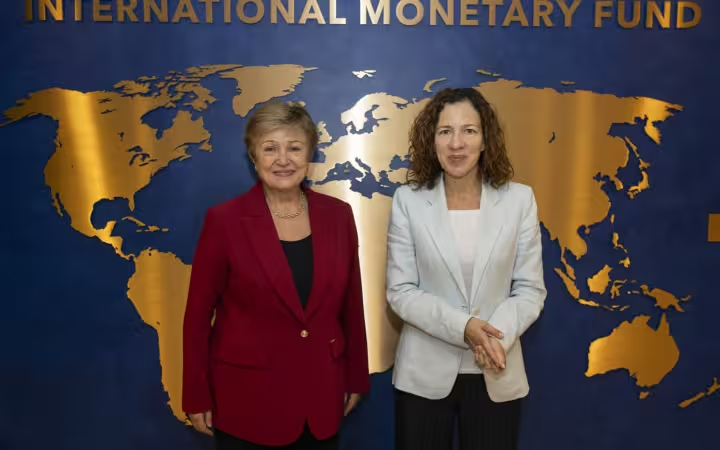
IMF managing director Kristalina Georgieva said on 12 October that investment in AI infrastructure is keeping global growth at around 3%, Reuters reported. Speaking at the IMF and World Bank annual meetings in Bangkok, she pointed to gains for Asian hardware suppliers even as an energy supply shock weighs on the world economy.
Key points
- Georgieva says AI infrastructure investment is helping keep world growth at around 3%.
- She says it could lift growth in advanced regional economies by half to one percentage point.
- Her range for emerging Asian economies is 0.2 to 0.8 percentage point.
- AI hardware and related technology products account for more than 10% of world goods trade, Nation Thailand reported.
Georgieva sets AI investment against energy shock
Georgieva described the spending surge as a “demand shock, an investment shock”. She said it was helping sustain growth at around 3% “despite the fact we are being dragged down by the energy supply shock”.
In a 7 October speech in Singapore ahead of the Bangkok meetings, Georgieva had described AI-driven demand and the energy supply shock as opposing forces, Nation Thailand reported. She said the AI boom was also increasing demand for electricity and other energy resources while global fuel supplies remained under pressure.
That combination puts AI on both sides of the energy question. Georgieva’s account gives infrastructure spending a role in supporting growth while placing its power requirements alongside an existing supply squeeze.
Asian economies could gain up to one point
Georgieva said the shift into higher gear could raise growth in advanced regional economies by half to one full percentage point. For emerging Asian economies, she put the possible lift at 0.2 to 0.8 percentage point.
She identified Thailand as one of the Asian economies supplying hardware for the build-out. Her ranges describe possible growth gains across two groups of economies, rather than a single forecast for Asia.
AI hardware and related technology products account for more than 10% of world goods trade, Nation Thailand reported. Five of the top 10 economies in AI-related trade are Asian suppliers, while the United States, China and India are among the major net importers building AI infrastructure.
Georgieva warns of pressure on AI earnings
Georgieva said on 7 October that AI investment as a share of global GDP could eventually exceed earlier infrastructure booms in railways, electricity grids and telecommunications. She warned that heavy spending had increased pressure on technology companies to deliver the productivity and earnings markets expect.
She said disappointment could trigger wider financial shocks. AI Affairs previously reported her warning that an AI earnings shortfall could cause a market shock.
Georgieva also warned that the benefits were highly concentrated. She said unequal access to AI and the infrastructure needed to use it could widen inequality.

_Building_-_700_19th_St_NW_-_Washington_D.C..jpg)